Lu teacher and minister of justice whose sayings, gathered by his disciples in the Analects, became the founding texts of the Ru (Confucian) tradition
Mural guide
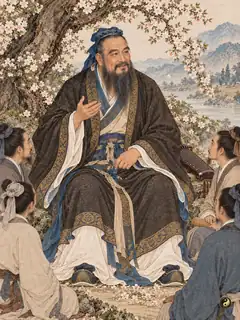
Mural of the event “Confucius's State Tour”, which this person took part in.
By the late Spring and Autumn the collapse of rites had reached its peak, with ministers killing rulers and sons killing fathers in frequent tragedy, the old social order in total ruin. Confucius resolved to serve and preach benevolent governance to save the realm.
Confucius, personal name Qiu and courtesy name Zhongni, came from Zouyi in the state of Lu (near modern Qufu, Shandong), and the Records of the Grand Historian (Shiji) places his birth in 551 BC. After minor posts keeping granaries and livestock, he rose under Duke Ding of Lu from magistrate of Zhongdu to Minister of Justice. Around 497 BC he left Lu and spent about fourteen years with his disciples in Wei, Chen, Cai, Song and other states, returning in 484 BC to teach and put the old texts in order. His disciples and their students compiled his sayings as the Analects (Lunyu), and the Shiji counts three thousand pupils, seventy-two of whom mastered the six arts. He died in 479 BC and was buried north of the Lu capital on the Si River. The Tang court named him King of Culture Propagation in 739, and in 1530 the Ming retitled him Supreme Sage and Foremost Teacher.
500 BCEHundred Schools ContentionTook partage 51Confucian, Mohist, Daoist, Legalist, and other thinkers debated ethics, human nature, and government across the rival states.
Confucius Lectures at the Apricot AltarConfucius established open education for all at Qufu's Apricot Altar, formulating core ethics of Ren and Li.
497 BCEConfucius's State TourTook partage 54Confucius and his disciples spent fourteen years touring states, advising rulers on benevolent government while spreading their teachings.
Confucius Travels Among the Feudal StatesConfucius left Lu and traveled through Wei, Chen, Cai, and other states seeking to put his teachings into practice, continuing to teach through the ordeal between Chen and Cai.
479 BCEDied
Works
Literature · Prose15
Spring and Autumn AnnalsZhouChronicle of Lu from 722 to 481 BCE, held to be edited by Confucius; one of the Five Classics
Commentaries on the ChangesZhouThe Ten Wings, ten commentary pieces on the Zhou Yi, traditionally credited to Confucius
Withdrew to edit the Odes, Documents, Rites and Music, and made the Spring and Autumn Annals
Spring and Autumn
Confucius did not take office; he withdrew and edited the Odes, the Documents, the Rites and the Music, and arranged the Documents and their traditions back to the age of Yao and Shun. Sighing that his Way was not being followed and asking how he would make himself known to later ages, he made the Spring and Autumn Annals from the records of Lu, keeping some lines and cutting others. The record says that from the Son of Heaven and the kings downward, those who spoke of the six arts took the Master as the standard.
Taught his students with the Odes, Documents, Rites and Music
To 479 BCE, Lu
Confucius taught his students with the Odes, the Documents, the Rites and the Music; he had about three thousand students, of whom seventy-two mastered the six arts. He died aged seventy-three on the jichou day of the fourth month in the sixteenth year of Duke Ai of Lu, and was buried north of the Lu capital on the Si River.

 Zhou


 Literature · Prose


