
Ministers › Chief Ministers
Duke of Zhou (Ji Dan)
Brother of King Wu who acted as regent for the young King Cheng, crushed the Three Overseers' revolt and built Luoyi, and is credited by tradition with the Zhou rites
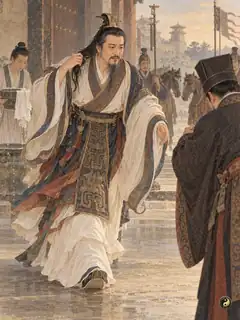
Mural of the event “Duke of Zhou Codifying Rites”, which this person took part in.
In the early Zhou the realm was vast, local tribes were complex, and King Wu's early death left the regime under severe internal and external duress. The court urgently needed a systematic regime to stabilize society.
Also known as Ji Dan · Duke of Zhou · Shu Dan
Ji Dan, Duke of Zhou, was a son of King Wen and younger brother of King Wu, titled after his fief at Zhou. The Shiji says he helped King Wu overthrow Shang and was enfeoffed at Qufu, but stayed at court and sent his eldest son Boqin to rule what became the state of Lu. When King Wu died leaving the young King Cheng, the duke took charge of the government; his brothers Guan and Cai spread rumours and joined Wugeng in revolt, and in an eastern campaign he executed Guan and Wugeng and exiled Cai, pacifying the east within two years. He oversaw the building of Chengzhou at Luoyi and after seven years handed power back to King Cheng. The Record of Rites credits him with creating the rites and music, and old tradition assigns him the Rites of Zhou (Zhouli), though neither claim can be proven. In the Analects Confucius laments that he had long ceased to dream of the Duke of Zhou.
Life and times
- UnknownBorn
 Shang
 Zhouearly Western Zhou
- 1042 BCERebellion of the Three Guards
 Took partThe crucial war that consolidated the newly founded Zhou dynasty and feudalism.
- Duke of Zhou Quelling RebellionDuke of Zhou campaigned eastward for three years, executing Wu Geng and Guan Shu while pacifying eastern territories.
- Duke of Zhou Quelling Rebellion
- 1042 BCEDuke of Zhou Codifying Rites
 Took partThe Duke of Zhou paired enfeoffment and lineage systems with rites and music to organize rank, kinship, and early Zhou rule.
- Duke of Zhou Founds Luoyi Capitalc. 1042 BCEDuke of Zhou surveyed Luoyi to build the eastern capital and codified rites and music.
- Duke of Zhou Founds Luoyi Capital
- UnknownDied
Works
 Literature · Prose22
- Rites of ZhouZhouConfucian classic ascribed to the Duke of Zhou, an ideal Zhou government in six ministries
- Ceremonial RitesZhouClassic of seventeen chapters on Zhou rites of capping, marriage, mourning and sacrifice
- Book of Documents: Against Idle EaseZhou
- Rites of Zhou: Heavenly Office: Duties of the Grand Steward (excerpt)Zhou
- Ceremonial Rites: Capping of a GentlemanZhou
+17 more
- Ceremonial Rites: Marriage of a GentlemanZhou
- Ceremonial Rites: Meeting between GentlemenZhou
- Ceremonial Rites: Village Drinking CeremonyZhou
- Ceremonial Rites: Village Archery CeremonyZhou
- Ceremonial Rites: Banquet CeremonyZhou
- Ceremonial Rites: Great ArcheryZhou
- Ceremonial Rites: Ceremony of MissionsZhou
- Ceremonial Rites: Duke's Feast for a Great OfficerZhou
- Ceremonial Rites: Audience CeremonyZhou
- Ceremonial Rites: Mourning DressZhou
- Ceremonial Rites: Funeral Rites of a GentlemanZhou
- Ceremonial Rites: Rites of the Eve of BurialZhou
- Ceremonial Rites: Repose Sacrifice of a GentlemanZhou
- Ceremonial Rites: Single-Victim Food OfferingZhou
- Ceremonial Rites: Lesser Pen Food OfferingZhou
- Ceremonial Rites: The AssistantsZhou
- Ceremonial Rites: Capping of a Gentleman: the Formulas (from the invitation to the naming)Zhou
- Literature · Poetry2
- Literature · Sayings2
- Laying Out the Capital and Measuring the FieldsZhouIdiom from the Rites of Zhou: plan the capital, survey the fields, govern the realm
- Establishing Offices and Dividing Duties: the Opening of the Rites of ZhouZhouAphorism from the Rites of Zhou: the king sets up offices and divides duties to order the realm
Family tree
- Direct kin
 Duke of Zhou (Ji Dan)


