
Ministers › Finance Ministers
Shang Yang
Statesman from the small state of Wey who carried out two rounds of legalist reform in Qin under Duke Xiao, became Lord of Shang, and was torn apart by chariots after his patron died
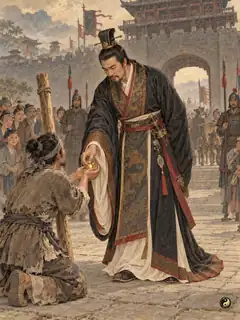
Mural of the event “Shang Yang's Legalist Reforms”, which this person took part in.
In the mid Warring States the western state of Qin was dismissed as a backward barbarian outpost on the brink of vassalage. The new Duke Xiao of Qin resolved to renew the state and issued an edict seeking talent.
Also known as Wei Yang · Gongsun Yang
Shang Yang, born Gongsun Yang and also called Wei Yang, descended from a minor branch of the Wey ruling house, studied penal law and served Gongshu Cuo, chancellor of Wei. When Duke Xiao of Qin called for talent, he went west and, through the favourite Jing Jian, persuaded the duke to reform. The Shiji relates that he won public trust by paying fifty measures of gold to the man who moved a pole from the capital's south gate, then imposed collective liability among households, rewards for military merit and priority for farming. In 350 BC Qin moved its capital to Xianyang; he merged villages into thirty-one counties, redrew field boundaries and standardized measures. After defeating Wei he received fifteen towns at Wu and Shang and the title Lord of Shang. When the duke died, Prince Qian and others accused him of rebellion, and after his defeat King Huiwen had him torn apart by chariots. A bronze measuring vessel inscribed in his name in 344 BC survives in the Shanghai Museum.
Life and times
Dates c. 390 BCE–338 BCE
- 361 BCEDuke Xiao Summons Talent
- 356 BCEShang Yang's Legalist ReformsTook part
- 356 BCEShang Yang Moves the Tree
- 356 BCEMilitary Merit Ranks Replace Well-Fields
- 334 BCEAlliances of Warring StatesPrecursor