
Campaigners › Commanders
Zuo Zongtang
Late Qing commander and governor-general who founded the Mawei shipyard and, as imperial commissioner, recovered Xinjiang outside Ili and proposed making it a province
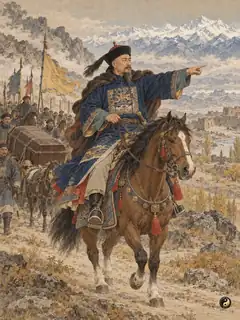
Mural of the event “Zuo Zongtang Reconquering Xinjiang”, which this person took part in.
In the 1860s, Central Asian adventurer Yakub Beg invaded Xinjiang with Anglo-Russian backing, while Tsarist Russia occupied Ili; Beijing erupted into the fierce 'Maritime vs. Frontier Defense' debate.
Also known as Zi Jigao · Yi Deng Ke Jing Bo · Wen Xiang · Shangan Zongdu
Zuo Zongtang, courtesy name Jigao, came from Xiangyin in Hunan. He gained the provincial degree in 1832 but failed the metropolitan examination three times. He ran military business for the Hunan governor Luo Bingzhang, then raised troops under Zeng Guofan and fought in Jiangxi and Zhejiang, becoming Earl Kejing of the first rank for retaking Zhejiang in 1864. In 1866 he founded the shipyard at Mawei near Fuzhou and moved to the Shaanxi-Gansu governor-generalship, campaigning against the Western Nian and the Muslim risings there. Named imperial commissioner for Xinjiang in 1875, he recovered every city except Ili within two years, was raised to marquis and proposed turning the region into a province. In 1880 he advanced from Suzhou to Hami taking his own coffin with him. He later served as grand councillor and governor-general at Nanjing, directed Fujian's defence in the war with France, and died at Fuzhou in 1885 under the posthumous name Wenxiang, a year after Xinjiang became a province.
Life and times
- 1812 CEBorn
 Qing
- 1861Self-Strengthening Movement
 Took partage 49Self-Strengthening officials founded arsenals, shipyards, and technical schools to introduce machine production, modern weapons, translation, and naval training.
- Zuo Zongtang Founds the Fuzhou Shipyard1866age 54In 1866, Zuo Zongtang initiated the Fuzhou Shipyard at Mawei, with Shen Baozhen subsequently taking charge of its development.
- Zuo Zongtang Founds the Fuzhou Shipyard
- 1876Zuo Zongtang Reconquering Xinjiang
 Took partage 64In 1876–77 Qing forces defeated Yaqub Beg's regime and recovered most of Xinjiang; Liu Jintang commanded in the field while Zuo Zongtang directed strategy, finance, and supply.
- Zuo Zongtang Plans the Xinjiang Campaignc. 1876In his memorial on Xinjiang strategy, Zuo Zongtang asked that earlier Xinjiang administrative and military records be sent to Suzhou so he could plan the campaign and recovery.
- Qing Forces Recover Most of Xinjiang1878age 66By 1878, the campaign organized by Zuo Zongtang had defeated Yaqub Beg's regime and recovered Urumqi, Kashgar, Hotan, and most of Xinjiang for Qing rule.
- Zuo Zongtang Plans the Xinjiang Campaign
- 1876Liu Jintang Takes Gumuji
 age 64In 1876 Liu Jintang's force took Gumuji, opening the northern offensive in Zuo Zongtang's reconquest of Xinjiang.
- 1876Qing Forces Recover Urumqiage 64In 1876 Qing forces recovered Urumqi, a key northern milestone in Zuo Zongtang's reconquest of Xinjiang.
- 1876Manas Siege Ends Northern Campaignage 64In 1876 the fall of Manas closed the principal northern phase of Zuo Zongtang's reconquest of Xinjiang.
- 1877Battle of Dabanchengage 65In 1877 Qing forces took Dabancheng, opening the route into the Turpan basin during Zuo Zongtang's Xinjiang campaign.
- 1877Recovery of Turpanage 65In 1877 Qing forces took Pichan, Lukchun, and Turpan, allowing Zuo Zongtang's reconquest of Xinjiang to turn south.
- c. 1877Recovery of the Southern Xinjiang Citiesage 65From 1877 to 1878 Qing forces recovered Kucha, Aksu, Kashgar, Khotan, and other cities, completing the main military phase of Zuo Zongtang's reconquest of Xinjiang.
- 1885 CEDied
Works
 Literature · Sayings1
- Not Half an Acre, Yet Anxious for the World (Self-inscribed Couplet)QingZuo Zongtang's youthful motto couplet: a poor scholar's resolve to care for the whole realm

