
 Atlas
Atlas



























 Huangpu Port & Shibosi Site
The ancient port and customs office of Guangzhou — China's first national-level maritime trade authority, witnessing the prosperity of the Age of Discovery on the South China Sea.
 Prefecture: Guangzhou
 Province: Guangdong
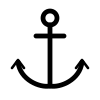
A traditional sailing ship approaches Huangpu’s stone landing piers, where tiled port buildings sit beneath a broad banyan tree.
Civic Building2

- Ancient Whampoa Anchorage & Customs
Western merchant ships such as the Gotheborg once anchored at Whampoa, an old port where the Guangdong Customs collected and supervised duties.
- Guangzhou Thirteen Hongs Museum Site
Under the Qing, the Thirteen Hongs held a monopoly on foreign trade, and this site recalls a global commerce hub once called the emperor's southern treasury.
Temple1

- Nanhai God Temple & Yuritai in Guangzhou
In Guangzhou stands the only surviving ancient temple where emperors made offerings to the god of the South Sea, and Su Dongpo once wrote poems at Yuri Pavilion.
Tower1

- Pazhou Pagoda in Guangzhou
Raised in the Ming dynasty at the mouth of the Pearl River, Pazhou Pagoda guided merchant ships from many nations and served as a beacon for ocean traders.
In its history2
- Li Longji685–762 CE
Part of Huangpu Port & Shibosi Site's history: Maritime Silk Road Flourishing. Tang emperor of the Kaiyuan and Tianbao eras who took power in the coups of 710 and 713 and fled to Sichuan when An Lushan rebelled
- Jianzhen688–763 CE
Part of Huangpu Port & Shibosi Site's history: Maritime Silk Road Flourishing. Tang Vinaya master from Yangzhou who reached Japan on his sixth attempt in 753, blind by then, and founded the Toshodaiji in Nara
Sui1

- Sui Founds Guangzhou's Nanhai Temple594 CE
In 594 CE, Emperor Wen of Sui ordered the Nanhai God Temple built near Guangzhou's Fuxu Port, creating a long-lived state maritime shrine.
Tang2

- Maritime Silk Road Flourishing
Establishing maritime customs in Guangzhou, inaugurating the flourishing era of Indian Ocean trade.
- Zhou Qingli Named Maritime Trade Commissioner714 CE
The Jiu Tangshu names Zhou Qingli Annan maritime trade commissioner in 714; a Guangzhou government trade history treats this as the earliest use of the title and puts him first in its list of Tang and Song Guangzhou commissioners.

Qing1

- Single-Port Trade Elevates Thirteen Hongs1757 CE
In 1757 the Qing concentrated overseas trade at Guangzhou, where the Thirteen Hongs became the officially authorized foreign-trade organization.