
Ministers › Chief Ministers
Wen Tianxiang
Southern Song top examination graduate and chief minister who fought the Mongol conquest to the end and was executed in Dadu after four years' refusal to serve the Yuan
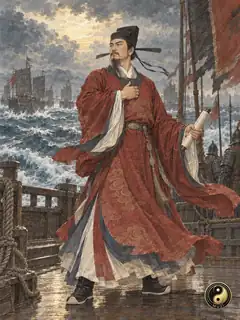
Mural of Passing Lingdingyang, a work by this person.
A captive patriot crosses the rough waters of Lingdingyang among broken shores and wind-driven waves. His steadfast figure holds fast to loyalty even as the sea closes around him.
Also known as Zi Lushan · Hao Wenshan · Xinguo Gong · Zhonglie · Zi Songrui
Wen Tianxiang, first named Yunsun, courtesy names Lushan and Songrui, styled Wenshan, came from Luling in Jizhou (modern Ji'an, Jiangxi). He took first place in the palace examination of 1256, and when Yuan armies came down the Yangzi in 1275 he spent his family fortune raising troops at Ganzhou. In 1276, with the enemy near Lin'an, he went to the Yuan camp as chief minister of the right to negotiate and was detained; escaping at Zhenjiang, he returned south by sea to keep fighting and was later made Duke of Xin. Captured at Wupoling in 1278, he wrote Crossing the Lingding Sea while being carried past it the next year, and after Yashan he was taken to Dadu. In prison there he wrote the Song of the Upright Spirit (Zhengqi ge) and refused to serve the Yuan until he was executed at the Chai market in January 1283. The Ming court named him Zhonglie in 1456, and his writings were gathered as the Collected Works of Master Wenshan.
Life and times
Dates 1236 CE–1283 CE
- c. 1278Wen Tianxiang Writes Lingding Sea Odeage 42
- c. 1279Wen Tianxiang Dies Unyielding at Daduage 43