
 Atlas
Atlas


























 Lake Tai
The heart of the Jiangnan water country — thirty-six thousand hectares of misty expanse, nourishing the richest land of fish and rice around Suzhou, Wuxi, Changzhou, Hangzhou, and Jiaxing.
 Prefecture: Wuxi
 Province: Jiangsu
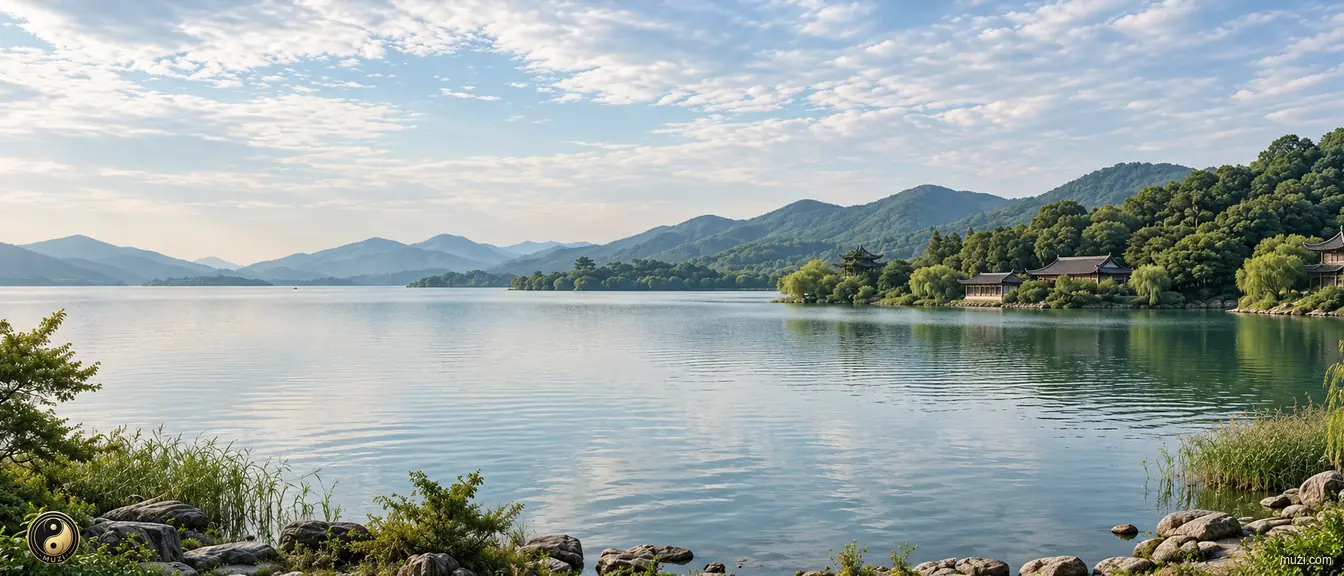
Lake Tai's calm waters spread beneath hazy wooded hills, reflecting traditional shoreline halls and pavilions, with reeds, willow foliage and natural rocks in the foreground.
Vista3

- Yuantouzhu Turtle Head Peninsula
The most celebrated scenic vantage point of Lake Taihu, surrounded by sakura blossoms and vast waters.
- Shanjuan Cave in Yixing
A world-famous limestone underground water cave associated with the Butterfly Lovers legend.
- Moli Peak in Dongshan
The highest peak of the Dongshan Peninsula, historic origin of the renowned Biluochun tea.
Sculpture1

- Lingshan Grand Buddha Sanctuary
An 88-meter bronze standing Buddha gazing serenely over Lake Taihu, paired with the Brahma Palace.
Gardens1

- Lihu Lake & Xi Shi Estate in Wuxi
A tranquil inner bay named after minister Fan Li and beauty Xi Shi, celebrating ancient Wu-Yue romance.
In its history5
- Wen ZhongDates unknown; Yue minister, late Spring and Autumn period
Part of Lake Tai's history: Goujian Conquering Wu. Grandee of Yue who bought King Goujian a truce at Kuaiji and helped him rebuild and destroy Wu, only to be ordered to kill himself once the war was won
- Fan LiDates unknown; late Spring and Autumn period
Part of Lake Tai's history: Goujian Conquering Wu. Counsellor of Yue who helped King Goujian destroy Wu, then left the court and, by the Shiji's account, grew rich in trade at Tao as Lord Zhu of Tao
- Gou JianBirth unknown–465 BCE (r. 496–465 BCE)
Part of Lake Tai's history: Goujian Conquering Wu. King of Yue who sued for peace after his defeat by Wu, rebuilt his state with Fan Li and Wen Zhong, destroyed Wu in 473 BC and was recognized by Zhou as hegemon
- Fu ChaiBirth unknown–473 BCE (r. 495–473 BCE)
Part of Lake Tai's history: Goujian Conquering Wu. Last king of Wu, son of Helu, who crushed Yue at Fujiao, spared King Goujian, contended with Jin at Huangchi, and killed himself when Yue destroyed his state
- Xi ShiDates unknown; traditionally of Yue, late Spring and Autumn period
Part of Lake Tai's history: Goujian Conquering Wu. Beauty of Yue already named in the Mozi and the Mencius, whom Han-era accounts make the woman King Goujian sent to distract Fuchai of Wu
Shang1

- Taibo and the Bodu River TraditionTraditional late Shang–early Zhou setting (c. 1100 BCE)
Local tradition links Taibo's migration to Wu with the Bodu River; later records describe the waterway's irrigation, drainage, and settlement functions.
Zhou2

- Goujian Conquering Wu
After captivity in Wu, Goujian rebuilt Yue's army and economy, then captured the Wu capital and ended Fuchai's reign.
- Fan Li Sails the Five LakesLate Spring and Autumn period (c. 473–468 BCE)
After Yue defeated Wu, the tradition of Fan Li leaving Yue by boat on the Five Lakes became a lasting model of retirement after achievement.

Tang1

- Lu Yu Writes Classic of TeaTang Dynasty (760–780 CE)
From 760, Lu Yu lived around Tiaoxi in Huzhou while collecting and organizing tea knowledge; a draft was completed around 765 and the received text took shape around 780.
Qing1

- Biluochun Named on Kangxi's 1699 Tour1699 CE
Suzhou local-history and intangible-heritage accounts date the association of the name Biluochun with Kangxi's 1699 tour of Taihu.