
 Atlas




























 Yangtze River
Asia's longest river, flowing six thousand kilometers from the Tibetan Plateau to the East China Sea — the aorta and golden waterway of Chinese civilization.
 Province: Shanghai
 Province: Jiangsu
 Province: Anhui
 Province: Jiangxi
 Province: Hubei
 Province: Hunan
 Province: Chongqing
 Province: Sichuan
 Province: Yunnan
 Province: Tibet
 Province: Qinghai
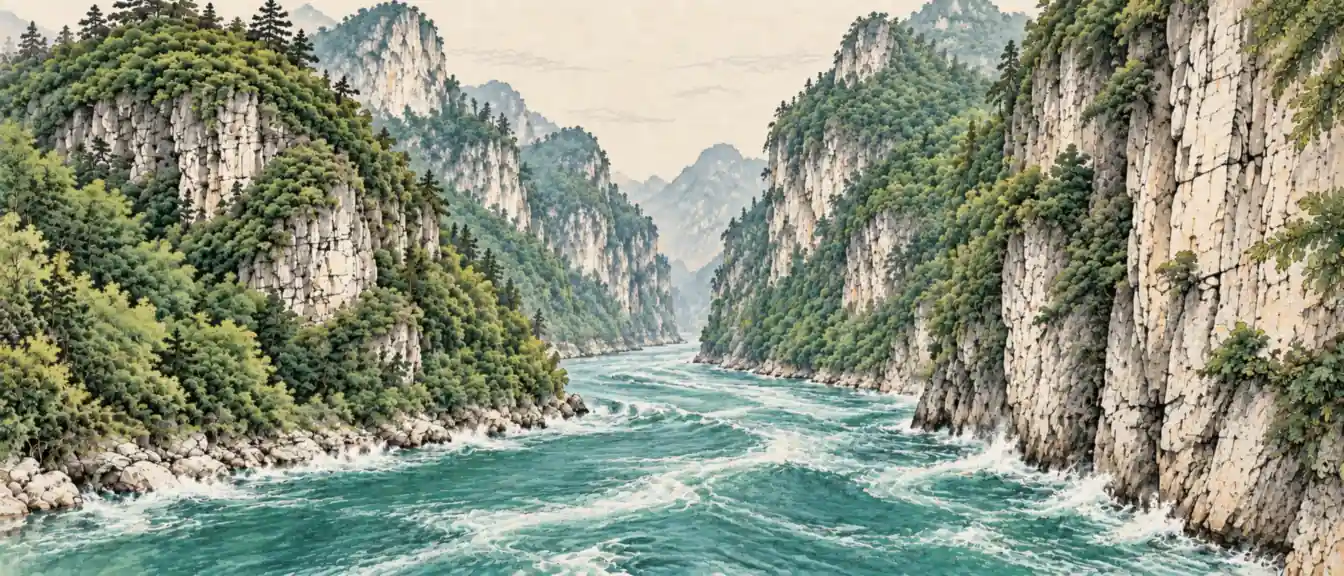
Green river water rushes in white-crested waves between pale sheer cliffs thick with trees, while far peaks fade softly toward the sky.
Natural Wonder3

- Huangniu Gorge & Rock in Xiling Gorge
A dramatic canyon praised by Ouyang Xiu and Su Shi, where legend says a celestial ox carved the gorge.
- First Bend of the Yangtze River
The Jinsha River runs south from the Tibetan plateau, meets a cliff near Shigu and doubles back in a near-V shape to flow northeast.
- Three Gorges of the Yangtze
Running about 193 km along the Yangtze from Baidi City in Fengjie to Nanjin Pass in Yichang, the Qutang, Wu and Xiling gorges make up the Three Gorges.
Vista4

- Kuimen Gate of Qutang Gorge
The western mouth of Qutang Gorge, where Red Armor Mountain and White Salt Mountain face each other across a river under 100 meters wide at its tightest; the scene is on the back of the fifth-series 10-yuan note.
- Goddess Peak of Wu Gorge
The most poetic of Wu Gorge's twelve peaks, legendary guardian maiden standing above misty swirling river clouds.
- Beigu Hill in Zhenjiang
Named for its steep stance over the Yangtze, the hill carries Ganlu Temple and Duojing Tower, and it was here that Xin Qiji, as prefect of Zhenjiang, wrote his lyrics on Beigu Pavilion.
- Tianmen Hills (East and West Liang Hills)
Facing each other across the Yangtze like the two leaves of a gate, the East and West Liang hills are the Tianmen of Li Bai's quatrain.
Temple1

- Qu Yuan Ancestral Shrine in Xiling Gorge
Birthplace and shrine of Qu Yuan overlooking Xiling Gorge, the cradle of Chu poetry and patriotic spirit.
Memorial4

- Ancient Battlefield of the Red Cliffs
The common view places the 208 Battle of Red Cliffs here, and the scenic area has a cliff carving, a Zhou Yu statue and the Wind-Praying Platform.
- Dongpo Chibi in Huanggang
Su Shi often boated here during his exile in Huangzhou and wrote the first Ode on the Red Cliff; 139 tablets of his calligraphy are set in the pavilions.
- Baidicheng Tuogu Hall in Fengjie
After his defeat at Yiling, Liu Bei of Shu Han retreated to Baidi City and entrusted his son and the realm to Zhuge Liang here in the second month of 223.
- Xiang Yu Shrine at Wujiang in He County
By the Wujiang crossing in He County, the shrine honours Xiang Yu where tradition holds he took his own life, the scene of Du Mu's quatrain weighing his defeat.
Sculpture1

- Sanyou Cave Inscriptions & Plank Road in Xiling Gorge
A cave in a Yangtze cliff at the mouth of Xiling Gorge, visited in 819 by Bai Juyi and Yuan Zhen and in 1056 by Su Xun and his sons.
Tower1

- Yellow Crane Tower in Wuhan
Poems by Cui Hao and Li Bai made this tower famous; the present tower was rebuilt on Snake Hill in 1985, about a kilometer from its old site.
On its attractions12
- Comprehensive Mirror for Aid in Government: The Battle of Red CliffProseAncient Battlefield of the Red CliffsSima Guang (comp.)
Sun and Liu join forces, fire sweeps Cao's fleet, and the three-way division of the realm is set.
- Charm of Niannu · Memories of the Red CliffsLyricsDongpo Chibi in HuanggangSu Shi
The Great River flows east, its waves washing away all heroic figures across millennia. West of the ancient ramparts, men say, lies the Red Cliff of Master Zhou of the Three Kingdoms. With feather fan and silk cap, amid chatting and laughing, masts and oars dissolved into smoke and ashes.
- First Rhapsody on the Red CliffRhapsodiesDongpo Chibi in HuanggangSu Shi
Lodging like mayflies between heaven and earth, tiny as a single grain in the vast ocean. Lamenting the transience of our brief life, envying the unending flow of the Great Yangtze. Only the clear breeze over the river and the bright moon among mountains: when ear hears it, it becomes sound; when eye meets it, it becomes color. Taking without prohibition, using without exhaustion—this is the boundless inexhaustible treasury of the Creator.
- Latter Rhapsody on the Red CliffRhapsodiesDongpo Chibi in HuanggangSu Shi
The river surged with audible currents, the sheer bluffs rose a thousand feet; the mountains loomed high beneath a diminutive moon, and as the waters receded, jagged rocks emerged. How brief the passage of days and months, yet the landscape is transformed beyond recognition!
- Red CliffPoetryDongpo Chibi in HuanggangDu Mu
A broken halberd buried in the sand, its iron unconsumed; washed and polished, it reveals an ancient dynasty. Had the east wind not favored Master Zhou, spring in the Bronze Sparrow Tower would have locked away the Two Qiaos.
- Commentary on the Water Classic: The Three GorgesProseThree Gorges of the YangtzeLi Daoyuan
Crag upon crag hides the sky and the sun; three cries of the gibbon and tears soak my robe.
- Yellow Crane TowerPoetryYellow Crane Tower in WuhanCui Hao
As the sun sets, where is my home village? Mist and waves on the river make one sorrow.
- Seeing Off Meng Haoran to Guangling at Yellow Crane TowerPoetryYellow Crane Tower in WuhanLi Bai
The far shadow of his lone sail fades into the blue void; I see only the Long River flowing to the edge of the sky.
- Tune: Nanxiang Zi — Thoughts on Climbing Beigu Pavilion at JingkouLyricsBeigu Hill in ZhenjiangXin Qiji
Among the world's heroes, who was his match? Cao and Liu. A son should be like Sun Zhongmou.
- Yong Yu Le (Meditation on the Past at Beigu Pavilion in Jingkou)LyricsBeigu Hill in ZhenjiangXin Qiji
Across eternal rivers and mountains, where can one find hero Sun Quan? Recall those bygone days: golden lances and armored steeds, swallowing ten thousand leagues like a tiger! Who will ask: General Lian Po has grown old—can he still eat his fill?
- Gazing at Tianmen MountainPoetryTianmen Hills (East and West Liang Hills)Li Bai
Green mountains on both banks stand out facing each other; a single lone sail comes from beside the sun.
- Written at Wujiang PavilionPoetryXiang Yu Shrine at Wujiang in He CountyDu Mu
The young men east of the Yangtze were many and gifted; had he returned, rolling up the dust again, who knows what might have been?
Authors7
- Sima Guang1019–1086 CE
Wrote of Ancient Battlefield of the Red Cliffs in “Comprehensive Mirror for Aid in Government: The Battle of Red Cliff”. Northern Song historian and statesman who compiled the Comprehensive Mirror for Aid in Government and, as chief minister, repealed Wang Anshi's new laws
- Su Shi (Su Dongpo)1037–1101 CE
Wrote of Dongpo Chibi in Huanggang in “Charm of Niannu · Memories of the Red Cliffs”; Wrote of Dongpo Chibi in Huanggang in “First Rhapsody on the Red Cliff”; Wrote of Dongpo Chibi in Huanggang in “Latter Rhapsody on the Red Cliff”. Northern Song writer, calligrapher and official, exiled to Huangzhou after the Crow Terrace poetry trial and later to Huizhou and Hainan
- Du Mu803–852 CE
Wrote “Red Cliff” at Dongpo Chibi in Huanggang; Wrote “Written at Wujiang Pavilion” at Xiang Yu Shrine at Wujiang in He County. Late Tang poet and grandson of the chancellor Du You, author of the Epang Palace Rhapsody, paired with Li Shangyin as the Lesser Li and Du
- Li Daoyuanc. 466–527 CE
Wrote of Three Gorges of the Yangtze in “Commentary on the Water Classic: The Three Gorges”. Northern Wei official from Fanyang who wrote the Commentary on the Water Classic and was killed by Xiao Baoyin while on a mission to the west in 527
- Cui Haoc. 704–754 CE
Wrote of Yellow Crane Tower in Wuhan in “Yellow Crane Tower”. High Tang poet from Bianzhou whose regulated verse on Yellow Crane Tower Yan Yu ranked first among all Tang poems of that form
- Li Bai701–762 CE
Wrote “Seeing Off Meng Haoran to Guangling at Yellow Crane Tower” at Yellow Crane Tower in Wuhan; Wrote of Tianmen Hills (East and West Liang Hills) in “Gazing at Tianmen Mountain”. High Tang poet who served briefly in the Hanlin Academy, was banished to Yelang for joining Prince Yong, and was hailed by He Zhizhang as a banished immortal
- Xin Qiji1140–1207 CE
Wrote of Beigu Hill in Zhenjiang in “Tune: Nanxiang Zi — Thoughts on Climbing Beigu Pavilion at Jingkou”; Wrote “Yong Yu Le (Meditation on the Past at Beigu Pavilion in Jingkou)” at Beigu Hill in Zhenjiang. Southern Song ci poet and commander who raised troops under Jin rule as a young man, came south, and left more than six hundred lyrics
In its history11
- Cao Cao155–220 CE
Part of Yangtze River's history: Battle of Red Cliffs. Eastern Han chancellor who reunified the north from his base at Xu, laid the foundations of Cao Wei, and wrote yuefu poems such as Short Song
- Zhou Yu175–210 CE
Part of Yangtze River's history: Battle of Red Cliffs. Wu commander from Lujiang who, with Cheng Pu, led the allied forces that burned Cao Cao's fleet at Red Cliffs in 208
- Zhuge Liang181–234 CE
Part of Yangtze River's history: Battle of Red Cliffs; Part of Yangtze River's history: Three Kingdoms Divide; Part of Yangtze River's history: Battle of Yiling; Part of Yangtze River's history: Zhuge Liang Southern Campaign. Shu Han chancellor who planned the alliance with Sun Quan, governed for Liu Bei's heir, and led repeated northern campaigns against Wei
- Liu Bei161–223 CE
Part of Yangtze River's history: Battle of Red Cliffs; Part of Yangtze River's history: Three Kingdoms Divide; Part of Yangtze River's history: Battle of Yiling; Part of Yangtze River's history: Zhuge Liang Southern Campaign. Founder of Shu Han, a distant Han kinsman who won Zhuge Liang's service, took Yizhou and proclaimed himself emperor at Chengdu in 221
- Sun Quan182–252 CE
Part of Yangtze River's history: Battle of Red Cliffs; Part of Yangtze River's history: Three Kingdoms Divide; Part of Yangtze River's history: Battle of Yiling. Founder of the state of Wu who took over his brother's command in the lower Yangzi, allied with Liu Bei at Red Cliff, seized Jing province and later proclaimed himself emperor
- Sima Yi179–251 CE
Part of Yangtze River's history: Three Kingdoms Divide. Cao Wei general and regent who held off Zhuge Liang's northern campaigns and seized power in the Gaopingling coup of 249, laying the ground for his grandson's Jin dynasty
- Cao Pi187–226 CE
Part of Yangtze River's history: Three Kingdoms Divide. First emperor of Cao Wei, who accepted the Han abdication in 220, adopted the nine-rank system and wrote the critical essay Discourse on Literature
- Lu Xun183–245 CE
Part of Yangtze River's history: Battle of Yiling. Wu general and chancellor who helped take Jing province from Guan Yu, burned Liu Bei's camps at Yiling in 222 and defeated Cao Xiu at Shiting
- Guan Yuc. 160–220 CE
Part of Yangtze River's history: Battle of Yiling. General under Liu Bei who killed Yan Liang at Baima and destroyed Cao Cao's relief armies at Fan, before Sun Quan's forces seized Jingzhou and executed him
- Ma Su190–228 CE
Part of Yangtze River's history: Zhuge Liang Southern Campaign. Shu Han officer and brother of Ma Liang whom Zhuge Liang trusted with the vanguard in 228, and whose defeat by Zhang He at Jieting wrecked the first northern campaign
- Meng Huo185–245 CE
Part of Yangtze River's history: Zhuge Liang Southern Campaign. Nanzhong leader who submitted after Zhuge Liang's southern campaign of 225 and later served Shu Han as vice censor
Xia1

- Yu Gong Records the Minshan RiverXia-Yu traditional context (c. 2000 BCE)
The Yu Gong chapter records ‘the Min Mountains conduct the river; eastward it branches as the Tuo,’ preserving an early geographic account of the Yangtze system.
Han2

- Battle of Red Cliffs
The Sun-Liu alliance used a fire attack to defeat Cao Cao's river fleet, checking his southern advance and reshaping the Yangtze power balance.
- Red Cliffs Fire Defeats Cao CaoEastern Han (208 CE)
In 208 the alliance of Sun Quan and Liu Bei used a fire attack at Red Cliffs to defeat Cao Cao's fleet, checking his advance and helping establish the later Three Kingdoms rivalry.

Three Kingdoms4

- Three Kingdoms Divide
Cao Pi founded Wei, Liu Bei founded Shu Han, and Sun Quan ruled Wu as three courts contested Jingzhou, Hanzhong, and the frontier.
- Battle of Yiling
Burning connected encampments along the Yangtze, finalizing the tripartite borders of the Three Kingdoms.
- Liu Bei Entrusts Zhuge Liang223 CE
In 223, while gravely ill at Baidicheng, Liu Bei entrusted Zhuge Liang with the future of Shu Han.
- Zhuge Liang Southern Campaign
Winning hearts through seven captures of Meng Huo, integrating the Southwest into the imperial fold.



Tang1

- Li Bai Departs Baidi at Dawn759 CE
In 759, Li Bai was pardoned at Baidi while traveling into exile and wrote 'Departing from Baidi at Dawn' as he sailed east.
Song1

- Su Shi's Two Red Cliff RhapsodiesNorthern Song (1082 CE)
In the seventh and tenth months of 1082, while exiled at Huangzhou, Su Shi made two excursions to Red Cliff and wrote the Former and Latter Red Cliff Rhapsodies.