 Atlas
Atlas



























 Poyang Lake
Poyang Lake is a major freshwater lake and natural regulator of the Yangtze, welcoming migratory birds each winter.
 Prefecture: Nanchang
 Province: Jiangxi
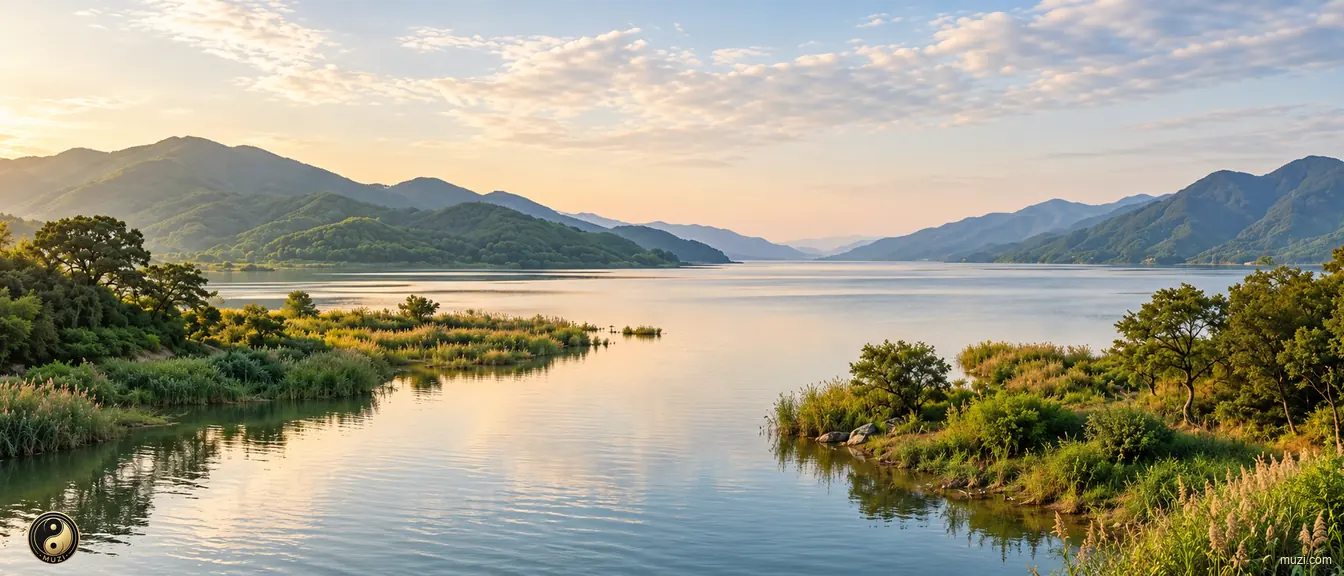
Poyang Lake's calm waters open beyond a reed-lined inlet, bordered by grassy banks and scattered trees, with wooded hills fading into warm morning haze.
Vista3

- Luoxingdun Lake Island
A tiny ancient stone island submerged in high summer tides and fully revealed upon lake grass plains in winter.
- Shizhong Mountain in Hukou
A rocky promontory where Lake Poyang meets the Yangtze, famous for stone caves ringing like bronze bells.
- Dagu Island (Shoe Mountain)
A solitary rocky limestone islet rising 90m out of the lake, resembling an embroidered slipper floating on water.
Natural Wonder1

- Poyang Lake Wetland Sanctuary
East Asia's greatest freshwater marsh, winter habitat for over 98% of the world's endangered Siberian cranes.
Archaeology1

- Kangshan Loyal Shrine Site in Yugan
Emperor Hongwu ordered this temple built for thirty-six loyal officials after crushing Chen Youliang's reputed 600,000-strong fleet; only its ruins remain today.
On its attractions1
- Record of Stone Bell MountainClassical ProseShizhong Mountain in HukouSu Shi
Can one draw arbitrary conclusions on whether a thing exists without personal sight and hearing? Li Daoyuan's observation was likely the same as mine, yet lacked detail; gentlemen refuse to moor a small boat under sheer cliffs at night, so they never learned; while fishermen and boatmen know, yet lack the words to write.
Authors1
- Su Shi (Su Dongpo)1037–1101 CE
Wrote of Shizhong Mountain in Hukou in “Record of Stone Bell Mountain”. Northern Song writer, calligrapher and official, exiled to Huangzhou after the Crow Terrace poetry trial and later to Huizhou and Hainan
In its history4
- Zhu Yuanzhang1328–1398 CE
Part of Poyang Lake's history: Founding of Ming. Founding emperor of the Ming, a former monk who rose through the Red Turban armies, defeated his rivals and reigned as the Hongwu Emperor from 1368
- Chang Yuchun1330–1369 CE
Part of Poyang Lake's history: Founding of Ming. Early Ming general from Huaiyuan who led the assault at Caishi, served as Xu Da's deputy in the northern campaign that took Dadu, and died suddenly on the march home
- Xu Da1332–1385 CE
Part of Poyang Lake's history: Founding of Ming. Founding general of the Ming who led the northern expedition that took the Yuan capital in 1368 and spent years guarding the frontier from Beiping
- Toghon Temur (Emperor Shun of Yuan)1320–1370 CE
Part of Poyang Lake's history: Founding of Ming. Last Yuan emperor to rule from Dadu, whose long reign saw Toghto's reforms and the Red Turban risings and ended with his flight north before the Ming army in 1368
Tang1

- Wang Bo's Prince Teng's Pavilion Preface675 CE, Tang
In 675, Wang Bo composed the Preface to Prince Teng's Pavilion at Hongzhou's pavilion, a major work of Tang parallel prose.
Song1

- Su Shi's Stone Bell Mountain RecordNorthern Song (1084 CE)
In 1084, while escorting his son to office, Su Shi investigated Stone Bell Mountain by boat at night and wrote the Record of Stone Bell Mountain from what he saw and heard.
Yuan2

- Battle of Lake PoyangLate Yuan Dynasty (1363 CE)
In 1363, Zhu Yuanzhang's fleet defeated Chen Youliang on Lake Poyang; Chen died during the breakout, decisively shifting the balance between the rival regimes.
- Zhu Yuanzhang Defeats Chen Youliang1363 CE
In 1363, Zhu Yuanzhang's fleet fought Chen Youliang on Lake Poyang; Chen's force was defeated, and Chen died during the breakout.
Ming1

- Founding of Ming
Zhu Yuanzhang defeated rival warlords, sent armies north to capture Dadu, and founded the Ming dynasty at Nanjing.