 Atlas
Atlas

























 Heilongjiang River
The Heilongjiang runs along an international border, freezing for much of the year beside northeastern wetlands and farmland.
 Prefecture: Hegang
 Province: Heilongjiang
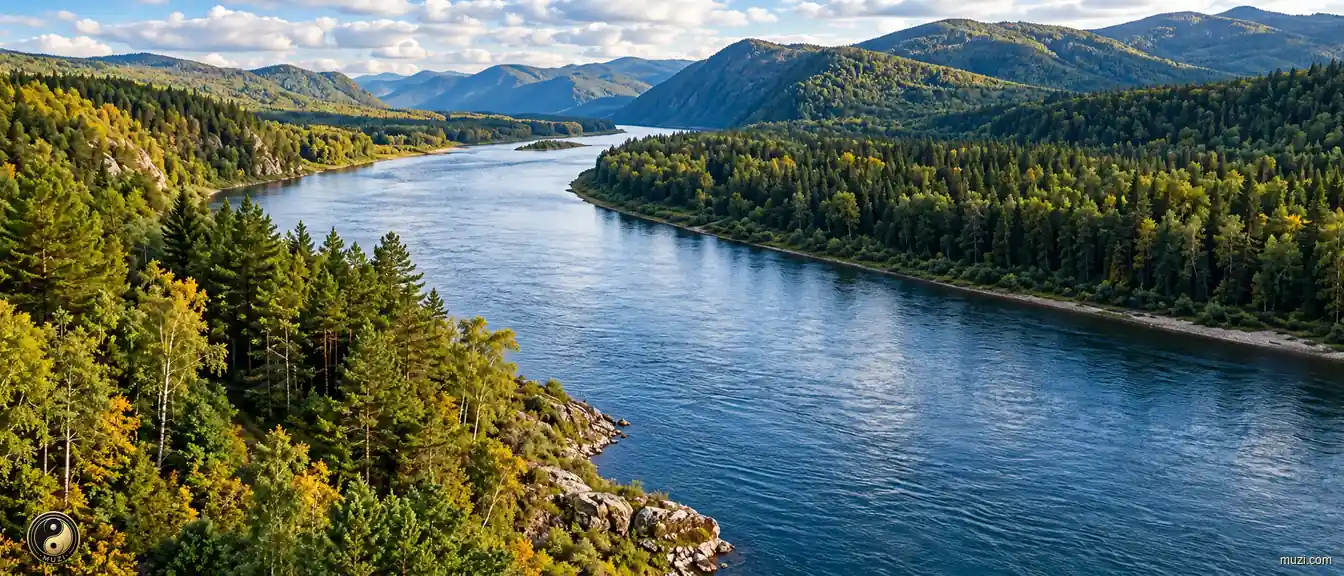
A broad blue river bends between forested hills, with birches, conifers and autumn-tinted foliage covering a rocky foreground shore.
Natural Wonder1
- First Bend of the Heilongjiang River
A colossal omega-shaped river bend cutting through primeval boreal forests along the Sino-Russian border.
Temple1

- Mohe Beiji Village Border River Viewpoint
The northernmost settlement in China, offering dramatic river views of the frozen international border.
Vista1

- Jiayin Dinosaur National Geopark
Historic site of China's first excavated dinosaur fossils overlooking picturesque bluffs along the Amur riverbank.
Tower1

- Heixiazi Island Dongji Pagoda in Fuyuan
Standing at the easternmost extremity of China where the Heilongjiang and Ussuri rivers meet.
In its history1
- Kangxi Emperor1654–1722 CE
Part of Heilongjiang River's history: Treaty of Nerchinsk. Qing emperor of the Kangxi reign who put down the Three Feudatories, annexed Taiwan, signed the Treaty of Nerchinsk with Russia and led campaigns against Galdan
Qing3

- Qing Forces Campaign Twice at AlbazinQing Dynasty (1685-1686 CE)
In 1685 Qing forces captured and dismantled Albazin; after Russian troops returned, Sabsu besieged the fort again in 1686 before negotiations intervened.
- Treaty of Nerchinsk
Qing and Russian envoys at Nerchinsk delimited their eastern frontier and set trade arrangements in their first formal boundary treaty.
- Qing and Russia Sign Nerchinsk TreatyQing Dynasty (1689 CE)
In 1689, Qing and Russian envoys concluded a treaty at Nerchinsk that delimited their eastern frontier using the Gorbitsa, Stanovoy watershed, and Argun River.