 Atlas
Atlas



























 Tarim River
A hidden river flowing silently beneath the Taklamakan Desert — fed by Tianshan snowmelt, the underground lifeline sustaining desert oases.
 Prefecture: Bayingolin
 Province: Xinjiang
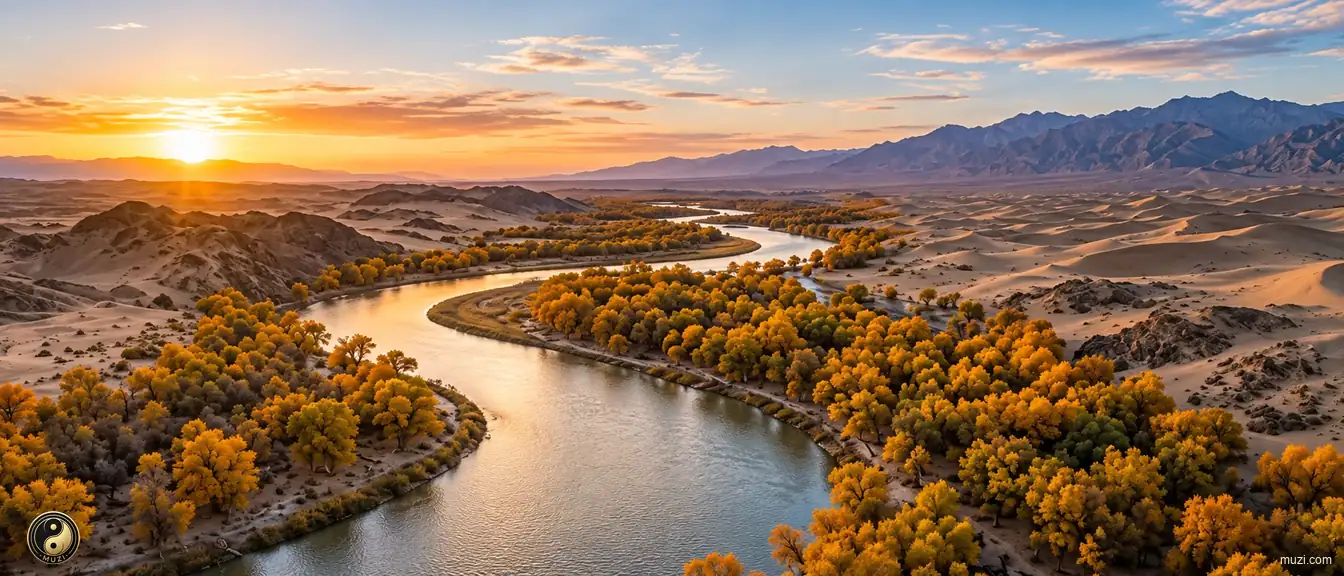
The Tarim River winds through a sandy desert landscape, bordered by golden autumn poplars, rolling dunes and barren ridges under warm sunset light.
Tower1

- Tarim Populus Euphratica Forest Park
The world's largest primeval desert poplar forest lining the banks of the Tarim River.
Residence1

- Lop Nur People Village in Yuli
An ancient indigenous desert settlement living alongside the Tarim River on traditional river fishing.
Vista1

- Tarim River Ancient Channel Remains
Ancient waterways and desert oases where Populus euphratica forests and ancient fishing villages endure.
Archaeology1

- Luntai Western Han Protectorate Ruins
Ruins of the Han Dynasty Protectorate and ancient beacon towers commanding the Northern Silk Road.
In its history2
- Zhang Qianc. 164–114 BCE
Part of Tarim River's history: Zhang Qian's Mission. Western Han envoy who crossed Xiongnu territory to reach the Yuezhi and Bactria, was held captive for over ten years and opened Han contact with Central Asia
- Emperor Wu of Han (Liu Che)156–87 BCE
Part of Tarim River's history: Zhang Qian's Mission. Western Han emperor for fifty-four years who began the use of reign titles, sent armies against the Xiongnu and envoys to Central Asia, and weakened the princes
Han3

- Zhang Qian's Mission
Zhang Qian's missions brought Central Asian geography and politics to the Han court, enabling sustained engagement along the emerging Silk Roads.
- Western Regions Protectorate and Wulei Farms60 BCE, Western Han
In 60 BCE, the Western Han established its Protectorate of the Western Regions at Wulei, expanding frontier farms and beacon systems across the region.
- Ban Chao Begins His Western-Regions Mission73 CE
In 73 CE, Ban Chao joined Dou Gu's frontier campaign and began a mission among the Western-Regions states.