
 Atlas
Atlas



























 West Lake
West Lake's cloud-wreathed hills, famous bridges, and causeways have shaped Jiangnan's poetic urban landscape for centuries.
 Prefecture: Hangzhou
 Province: Zhejiang
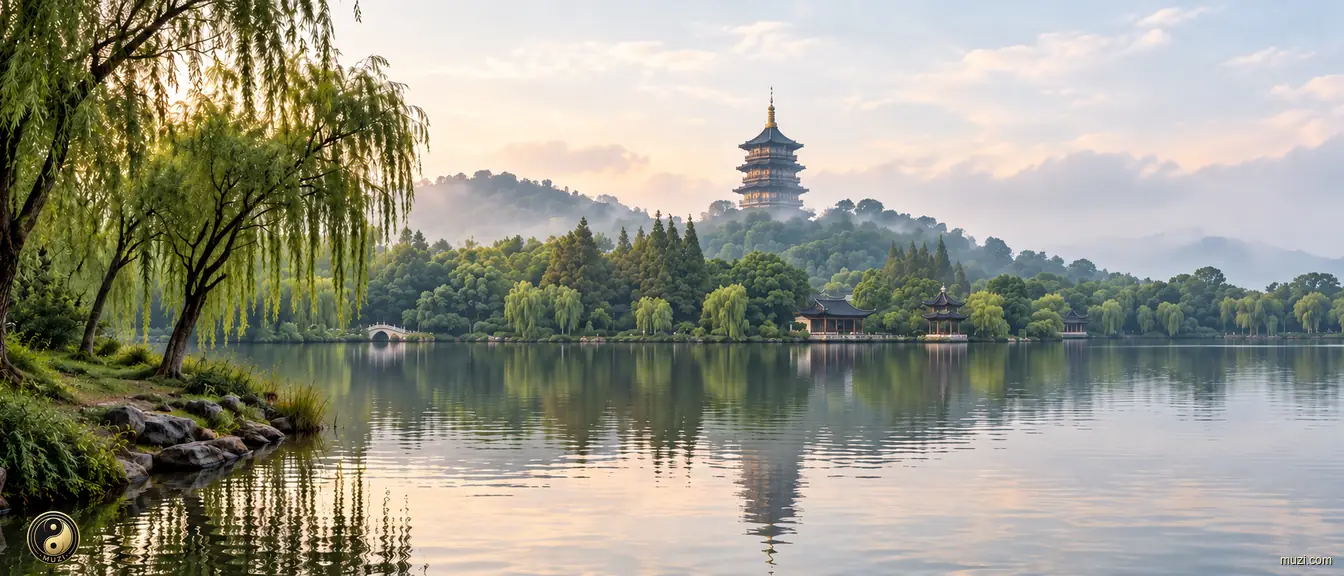
Drooping willows frame a tranquil lake reflecting a traditional pagoda, with wooded hills, small pavilions and a stone arch bridge along the distant shore.
Vista8

- Spring Dawn at Su Causeway
A dawn walk along Su Causeway, where willows and six bridges gather the first light of West Lake.
- Autumn Moon over the Calm Lake
An autumn moon spreads over still water by Gushan, turning the lakeside pavilion into a quiet mirror.
- Lingering Snow on Broken Bridge
At the east end of Bai Causeway, melting snow leaves the bridge half-veiled in winter light.
- Evening Bell at Nanping Hill
The evening bell of Jingci Temple carries from Nanping Hill across the lake into dusk.
- Twin Peaks Piercing the Clouds
North and South Peaks face each other beyond the lake, their summits appearing to pierce the clouds.
- Leifeng Pagoda in Evening Glow
Sunset catches Leifeng Pagoda above the southern lake, setting tower and water aglow.
- Three Pools Mirroring the Moon
Three stone pagodas south of Xiaoyingzhou turn moonlight on the lake into layered reflections.
- Orioles Singing in the Willows
Willows ripple along the southeastern shore while oriole song threads through the spring garden.
Gardens3

- Lotus in the Breeze at Quyuan Garden
Lotus leaves stir in summer wind at Quyuan Garden, carrying old wine fragrance across the lakeside.
- Yongjin Park
Historic Yongjin Gate recalls the Wuyue-era city wall, the spring-fed Yongjin Pool, and the legend of the golden ox.
- Changqiao Park
At West Lake’s southeastern corner, Changqiao Park pairs the legendary Long Bridge with broad views toward Leifeng Pagoda at sunset.
Temple2

- Viewing Fish at Flower Harbor
Flower Harbor gathers garden paths, red fish, and southern lakeshore water into one bright scene.
- Qian Kings Shrine
Within Orioles Singing in the Willows, the Qian Kings Shrine recalls the Wuyue rulers and their legacy of protecting Hangzhou and shaping West Lake.
Memorial1

- Yue Fei Temple in Hangzhou
Beside Yue Fei's tomb at the foot of Qixia Ridge on West Lake, the shrine grew from a monastery granted in 1221 and was listed as a national key heritage site in 1961.
Tower1

- Mid-Lake Pavilion of West Lake
Raised as an islet with a pavilion by Hangzhou prefect Sun Meng in 1552, it is the spot Zhang Dai rowed to on a snowy night in his celebrated sketch.
Depicts6
- Watching the Ocean Tide (Southeast Majestic Realm)Ci LyricsLiu Yong
Layered lakes and stacked peaks are pristine and fair. With autumn sweet osmanthus and ten leagues of lotus blooms. Markets display jewels and pearls, households overflow with silk brocades, vying in splendor.
- Record of an Evening Tour on Six Bridges Awaiting the MoonClassical ProseYuan Hongdao
West Lake is at its most splendid in spring and under the moon; in a single day, at morning mist and evening mountain haze. This year spring snow was heavy and plum blossoms were held back by cold, blooming together with apricot and peach in an extraordinary spectacle.
- Watching Snow at the Mid-Lake PavilionClassical ProseZhang Dai
Mist and frost coalesced into boundless haze; sky, clouds, hills, and waters were pure white above and below. Shadows on the lake were merely one line of long dike, one dot of Mid-Lake Pavilion, one blade of grass for my skiff, and two or three mustard seeds for the passengers aboard.
- West Lake on the Fifteenth of the Seventh MonthClassical ProseZhang Dai
On West Lake during the Mid-Seventh Month, there is nothing worth seeing except the crowds who come to look. Viewing these crowds, one classifies them into five types... When moonlight turned pale and the east showed white, the guests finally dispersed.
- Leaving Jingci Temple at Dawn to See Off Lin ZifangClassical PoetryYang Wanli
Lotus leaves reaching to the sky, an endless green; lotus blossoms catching the sun, a red like no other.
- Drinking on the Lake, First Clear, Then Rain, No. 2Classical PoetrySu Shi
If I were to compare West Lake to Xi Shi, light make-up or heavy, either way she is lovely.
Mentions1
- Tomb of Prince Yue of EClassical PoetryZhao Mengfu
On the tomb of the Prince of E the grass grows thick; in the autumn sun, desolate, the stone beasts stand tottering. The ruler and ministers who crossed south made light of the state; the elders of the Central Plains watched for the banners. The hero is dead; what use is lamenting now? The realm was split in two and could no longer hold. Do not sing this song by the West Lake: the light on the water and the colours of the hills cannot bear such grief.
Authors6
- Liu Yongc. 987 CE–c. 1053 CE
Wrote of West Lake in “Watching the Ocean Tide (Southeast Majestic Realm)”. Northern Song lyricist of long slow-tune songs such as Bells in the Rain, sung so widely that it was said every place with a well knew his words
- Yuan Hongdao1568 - 1610
Wrote of West Lake in “Record of an Evening Tour on Six Bridges Awaiting the Moon”. Leader of the Gong'an School and Master of Late Ming Expressive Prose
- Zhang Dai1597 - 1689
Wrote of West Lake in “Watching Snow at the Mid-Lake Pavilion”; Wrote of West Lake in “West Lake on the Fifteenth of the Seventh Month”. Supreme Master of Late Ming Essay and Author of Tao'an Dream Memories
- Yang Wanli1127–1206 CE
Wrote of West Lake in “Leaving Jingci Temple at Dawn to See Off Lin Zifang”. Southern Song poet and official from Jishui whose lively, colloquial manner came to be called the Chengzhai style, one of the four poets of the Restoration era
- Su Shi (Su Dongpo)1037–1101 CE
Wrote of West Lake in “Drinking on the Lake, First Clear, Then Rain, No. 2”. Northern Song writer, calligrapher and official, exiled to Huangzhou after the Crow Terrace poetry trial and later to Huizhou and Hainan
- Zhao Mengfu1254–1322 CE
Mentions West Lake in “Tomb of Prince Yue of E”. Descendant of the Song imperial house who served the Yuan as a Hanlin academician and whose calligraphy and landscapes set the course of Yuan painting and writing
In its history5
- Qi Baishi1864–1957
Part of West Lake's history: Renewal of Ink Painting. Painter and seal carver, a carpenter by training, who settled in Beijing in 1917 and became known for freehand flowers, birds, shrimps, crabs and insects and for his seals.
- Chen Shizeng1876–1923
Part of West Lake's history: Renewal of Ink Painting. Painter and seal carver who lived in Beijing from 1913, working at the Ministry of Education and teaching painting, wrote The Value of Literati Painting and championed Qi Baishi.
- Lin Fengmian1900–1991
Part of West Lake's history: Renewal of Ink Painting. Painter and art educator who, back from France, headed the Beijing art school and in 1928 founded the National Academy of Art in Hangzhou, championing a blend of Chinese and Western painting.
- Xu Beihong1895–1953
Part of West Lake's history: Renewal of Ink Painting. Painter and art educator trained in drawing and oil painting in Paris, author of Tian Heng and His Five Hundred Retainers and The Foolish Old Man Who Moved the Mountains, and head of the Beiping art academy.
- Huang Binhong1865–1955
Part of West Lake's history: Renewal of Ink Painting. Landscape painter and art historian who spent thirty years editing art publications in Shanghai, co-edited the Meishu congshu with Deng Shi, and in old age built his landscapes from layer upon layer of ink.
Tang1

- Bai Juyi Repairs West Lake DikesTang (822-823)
Bai Juyi's Tang-era West Lake works repaired dikes and gates, expanded storage, and improved irrigation for the fields around Qiantang.
Five Dynasties and Ten Kingdoms3

- Yongjin Gate ConstructedFive Dynasties and Ten Kingdoms (936)
In 936, Wuyue ruler Qian Yuanguan cut Yongjin Pool, brought West Lake water into the city, and built Yongjin Gate.
- Jingci Temple FoundedFive Dynasties and Ten Kingdoms (954)
In 954, Wuyue ruler Qian Hongchu founded Jingci Temple, whose bells became the cultural heart of Evening Bell at Nanping Hill.
- Leifeng Pagoda FoundedFive Dynasties and Ten Kingdoms (975-977)
During the Wuyue period, Leifeng Pagoda rose on West Lake's southern shore as the landmark of the Leifeng sunset scene.
Song3

- Biaozhongguan FoundedNorthern Song (1077)
In 1077, Hangzhou founded Biaozhongguan to honor the Wuyue kings; it later evolved into the Qian Kings Shrine.
- Su Shi Dredges West LakeNorthern Song (1090)
In 1090, Su Shi led a West Lake dredging project that formed Su Causeway and set three stone towers to define the lake's planting boundary.
- Southern Song Ten Scenes NamingSouthern Song
From the Southern Song onward, four-character names gathered West Lake's landscapes and seasonal moods into the Ten Scenes.
Republican Era3

- Renewal of Ink Painting
Qi Baishi's late-life change of style created his red-flower, ink-leaf manner, Lin Fengmian founded the National Academy of Art by West Lake and Xu Beihong led the art college in Beiping: Chinese painting moved into the modern age through new art schools.
- Leifeng Pagoda Collapses1924
The 1924 collapse transformed the Leifeng sunset from a standing pagoda into a memory carried by ruins.
- National Academy of Art Founded1928
In March 1928 the National Academy of Art opened at Luo Garden on Gushan by West Lake in Hangzhou, with Lin Fengmian as its first president; it grew into today's China Academy of Art.

Modern7
- Yongjin Park EstablishedModern (1950s)
In the 1950s, Yongjin Park was established near the old gate site and joined with Liulangwenying as a lakeside attraction.
- Qiantang River Water DiversionModern (1983-1986)
In the 1980s, clean water from the Qiantang River began flowing into West Lake, strengthening urban supply and lake health.
- West Lake's Third Major DredgingModern (1999-2003)
From 1999 to 2003, West Lake underwent its third major dredging since 1949, increasing depth and storage capacity.
- West Lake Comprehensive Protection BeginsModern (2001-2002)
At the start of the 21st century, comprehensive protection joined water management, heritage repair, and public landscape work into a long-term program.
- Leifeng Pagoda RebuiltModern (2002)
The pagoda was rebuilt on its original site in 2002, restoring the Leifeng sunset to the complete Ten Scenes tradition.
- Changqiao Park Added to Scenic PlanningModern (2010)
A 2010 scenic-area plan placed Changqiao Park within West Lake's management and visitor-service structure.
- World Heritage InscriptionModern (2011)
In 2011, the West Lake Cultural Landscape entered the World Heritage List, placing its hydraulic, garden, and historic features within an integrated protection framework.