
 Atlas
Atlas Tarim Basin
 Shennongjia
 Hengduan Mountains
 Xishuangbanna
 Changbai Forest Region
 Ejina
Ejina Min Mountains / Qionglai Mountains
 Jiuzhaigou
 Southern Qinling Foothills
 Junggar Wilds
 Hoh Xil
 Tianshan Mountains
 Yangtze Estuary Wetlands
 South China Mangroves
 Wuyi Mountain Tea Region
 Hainan Tropical Scrub















Wuyi Mountain Tea Region
The birthplace of black tea and oolong — the Danxia microclimate and mineral-saturated soil of the authentic rock-tea zone perfectly transcode geology into the world's finest tea aromas.
 Prefecture: Nanping
 Province: Fujian
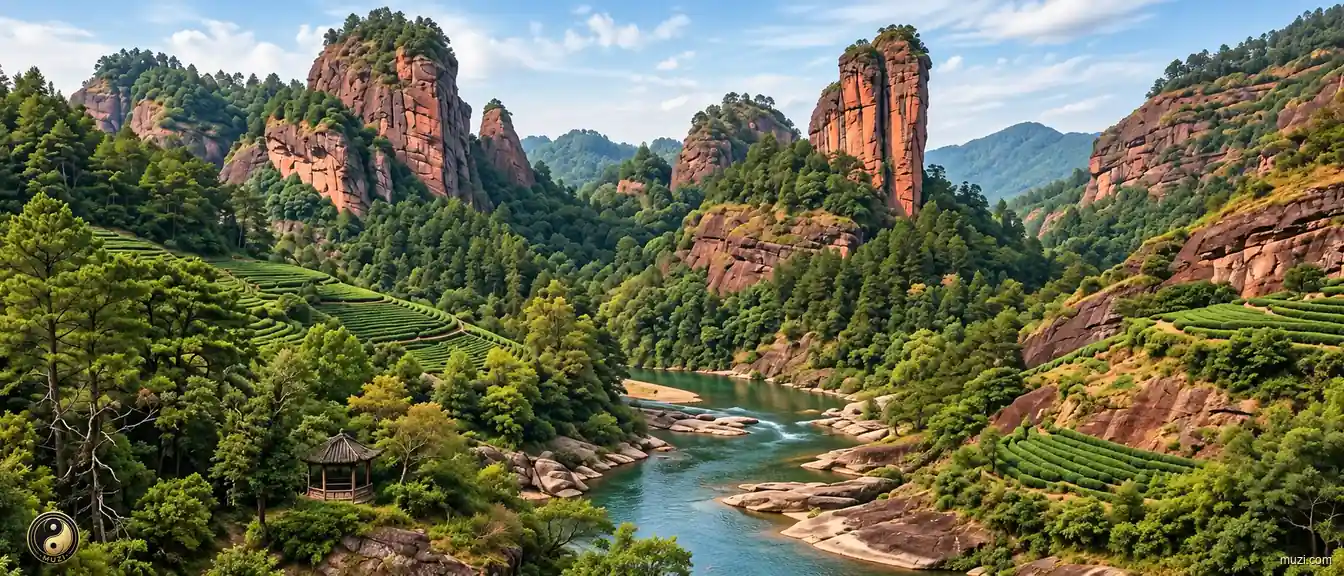
Red Danxia cliffs rise above wooded slopes and curving tea terraces beside a clear winding river in the Wuyi Mountain tea region.
Vista4

- Mount Wuyi Nine-Bend Stream
The soul of Mount Wuyi's Danxia scenery, the clear jade-green Nine-Bend Stream winds past thirty-six peaks and ninety-nine crags.
- Wuyi Mountain Dahongpao Mother Tea Trees
On a sheer cliff grow the six mother trees of Da Hong Pao, king of Chinese teas, at the heart of Wuyi rock-tea heritage and its traditional craft.
- Tongmuguan Zhengshan Xiaozhong Tea Agroforest
Regarded as the birthplace of Lapsang Souchong, the first black tea, Tongmuguan keeps highland gardens where old wild tea bushes grow among bamboo.
- Mount Wuyi Huanggangshan Subtropical Forest
Called the roof of mainland East China, Huanggangshan protects one of the largest and best-preserved mid-subtropical native forests at its latitude.
In its history2
- Zhu Xi1130–1200 CE
Part of Wuyi Mountain Tea Region's history: Zhu Xi's Neo-Confucianism. Southern Song Neo-Confucian whose Collected Commentaries on the Four Books became the set text of the civil examinations from the Yuan onward
- Lu Jiuyuan1139–1193 CE
Part of Wuyi Mountain Tea Region's history: Zhu Xi's Neo-Confucianism. Southern Song Confucian teacher known as Master Xiangshan, who held that the mind is principle and argued with Zhu Xi at Goose Lake in 1175
Song2

- Zhu Xi's Neo-Confucianism
The official ideology that shaped East Asian intellectual elite's spiritual world for seven centuries.
- Zhu Xi Establishes Wuyi Jingshe1183 CE
In 1183 Zhu Xi established Wuyi Jingshe at Mount Wuyi, teaching and writing there and making the academy a physical center of his Neo-Confucian learning.

Ming1

- Zhengshan Xiaozhong Gains Its Tongmuguan IdentityMing period
During the Ming period, Tongmuguan developed the pine-smoked Zhengshan Xiaozhong tradition, an important source in black-tea history.