 Atlas
 Tarim Basin
 Shennongjia
 Hengduan Mountains
 Xishuangbanna
 Changbai Forest Region
 Ejina
 Min Mountains / Qionglai Mountains
 Jiuzhaigou
 Southern Qinling Foothills
 Junggar Wilds
 Hoh Xil
 Tianshan Mountains
 Yangtze Estuary Wetlands
 South China Mangroves
 Wuyi Mountain Tea Region
 Hainan Tropical Scrub















Southern Qinling Foothills
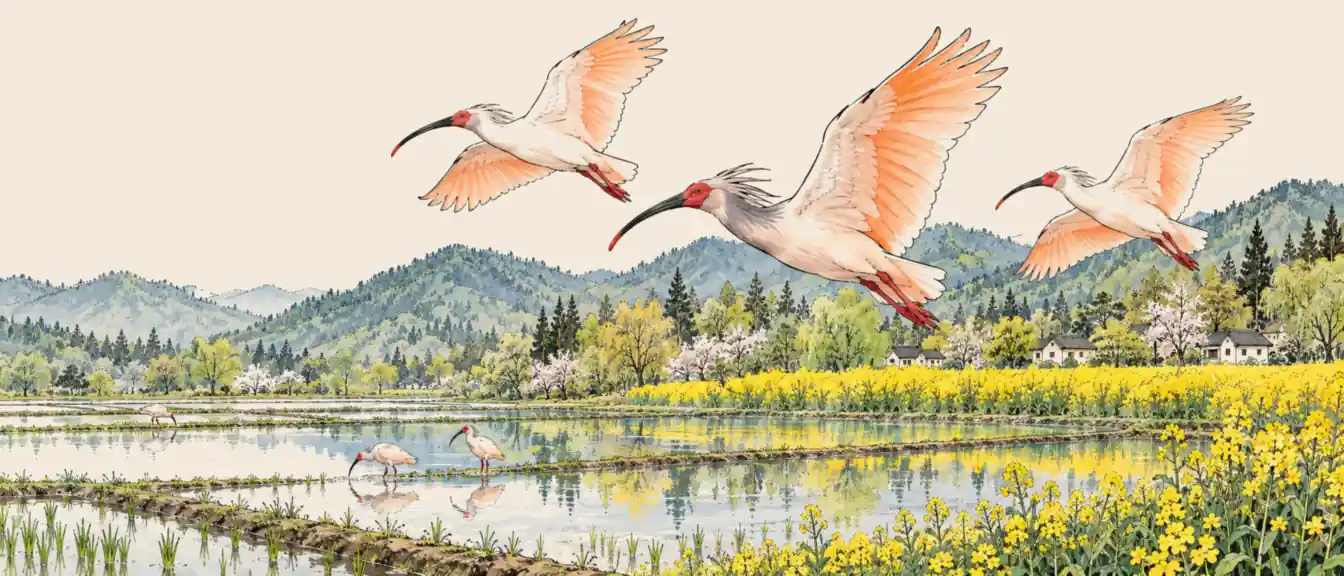
Terraced fields and streams weave a network on the southern slopes of Qinling — where the last wild crested ibis was rediscovered, scripting a miracle of species resurrection from the brink of extinction.
 Prefecture: Ankang
 Province: Shaanxi
Three large curved-billed, red-faced birds with orange-tinged wings fly over flooded fields where a few more wade, yellow rapeseed blooms along the edge and houses sit below wooded hills.
Vista3

- Yangxian Crested Ibis Nature Reserve
Once the last refuge of the wild crested ibis, the bird called the jewel of the East, Yangxian is now a cradle for captive breeding and release.
- Yangxian Organic Rice Terrace Wetland
Farmers and crested ibises share these paddies, where chemical fertilisers and pesticides are banned across a showcase of organic farming culture.
- Liuba Zibaishan Sinkholes & Meadow
On the southern slopes of the Qinling, Zibaishan pairs karst sinkholes and caves with alpine meadows, a vital water-conserving area for the Han River basin.
Natural Wonder1

- Foping Giant Panda Nature Reserve
Foping holds one of the densest wild giant panda populations in the Qinling Mountains, and rare brown pandas have been sighted here several times.
Han1

- Zhang Liang Hermitage on Mount ZibaiWestern Han Dynasty Tradition (c. 2nd Century BCE)
Following the founding of the Han Dynasty, founding strategist Zhang Liang withdrew from public life; according to enduring cultural tradition, he practiced Daoist fasting and seclusion in the Zibaishan mountains of Liuba.
Modern Era2

- The Crested Ibis Returns
In May 1981 a Chinese Academy of Sciences survey team found seven wild crested ibises in Yangxian, Shaanxi, and announced the find; protection in the wild at Yangxian and captive breeding at Beijing Zoo followed.
- Discovery of Wild Crested Ibis Population1981 CE
In May 1981 a survey team from the Institute of Zoology of the Chinese Academy of Sciences found seven wild crested ibises in Yangxian, Shaanxi, and habitat protection and captive breeding followed.