
 Atlas
Atlas



























 Dujiangyan
A two-thousand-year-old dam-free irrigation miracle — the fish-mouth divider, the flying-sand weir, and the bottle-neck channel still irrigating the Chengdu Plain's Land of Abundance today.
 Prefecture: Chengdu
 Province: Sichuan
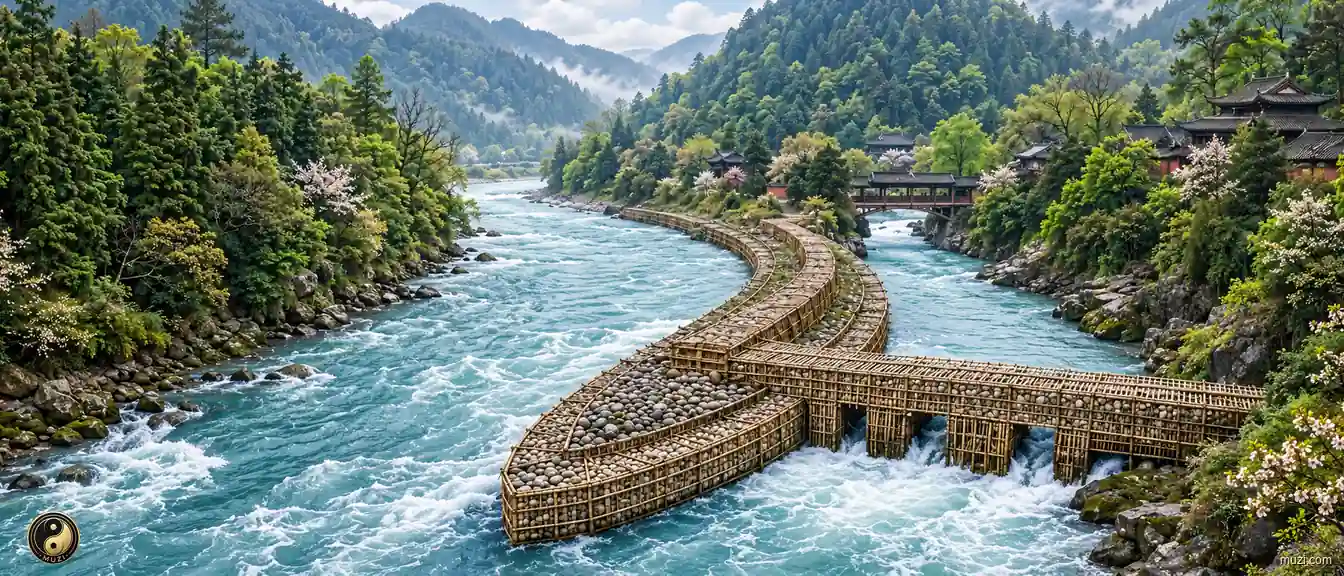
Rushing turquoise water divides around a curved bamboo-and-stone diversion, framed by wooded slopes, flowering trees and traditional tiled roofs in a Dujiangyan-inspired scene.
Infrastructure3

- Dujiangyan Yuzui Water-Dividing Dike
Where the Min River leaves the mountains, the Yuzui fish-mouth dike splits the flow four to six, irrigating the Chengdu Plain without a dam.
- Dujiangyan Feishayan Spillway
Using the helical flow of a river bend, the Feishayan spillway sheds floodwater and sand automatically, a brilliant example of ancient hydraulic design.
- Dujiangyan Baopingkou Intake
Cut through Yulei Mountain under Li Bing, the narrow Baopingkou intake controls the inner river's flow, giving people command over drought and flood.
Temple1

- Erwang Temple & Fulong Temple at Dujiangyan
Honouring Li Bing and his son for taming the waters, these temple halls hold the carved maxim on dredging riverbeds deep and building weirs low.
Bridge1

- Dujiangyan Anlan Cable Bridge
Stretched across the Min River where Dujiangyan splits it into inner and outer channels, the Anlan Bridge is counted among China's five great ancient bridges.
In its history2
- Li BingDates unknown; Qin governor of Shu, late Warring States
Part of Dujiangyan's history: Dujiangyan Irrigation System. Qin governor of Shu who cut through the Lidui spur and divided the Min River into two channels across the Chengdu plain, the works later known as Dujiangyan
- King Zhaoxiang of Qinc. 325–251 BCE
Part of Dujiangyan's history: Dujiangyan Irrigation System. King of Qin for fifty-six years whose general Bai Qi crushed Zhao at Changping and whose armies ended the Western Zhou principality
Zhou2

- Dujiangyan Irrigation System
Harnessing the Min River without dams, transforming Sichuan into the Land of Abundance for millennia.
- Li Bing Begins DujiangyanLate Warring States, c. 256–251 BCE
Around 256–251 BCE, Li Bing oversaw the initial Dujiangyan works, dividing the Min River and supporting irrigation on the Chengdu Plain.

Three Kingdoms1

- Zhuge Liang's Dujiangyan Weir Officers227 CE
In 227, Zhuge Liang established weir officers and organized a standing maintenance workforce for the Dujiangyan irrigation system.
Yuan1

- Dujiangyan's Six-Character Maintenance RuleYuan period
Yuan histories and inscriptions record 'deepen the shoals, keep the weir low' and attribute the rule to Li Bing, while its earlier origin remains debated.
Modern1
- Qingcheng and Dujiangyan Inscribed2000 CE
In 2000, Mount Qingcheng and the Dujiangyan Irrigation System were inscribed for their Taoist heritage, hydraulic engineering, and continuing historical function.