
 Atlas
Atlas























 Qin Straight Road
The ancient expressway built by Qin Shi Huang — a geometric military corridor stretching seven hundred kilometers straight along the loess ridge, enabling cavalry to reach the frontier in three days.
 Province: Inner Mongolia
 Province: Shaanxi
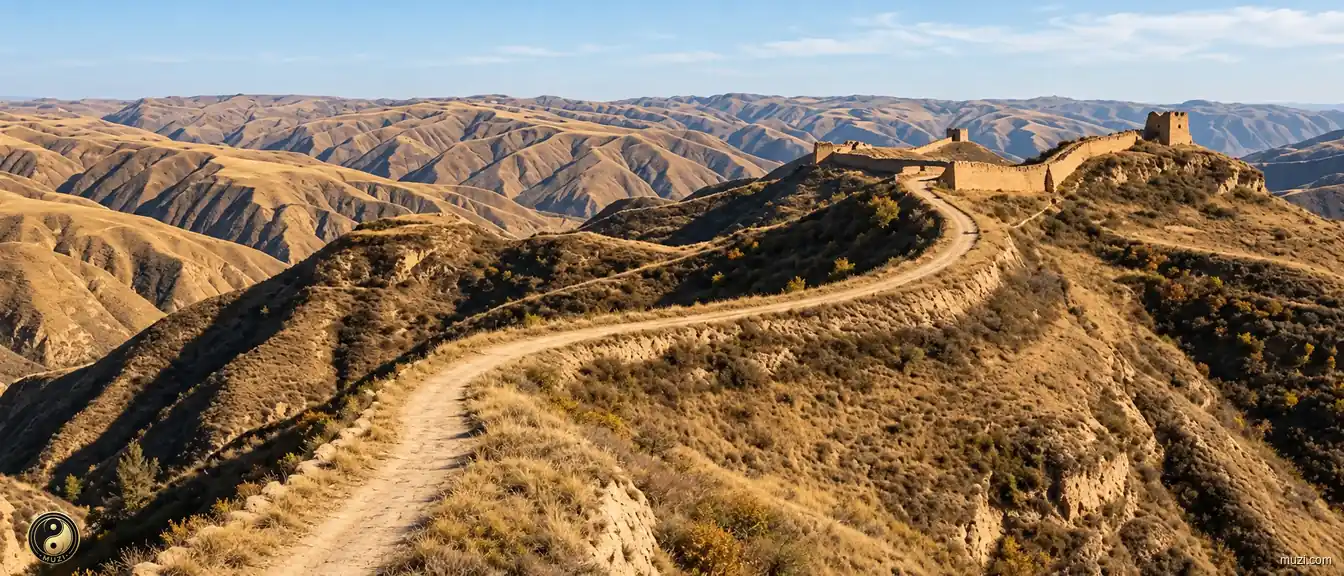
An earthen ridge route crosses dry loess hills and deep gullies toward weathered wall ruins in a Qin Straight Road-inspired landscape.
Archaeology2

- Xunyi Shimen Pass Qin Straight Road Site
This first pass where the Qin Straight Road left the Guanzhong Plain for the Loess Plateau keeps clear traces of hills cut and valleys filled.
- Ordos Jiuyuan Qin Highway Terminal Site
Jiuyuan, near today's Baotou and Ordos, marked the northern terminus of the First Emperor's Straight Road and served as a pivotal military stronghold.
Infrastructure1
- Fuxian Qin Straight Road Ruts & Beacons
Along the Ziwu Ridge crest on the Loess Plateau, a rammed-earth Qin road tens of metres wide still shows well-kept ruts running in both directions.
In its history2
- Meng TianBirth unknown–210 BCE
Part of Qin Straight Road's history: Building the Great Wall. Qin general who, after the unification, drove the northern peoples back, built the frontier wall from Lintao to Liaodong and was forced to take poison in 210 BC
- Qin Shi Huang (Ying Zheng)259–210 BCE
Part of Qin Straight Road's history: Building the Great Wall. King of Qin who conquered the six rival states by 221 BC, took the title First Emperor and imposed commanderies, one script and uniform measures
Qin2

- Building the Great Wall
Qin linked and expanded earlier Yan, Zhao, and Qin fortifications into a northern network of walls, passes, and beacons.
- Meng Tian Builds the Straight Road212–210 BCE, Qin
From 212 to 210 BCE, Meng Tian oversaw the Qin Straight Road linking Ganquan Palace and Jiuyuan for northern frontier transport.

Han1

- Han Wudi Inspects the Direct Road110 BCE
In 110 BCE, Emperor Wu traveled north along the Qin Direct Road to inspect the Shuofang frontier.