
 Atlas
Atlas


























 Karez
Karez
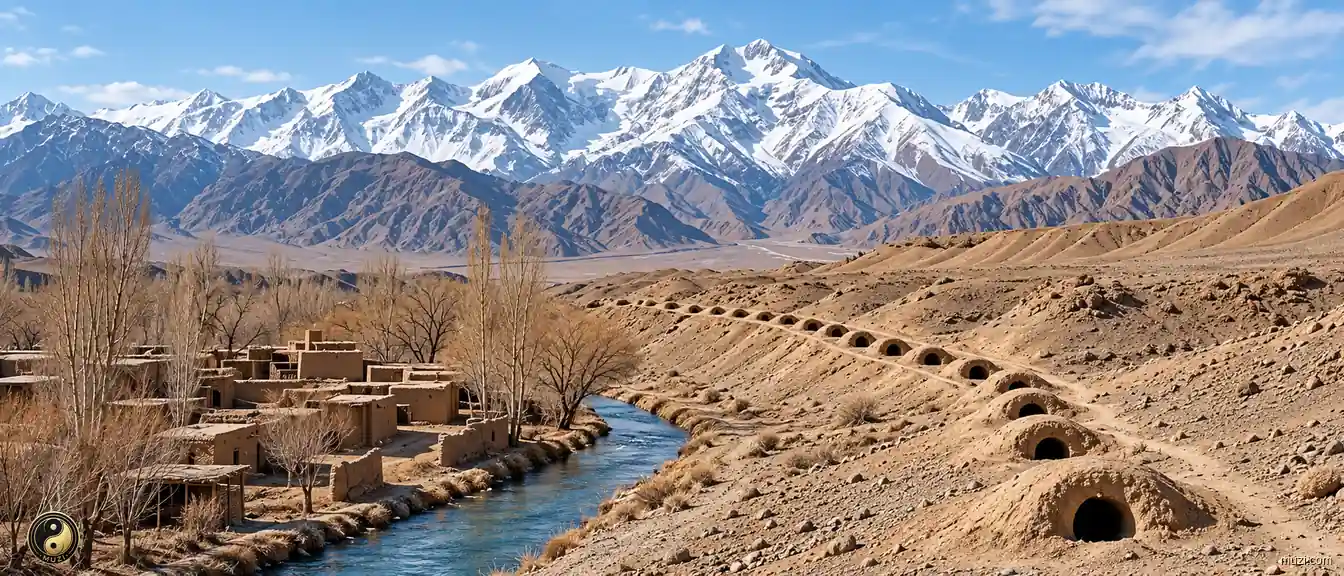
Turpan's Karez channels carry Tianshan snowmelt to oases with little evaporation, an enduring feat of underground water engineering.
 Prefecture: Turpan
 Province: Xinjiang
A clear irrigation channel curves past adobe homes and leafless poplars, while earthen karez openings recede across dry foothills beneath a snowy mountain range.
Infrastructure2

- Turpan Karez Underground Channel
Hidden from a few metres to a hundred metres underground, karez channels carry Tianshan snowmelt without evaporation, alongside storage ponds displayed at this site.
- Toksun Open Karez Shafts & Irrigation
Hundreds of bead-like mounds marking vertical shafts run across the Gobi, revealing a vast network that sustains life in a desert oasis.
Archaeology1

- Jiaohe Ancient City Karez Water Network
Outside Jiaohe, the ancient city carved from raw earth, these water works secured its supply and oasis irrigation for two thousand years.
Han1

- Han Western Regions Protectorate and Farms60 BCE
In 60 BCE, Han appointed Zheng Ji as the first Protector-General of the Western Regions, established the protectorate, and expanded garrison farming.
Qing2

- Karez Irrigation Develops through the QingQing dynasty (1644–1911 CE)
Karez channels in Turpan continued to be built during the Qing, when government encouragement and tuntian measures supported their development.
- Lin Zexu Inspects the Turpan Karez1845 CE
In 1845, Lin Zexu inspected land in Turpan and recorded the Karez system's underground water-conveyance design.