 Atlas










Jiayuguan Pass
Begun in 1372 under the Ming, Jiayuguan stands in a narrow valley in the central-western Hexi Corridor, its inner and outer cities, fore-wall, barbicans and moat forming layered lines of defense.
 Prefecture: Jiayuguan City
 Province: Gansu
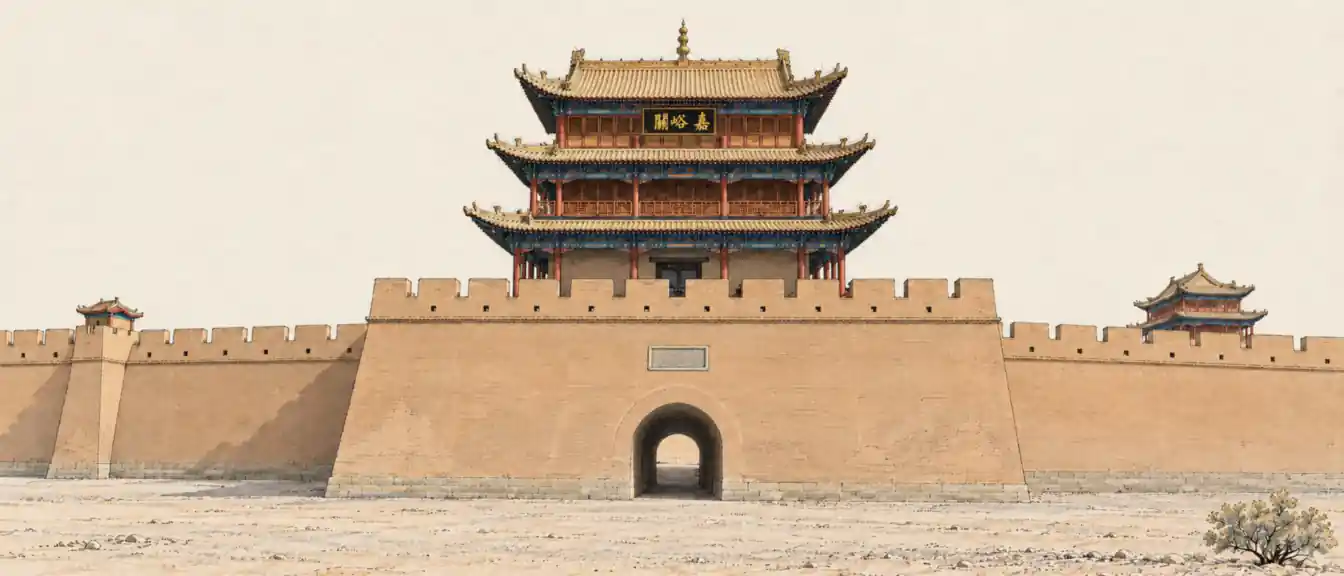
Jiayuguan Pass seen head-on: a yellow-brown crenellated wall with a plain stone tablet above its arched gate; behind it rises a three-storey gate tower with three tiers of eaves and a golden finial, a black plaque with gold characters reading Jiayuguan under its top eave; smaller towers stand on the wall to the left and right, and a low scrub tuft grows from the gravel desert in front.
Infrastructure1
- Jiayuguan Pass Fortress & Overhanging Wall
At the western end of the Ming Great Wall, Jiayuguan rises between Gobi and oasis as an iron-clad fortress commanding a Silk Road chokepoint.
Ming1

- Jiayuguan Pass Begun in Hexi Corridor1372 CE
In 1372, the fifth year of the Hongwu reign, work began on Jiayuguan Pass in a narrow valley of the Hexi Corridor, on a site chosen by the general Feng Sheng.
Modern Era2
- Six Sites Join the World Heritage List
China became a State Party to the World Heritage Convention in December 1985, and in December 1987 six Chinese properties, among them the Great Wall, the Forbidden City and the Mogao Caves, were inscribed on the World Heritage List.
- Jiayuguan Inscribed with the Great Wall1987 CE
In 1987 the Great Wall was inscribed on the World Heritage List, with Jiayuguan as the western end of the Ming Great Wall.