
 Atlas
Atlas

























 Grand Canal
The world's longest man-made waterway — crossing five major river systems to connect north and south, continuously pumping southern grain and wealth into the empire's heart.
 Province: Beijing
 Province: Tianjin
 Province: Hebei
 Province: Jiangsu
 Province: Zhejiang
 Province: Shandong
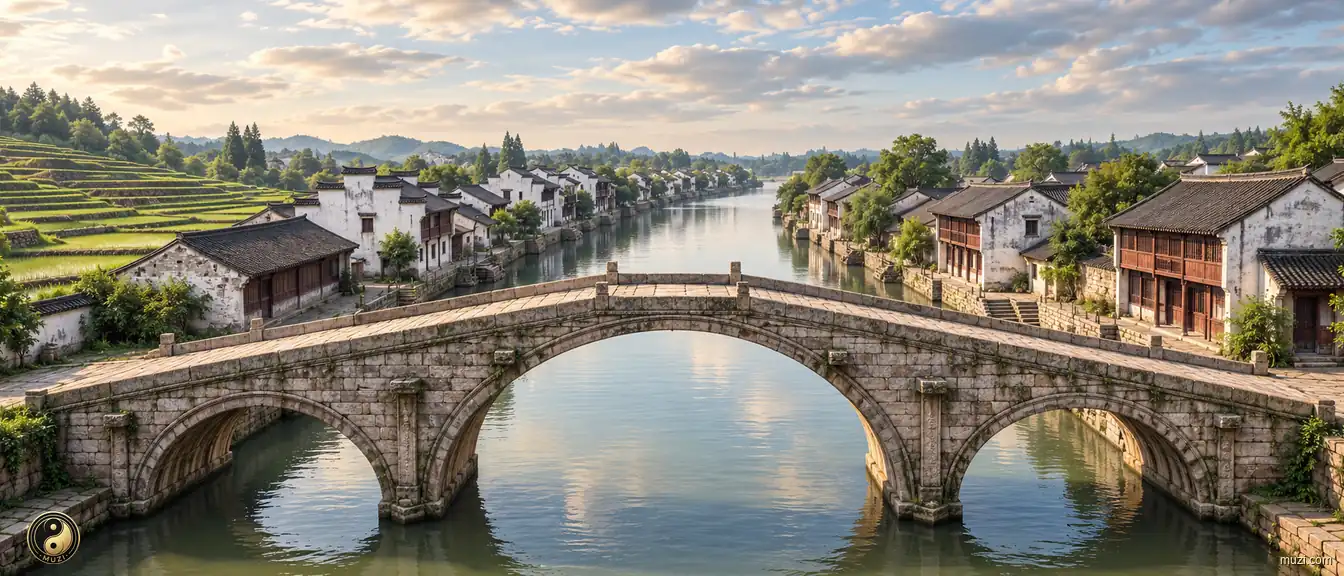
A weathered three-arched stone bridge spans a quiet Grand Canal scene, with traditional tiled houses, cultivated terraces and trees along the banks.
Bridge2

- Gongchen Bridge & Grand Canal Pier in Hangzhou
Marking the southern end of the Beijing-Hangzhou Grand Canal, Gongchen Bridge is a three-arch stone span with slender piers beside a historic canal landing.
- Suzhou Shantang Street & Canal Pier
Laid out under Bai Juyi in the Tang dynasty, the seven-li Shantang Street runs beside its canal, a classic Jiangnan water town of homes lining the stream.
Civic Building1

- Yangzhou Sanwan Grand Canal Section
Sanwan preserves a Ming dynasty hydraulic idea of three bends doing the work of one dam, and hosts the China Grand Canal Museum.
Archaeology2

- Huai'an Qingjiang Dam & Canal Heritage
Huai'an keeps one of the canal's best-preserved Ming locks, near the seat of the grain transport governor where southern boats met northern horses.
- Grand Canal Nanwang Water Dividing Hub Site
A UNESCO World Heritage engineering landmark that diverted river waters north and south to sustain canal transport.
Tower1

- Tongzhou Randeng Pagoda on Grand Canal
Rising where the canal ends in the north, Randeng Pagoda guided grain barges into Tongzhou for a millennium, its silhouette long celebrated in verse.
In its history2
- Yang Guang569–618 CE
Part of Grand Canal's history: Building of Eastern Luoyang. Second Sui emperor, Yangdi, who built the eastern capital at Luoyang and the Grand Canal, failed in three wars against Goguryeo, and was strangled in a mutiny at Jiangdu
- Guo Shoujing1231–1316 CE
Part of Grand Canal's history: Yuan Grand Canal Integration. Yuan astronomer and hydraulic engineer who designed the instruments and observations behind the Shoushi calendar and cut the Tonghui canal into the capital Dadu
Sui2

- Building of Eastern Luoyang
Emperor Yang built the eastern capital at Luoyang with palaces, wards, markets, and canals linking the Sui realm north and south.
- Emperor Yang Opens the Tongji Canal605 CE
In 605 CE, Emperor Yang ordered the Tongji Canal, linking Luoyang with the Huai River waterway.

Tang1

- Bai Juyi Builds the Shantang Canal825 CE
In 825, Suzhou prefect Bai Juyi organized excavation of the Shantang River from Changmen to Tiger Hill and built a riverside road to improve transport.
Yuan2

- Guo Shoujing Opens the Tonghui River1292–1293 CE
From 1292 to 1293, Guo Shoujing directed the Baifu-spring diversion and Tonghui River works, allowing grain boats to sail from Tongzhou into Dadu's Jishuitan.
- Yuan Grand Canal Integration
Straightening the direct waterway from Dadu to Hangzhou, formalizing the enduring Jing-Hang Grand Canal.
Ming1

- Song Li Begins the Nanwang WorksMing Dynasty (1411 CE)
In 1411, Song Li adopted Bai Ying's plan to divert the Wen River and began the Daicun Dam, Xiaowen channel, and Nanwang water-division system, a program continued over subsequent years.
Modern1
- Grand Canal Inscribed as World Heritage2014 CE
In 2014, the Grand Canal serial property was inscribed for its long-lived hydraulic works, grain-transport system, and role in imperial communications.