 Atlas
 Grand Canal
 Dujiangyan
 Great Wall
 Qin Straight Road
 Lingqu Canal
 Zhengguo Canal
 Hangu Pass
 Jianmen Pass
 Yanmen Pass
 Yumen Pass
 Liuhe Pagoda
 Huizhou Weir Dam
 Karez
 Qiantang Seawall
 Tongji Canal
 Three Gorges Plank Road
 Shanhaiguan Pass
 Jiayuguan Pass
 Juyongguan Pass
 Tongguan Pass
 Yangguan Pass
 Niangziguan Pass
 Dasanguan Pass










Great Wall
The longest military fortification in human history — winding ten thousand li along the northern ridges, guarding the boundary of agrarian civilization for two millennia.
 Province: Beijing
 Province: Tianjin
 Province: Hebei
 Province: Shanxi
 Province: Inner Mongolia
 Province: Liaoning
 Province: Shaanxi
 Province: Gansu
 Province: Ningxia
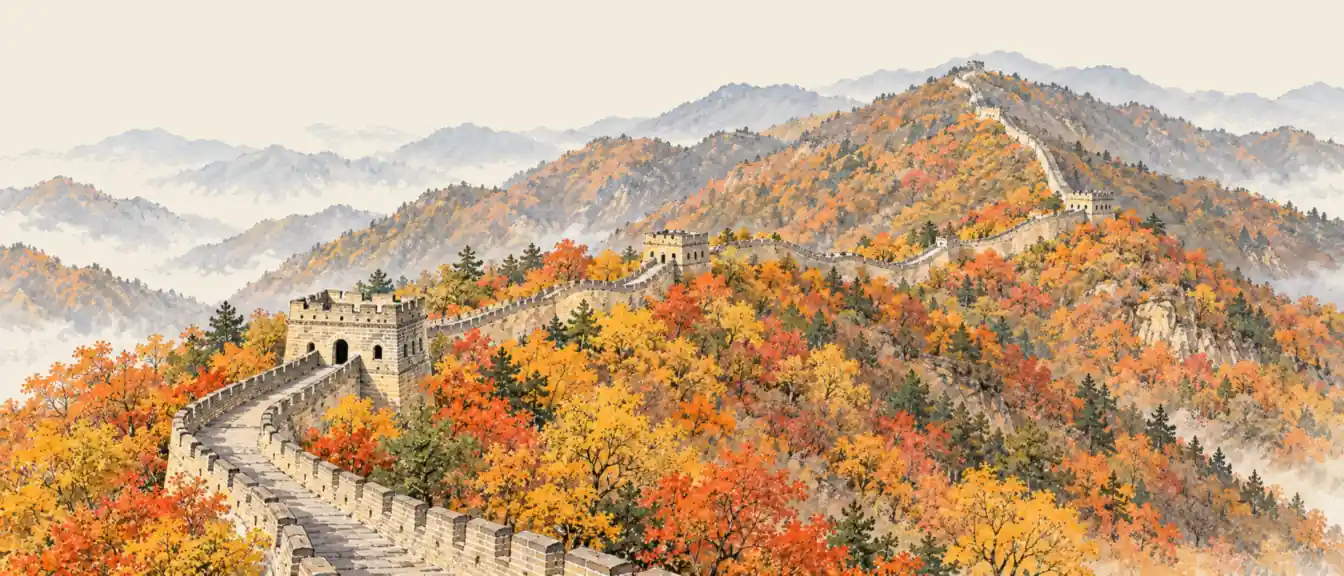
A stone stretch of the Great Wall winds up autumn-coloured ridges, a gate tower and stepped battlements in front, with hills fading into thin mist behind.
Vista1

- Laolongtou (Old Dragon's Head) & Chenghai Tower
Laolongtou in Shanhaiguan District, Qinhuangdao, is where the Ming Great Wall runs into the Bohai Sea; the wall was repaired in 1984 and Chenghai Tower has been rebuilt.
Infrastructure4
- Badaling Great Wall Fortress & Beacon Towers
Built under the Ming in 1504 and 1505 north of Juyong Pass to guard the pass and the capital, Badaling has an open section 3,741 meters long.
- Jiayuguan Pass Fortress & Overhanging Wall
Begun in 1372 under the Hongwu Emperor of the Ming, the fortress stands between Gobi and oasis, with rammed-earth walls about 10.7 meters high.
- Mutianyu Great Wall & Zhengguantai
A Great Wall section in the Jundu Mountains with 22 watchtowers along about 2,250 meters, set in forest with coverage above 90 percent.
- Simatai Great Wall & Wangjing Watchtower
Built along precipitous ridgelines, Simatai is a breathtaking stretch of Ming Great Wall, and its Wangjing Tower is said to offer distant views toward Beijing.
Sculpture1

- Juyongguan Great Wall & Yuntai Platform Inscriptions
A pass town in a Jundu Mountains gorge whose Cloud Platform, begun in 1342 under the Yuan, has walls carved with Buddhist texts in six scripts.
In its history2
- Meng TianBirth unknown–210 BCE
Part of Great Wall's history: Building the Great Wall. Qin general who, after the unification, drove the northern peoples back, built the frontier wall from Lintao to Liaodong and was forced to take poison in 210 BC
- Qin Shi Huang (Ying Zheng)259–210 BCE
Part of Great Wall's history: Building the Great Wall. King of Qin who conquered the six rival states by 221 BC, took the title First Emperor and imposed commanderies, one script and uniform measures
Qin2

- Building the Great Wall
Qin linked and expanded earlier Yan, Zhao, and Qin fortifications into a northern network of walls, passes, and beacons.
- Meng Tian Extends Qin's Great Wall214-210 BCE
After Qin unification, historical accounts describe Meng Tian linking and extending earlier Yan, Zhao, and Qin walls into a northern frontier system.

Yuan1

- Juyong Pass Cloud Platform Completed1345 CE
In 1345, the Cloud Platform beneath Juyong Pass's crossing stupas was completed, with Buddhist images and dharani inscriptions in six scripts.
Ming2

- Jiayuguan Pass Begun in Hexi Corridor1372 CE
In 1372, the fifth year of the Hongwu reign, work began on Jiayuguan Pass in a narrow valley of the Hexi Corridor, on a site chosen by the general Feng Sheng.
- Qi Jiguang Rebuilds the Jizhen Wall1568–1571 CE
From 1568 to 1571, Qi Jiguang directed wall and hollow-watchtower works and reorganized the Jizhen garrison into an integrated frontier-defense system.
Modern Era3

- Six Sites Join the World Heritage List
China became a State Party to the World Heritage Convention in December 1985, and in December 1987 six Chinese properties, among them the Great Wall, the Forbidden City and the Mogao Caves, were inscribed on the World Heritage List.
- Great Wall Inscribed as World Heritage1987 CE
In 1987, the Great Wall was inscribed as a defensive work and cultural landscape developed across successive historical periods.
- Jiayuguan Inscribed with the Great Wall1987 CE
In 1987 the Great Wall was inscribed on the World Heritage List, with Jiayuguan as the western end of the Ming Great Wall.