


 Gansu
 Hexi Corridor
The narrow oasis belt pinched between the Qilian Mountains and the desert — the golden passage of the Silk Road, Chinese civilization's sole overland corridor into the heart of Eurasia.
 MUZIMatrix
 Jiayuguan City
Jiayuguan Pass, the Ming Great Wall's western stronghold hailed as the greatest pass under heaven, stands near the Overhanging Great Wall and Wei-Jin tomb murals.
Hexi Corridor
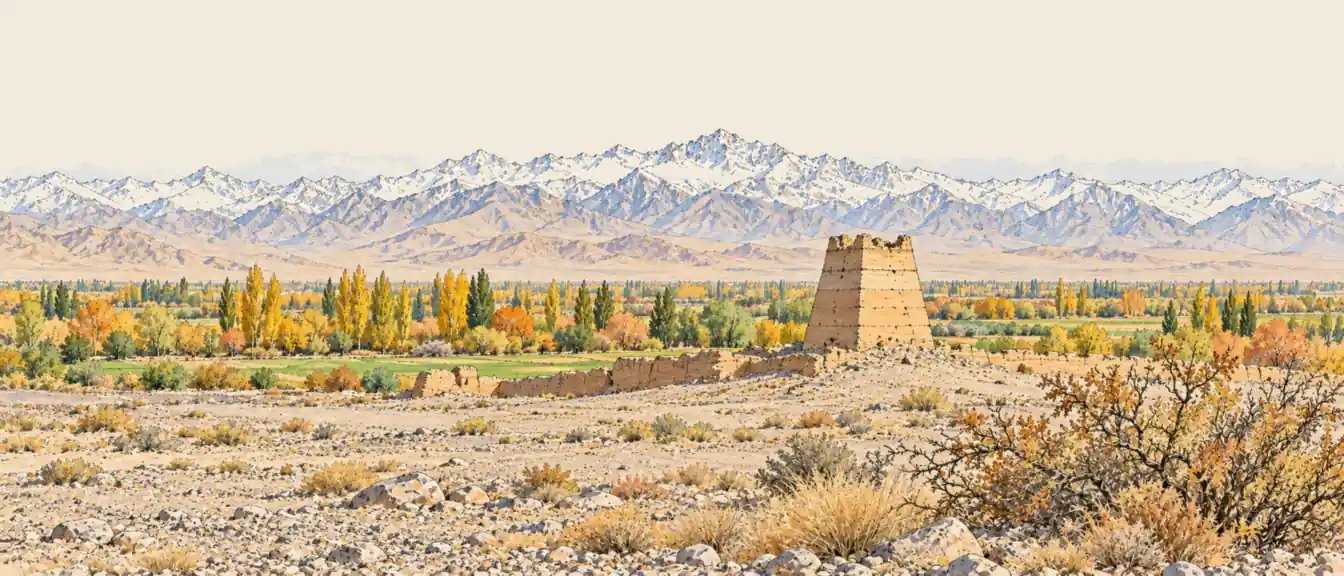
A square earthen tower and a stretch of broken wall stand on stony ground, with rows of trees behind them and a long line of snowy mountains beyond.
Open the entryThe spatial setting of Jiayuguan City is grounded in the local fact “Jiayuguan Pass, the Ming Great Wall's western stronghold hailed as the greatest pass under heaven, stands near the Overhanging Great Wall and Wei-Jin tomb murals.” These relationships connect landscape, inherited places, and community experience without reducing Jiayuguan City to an administrative label. Over time, these relationships accumulated through residence, exchange, production, and community continuity across successive historical periods. Viewed beside neighboring areas, Jiayuguan City also shows how roads, resources, and movement create local distinctions within a wider region. For regional study, Jiayuguan City places location, long-term formation, and present meaning within one connected explanation.
Hexi CorridorThe narrow oasis belt pinched between the Qilian Mountains and the desert — the golden passage of the Silk Road, Chinese civilization's sole overland corridor into the heart of Eurasia.
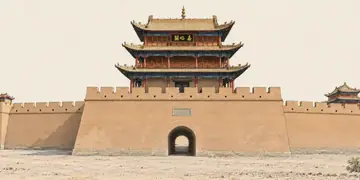
 Jiayuguan Pass
Begun in 1372 under the Ming, Jiayuguan stands in a narrow valley in the central-western Hexi Corridor, its inner and outer cities, fore-wall, barbicans and moat forming layered lines of defense.
Begun in 1372 under the Hongwu Emperor of the Ming, the fortress stands between Gobi and oasis, with rammed-earth walls about 10.7 meters high.
View attraction