
 Atlas
Atlas


























 Hexi Corridor
The narrow oasis belt pinched between the Qilian Mountains and the desert — the golden passage of the Silk Road, Chinese civilization's sole overland corridor into the heart of Eurasia.
 Prefecture: Jiayuguan City
 Province: Gansu
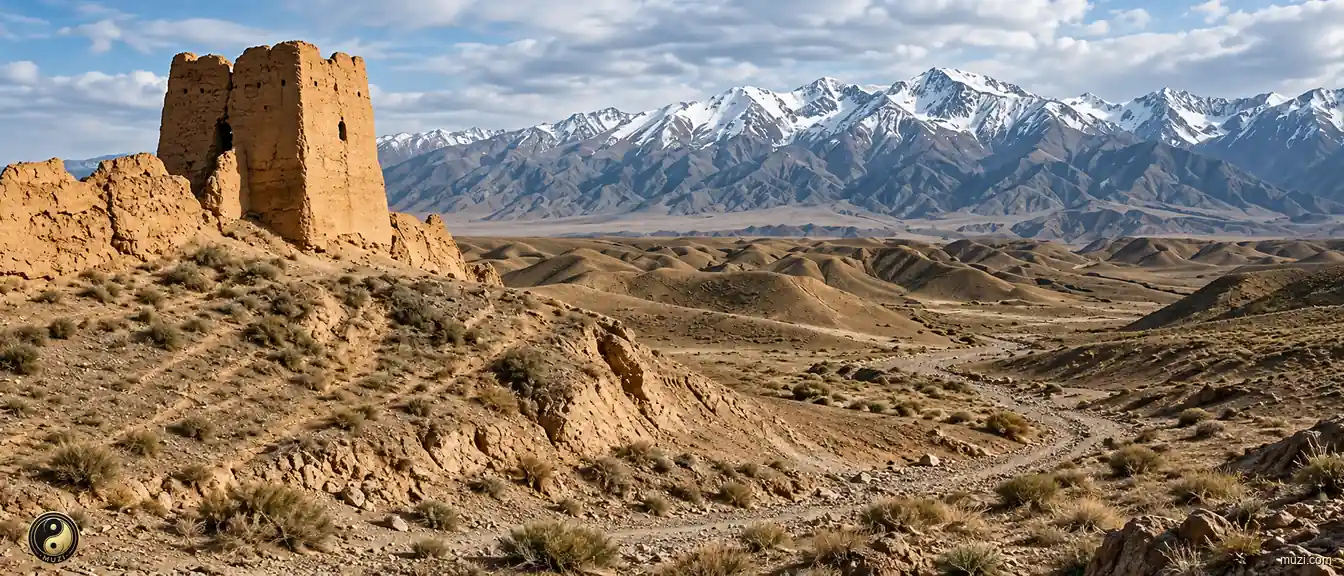
A weathered rammed-earth tower and broken wall overlook dry gravel hills and sparse desert grasses, with a broad snowy mountain range beyond.
Vista3

- Zhangye Danxia National Geopark
Banded ridges of red, orange and yellow sandstone ripple across the Hexi Corridor at Zhangye, among the most vividly colored danxia hills, like a rainbow laid on the earth.
- Jiuquan Western Han Historic Site
Legend says General Huo Qubing poured imperial wine into this spring to share with his troops, and Jiuquan is also credited as the home of Qilian luminous jade cups.
- Jiuquan Zuo Gong Willow & Western HQ
From this Jiuquan camp, Zuo Zongtang marshaled troops and supplies for the Qing campaign to retake Xinjiang, and his famed willows, praised in verse, spread from here.
Memorial1

- Wuwei Leitai Han Tomb
This large Han-era brick tomb of a Liangzhou military noble yielded the Bronze Galloping Horse, the steed now used as the emblem of Chinese tourism.
Temple1

- Zhangye Dafo Temple
A huge clay reclining Buddha lies inside one of China's largest surviving Western Xia-era timber halls, a Silk Road landmark where many peoples and cultures met.
Archaeology1

- Wuwei Baita Temple Liangzhou Talks Site
Baita Temple marks the 1247 Liangzhou meeting between Sakya Pandita and Prince Godan, a pivotal moment in relations between Tibet and the Mongol court.
Tower1

- Wuwei Kumarajiva Temple & Tongue Relic Stupa
Kumarajiva, translator of the Diamond and Lotus Sutras, spent seventeen years in Liangzhou, and this temple with its tongue relic stupa honors his stay.
Civic Building1

- Gaotai Red Army Western Route Memorial Hall
Over twenty thousand soldiers of the Red Army's Western Route Army fought their way across the Hexi Corridor, and this memorial in Gaotai honors their battles.
In its history8
- Xiao Yan464–549 CE
Part of Hexi Corridor's history: Buddhism Spreading East. Founder of the Liang who reigned for nearly fifty years, four times gave himself to the Tongtai monastery, and died confined in Jiankang after Hou Jing's rebels took the palace city
- Kasyapa Matanga1–73 CE
Part of Hexi Corridor's history: Buddhism Spreading East. Eminent Indian Buddhist master who arrived at Luoyang upon Emperor Ming's invitation, co-founding White Horse Temple.
- Dharmaratna1–75 CE
Part of Hexi Corridor's history: Buddhism Spreading East. Indian Buddhist monk who accompanied Kasyapa Matanga to Luoyang and co-translated the Sutra of Forty-two Chapters.
- Zuo Zongtang1812–1885 CE
Part of Hexi Corridor's history: Zuo Zongtang Reconquering Xinjiang. Late Qing commander and governor-general who founded the Mawei shipyard and, as imperial commissioner, recovered Xinjiang outside Ili and proposed making it a province
- Zeng Jize1839–1890 CE
Part of Hexi Corridor's history: Zuo Zongtang Reconquering Xinjiang. Late Qing diplomat and son of Zeng Guofan who, as minister to Britain, France and Russia, renegotiated the Ili treaty at St Petersburg in 1881
- Liu Jintang1844–1894 CE
Part of Hexi Corridor's history: Zuo Zongtang Reconquering Xinjiang. Late Qing military commander in Zuo Zongtang's recovery of Xinjiang and the inaugural Governor of Xinjiang Province.
- Zhang Qianc. 164–114 BCE
Part of Hexi Corridor's history: Zhang Qian's Mission. Western Han envoy who crossed Xiongnu territory to reach the Yuezhi and Bactria, was held captive for over ten years and opened Han contact with Central Asia
- Emperor Wu of Han (Liu Che)156–87 BCE
Part of Hexi Corridor's history: Zhang Qian's Mission. Western Han emperor for fifty-four years who began the use of reign titles, sent armies against the Xiongnu and envoys to Central Asia, and weakened the princes
Han3

- Zhang Qian's Mission
Zhang Qian's missions brought Central Asian geography and politics to the Han court, enabling sustained engagement along the emerging Silk Roads.
- Zhang Qian's First Western Mission138 BCE
In 138 BCE, Zhang Qian was commissioned by Emperor Wu of Han to seek the Yuezhi, beginning a new phase of Han engagement with the Western Regions.
- Huo Qubing's Hexi Expedition121 BCE, Western Han
In 121 BCE, Huo Qubing led two deep Han incursions into Hexi, defeating Xiongnu forces and opening the corridor's military route.

Jin2

- Buddhism Spreading East
Buddhist monks and texts reached Han lands through Central Asia; translation and monasteries gradually embedded the new religion in local society.
- Kumarajiva Resides in Liangzhou383–401 CE
From 383 to 401 CE, Kumarajiva remained in Liangzhou and studied Chinese before later translation work in Chang'an.

Sui1

- Emperor Yang Meets Envoys at Zhangye609 CE
In 609 CE, Emperor Yang visited Zhangye, meeting Western-Region envoys and rulers at a formal gathering.
Tang2

- Wang Wei's Hexi Frontier Poem737 CE
In 737 CE, Wang Wei traveled to Liangzhou on an official mission and wrote his frontier poem On Reaching the Frontier.
- Zhang Yichao Restores Hexi848–851 CE
From 848 to 851 CE, Zhang Yichao's uprising recovered Shazhou, Guazhou, and other Hexi territories before the Tang established the Guiyijun command.
Song1

- Western Xia Establishes Zhangye Dafo Temple1098 CE
In 1098, during the reign of Western Xia Chongzong, Dafo Temple was established at Zhangye and became an important Buddhist site in Hexi.
Yuan1

- Sakya Pandita Meets Koden at Liangzhou1247 CE
In 1247, Sakya Pandita met the Mongol prince Koden at Liangzhou, an important stage in Mongol–Tibetan political negotiations.
Qing2

- Zuo Zongtang Reconquering Xinjiang
In 1876–77 Qing forces defeated Yaqub Beg's regime and recovered most of Xinjiang; Liu Jintang commanded in the field while Zuo Zongtang directed strategy, finance, and supply.
- Zuo Zongtang Plans the Xinjiang Campaign1876–1878 CE
In his memorial on Xinjiang strategy, Zuo Zongtang asked that earlier Xinjiang administrative and military records be sent to Suzhou so he could plan the campaign and recovery.

Modern1
- Chang'an–Tianshan Corridor Inscribed2014 CE
In 2014, the 33-component Chang'an–Tianshan Corridor, jointly nominated by China, Kazakhstan, and Kyrgyzstan, was inscribed on the World Heritage List.