 Atlas
Atlas


























 Qilian Mountains
A high-altitude glacier belt straddling the south side of the Hexi Corridor — its endless frozen reservoir drip-irrigating the entire lifeline of the Silk Road.
 Province: Gansu
 Province: Qinghai
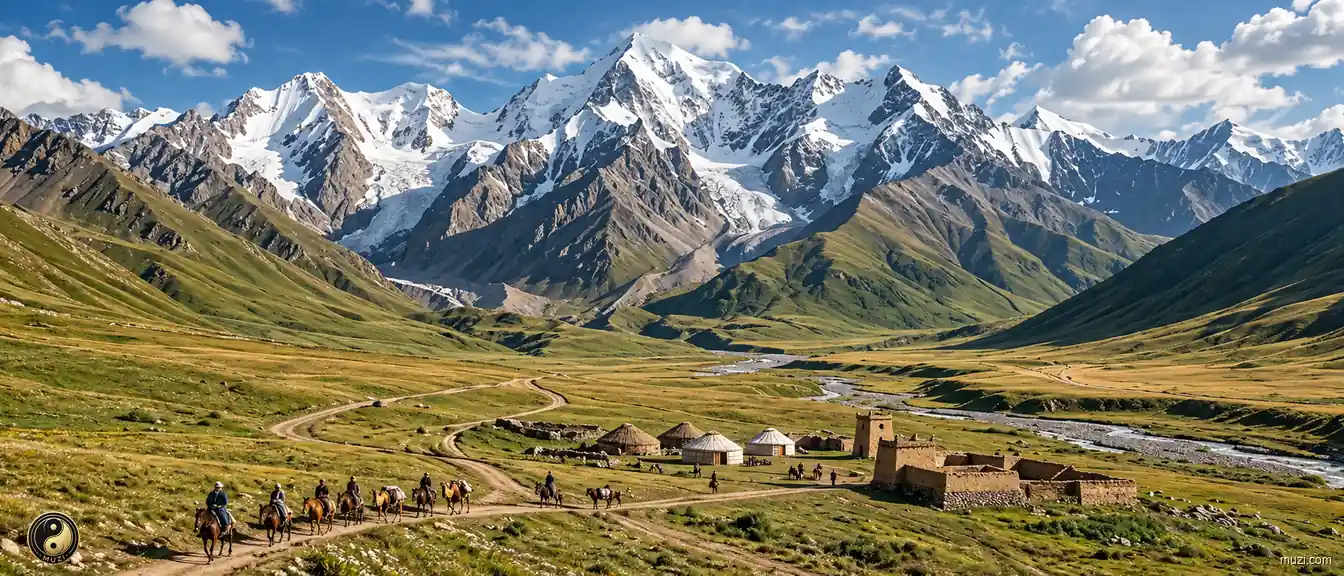
Mounted travelers follow the valley trail past round yurts and a stone settlement beneath a small tower, with the snowbound Qilian range rising above the braided stream.
Temple1

- Mount Zhuo'er Qilian National Park Viewpoint
Known as the Little Switzerland of the East, Zhuo'er Mountain weaves red sandstone, alpine meadows and the snowy Amidongsuo peak into one ecological window.
Vista1

- Shandan Imperial Horse Pasture in Zhangye
Horses have galloped at Shandan for some two thousand years since the Western Han, making it one of the world's oldest and largest imperial cavalry pastures.
Natural Wonder2

- Menyuan Rapeseed Flower Sea & Gangshika Peak
Golden rapeseed fields fill a Qilian Mountain basin at Menyuan, framed by the ever-snowy Gangshika Peak in a striking farmland spectacle.
- Babao River Valley Conifer Forest in Qilian
Dense Qinghai spruce cloaks the Babao River valley, the core water-conserving forest of the upper Heihe, holding alpine snowmelt in the Qilian range.
In its history3
- Xiao Yan464–549 CE
Part of Qilian Mountains's history: Buddhism Spreading East. Founder of the Liang who reigned for nearly fifty years, four times gave himself to the Tongtai monastery, and died confined in Jiankang after Hou Jing's rebels took the palace city
- Kasyapa Matanga1–73 CE
Part of Qilian Mountains's history: Buddhism Spreading East. Eminent Indian Buddhist master who arrived at Luoyang upon Emperor Ming's invitation, co-founding White Horse Temple.
- Dharmaratna1–75 CE
Part of Qilian Mountains's history: Buddhism Spreading East. Indian Buddhist monk who accompanied Kasyapa Matanga to Luoyang and co-translated the Sutra of Forty-two Chapters.
Han1

- Huo Qubing's Shandan Horse Field121 BCE
In 121 BCE, after defeating the Xiongnu, Huo Qubing garrisoned the Shandan area, leaving a Han frontier horse-management tradition.
Jin2

- Buddhism Spreading East
Buddhist monks and texts reached Han lands through Central Asia; translation and monasteries gradually embedded the new religion in local society.
- Faxian Begins His Westward Journey399 CE
In 399, the monk Faxian left Chang'an and traveled through the Hexi Corridor and the Western Regions toward India in search of Buddhist law.