
 Atlas
Atlas






















 Lop Nur
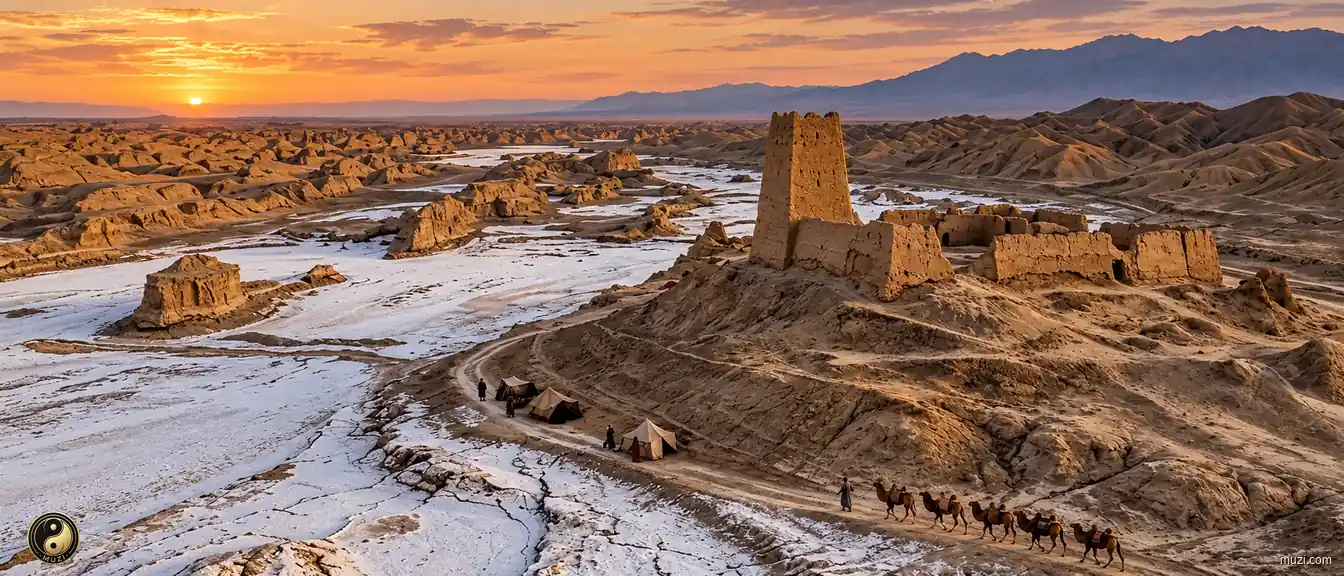
The burial ground of the Loulan Kingdom — a once-vast lake desiccated entirely into a giant ear-shaped salt crust, sealing and encrypting a thousand years of Silk Road exploration memory.
 Prefecture: Turpan
 Province: Xinjiang
A camel caravan follows the track past tents and an earthen watchtower, crossing Lop Nur’s pale salt channels beneath distant mountains at dusk.
Archaeology1

- Loulan Three-Room Site & Stupa
Loulan, capital of one of the thirty-six Western Regions kingdoms, left these earthen office ruins and an old stupa in the Lop desert before mysteriously vanishing.
Natural Wonder1
- Lop Nur Ear-of-the-Earth Salt Crust Core
Seen from satellites, the Ear of the Earth at Lop Nur is a stunning ring of dried salt crust left behind in the desert.
Memorial1

- Xiaohe Bronze Age Cemetery Site
Nearly four thousand years old, the Xiaohe cemetery holds boat-shaped coffins marked by wooden posts in the desert and yielded the famed Xiaohe Princess mummy.
Han1

- Han Renames Loulan as Shanshan77 BCE
In 77 BCE, Fu Jiezi killed the Loulan king, after which Han authorities installed Weituqi and renamed the kingdom Shanshan.
Qing1

- Sven Hedin Discovers Loulan in 19001900 CE
In March 1900, Sven Hedin discovered the ruins of the ancient Loulan city while surveying Lop Nur.