
 Atlas
Atlas

















 Hulunbuir
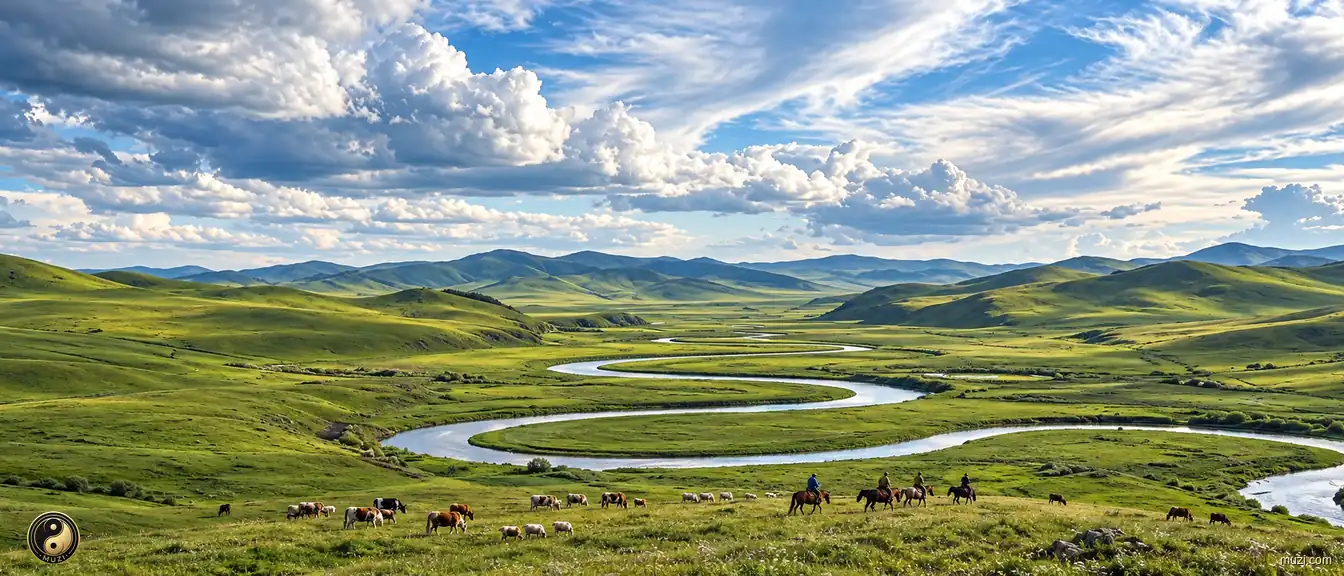
Hulunbuir's broad natural grasslands supported pastoral life and supplied horses and livestock beyond the Great Wall.
 Prefecture: Hulunbuir
 Province: Inner Mongolia
Riders guide grazing livestock across Hulunbuir grassland beside broad river bends beneath expansive clouds.
Vista3

- Morgle River in Hulunbuir
Praised by the writer Lao She as the most winding river under heaven, the Morgle meanders like a silver ribbon across the vast Hulunbuir grassland.
- Ergune National Wetland Reserve
Where the Gen and Ergune rivers meet, this reserve protects one of Asia's largest and most intact riverine shrub wetlands.
- Hulun Lake & Buir Lake Aquatic Eco-Zone
Called a lake as vast as the sea, Hulun Lake ranks among northern China's biggest and offers a vital stopover for grassland waterbirds and migrating flocks.
Gate & Wall1

- Manzhouli China-Russia Border Gate
Manzhouli's gate marks one of China's biggest land ports, standing on the China-Russia railway at a key junction of the Eurasian land bridge.
In its history1
- Temujin1162–1227 CE (birth by other accounts 1155 or 1167)
Part of Hulunbuir's history: Rise of Genghis Khan. Founder of the Mongol empire, proclaimed Chinggis Khan at the source of the Onon in 1206, who made war on the Jin and Khwarazm and died during his last campaign against Western Xia
Yuan2

- Temujin Wins at the Teni River1201 CE
In 1201 CE, Temujin defeated a tribal coalition led by Jamukha at the Teni River, a tributary of the Hailar.
- Rise of Genghis Khan
Temujin united the Mongol Plateau tribes and was proclaimed Genghis Khan at a kurultai, founding the Mongol Empire and launching its expansion.

Qing1

- Butha Banners Move to Hulunbuir1732 CE
In 1732, the Qing organized Daur and Ewenk communities in Butha into the Butha Eight Banners and moved some troops and families to garrison Hulunbuir.