 Atlas
Atlas


























 Greater Khingan Range
The steep ecological fault where taiga forest transitions abruptly to arid Mongolian steppe — the evolutionary cradle from which northern nomadic, hunting, and fishing peoples emerged from the forest onto the grassland to begin their conquest of the Central Plains.
 Province: Inner Mongolia
 Province: Heilongjiang
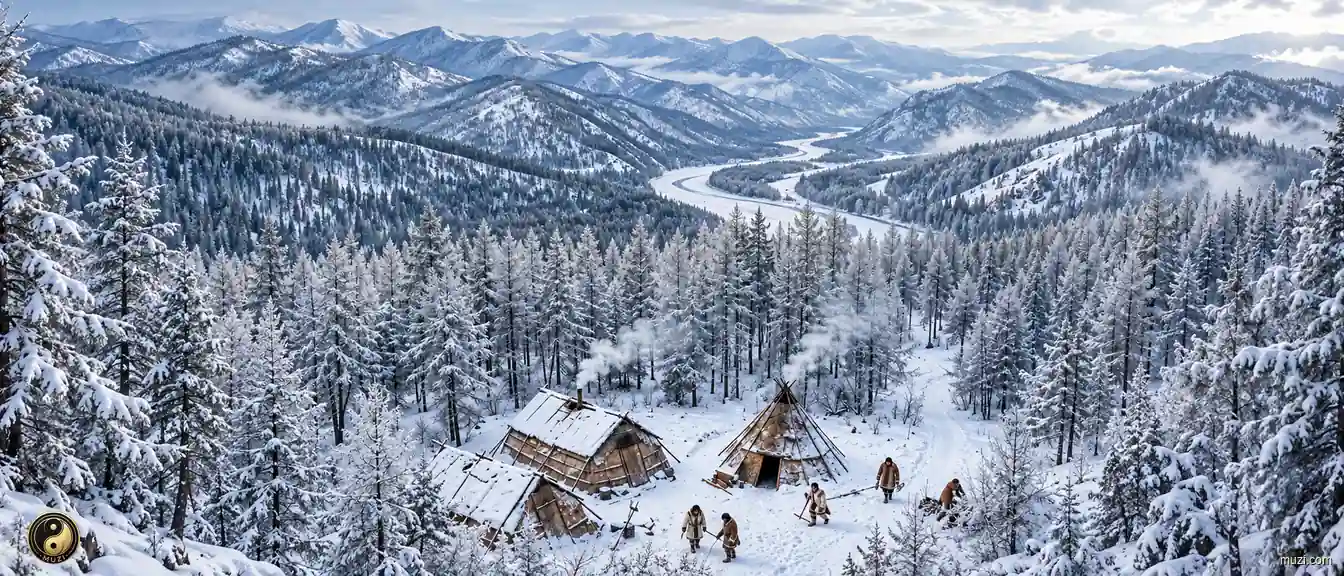
Snow settles across the Greater Khingan taiga, surrounding timber dwellings and conical shelters as people move through a clearing beside the winding river.
Temple1

- Gaxian Cave Xianbei Ancestral Shrine
A stone-carved prayer text dated to the Northern Wei in 443 marks Gaxian Cave, ancestral home of the Tuoba Xianbei before they left the forests for the Central Plains.
Memorial1

- Mohe Arctic Village China-Russia Border Post
Billed as the northernmost sentry post in China, this Arctic Village outpost watches over boundary river markers and offers views of auroras and midsummer white nights.
Residence1

- Genhe Aoluguya Ewenki Reindeer Village
Often called China's last reindeer-herding community, Aoluguya preserves the ancient taiga culture of Ewenki hunters living alongside their reindeer.
Natural Wonder1

- Mo'erdaoga National Forest Park Taiga
Paired in a popular saying with Xishuangbanna in the south, Mo'erdaoga protects a vast primeval larch forest at the ecological heart of the Greater Khingan.
In its history1
- Kangxi Emperor1654–1722 CE
Part of Greater Khingan Range's history: Treaty of Nerchinsk. Qing emperor of the Kangxi reign who put down the Three Feudatories, annexed Taiwan, signed the Treaty of Nerchinsk with Russia and led campaigns against Galdan
Northern and Southern1

- Northern Wei Inscription at Gaxian Cave443 CE
In 443 CE, the Northern Wei sent Li Chang to Gaxian Cave to perform an ancestral rite and inscribe a commemorative text.
Qing2

- Kangxi-Era Post Route to Heilongjiang Established1683–1684 CE
From 1683 to 1684, the post route from Jilin Ula to Heilongjiang City was surveyed and completed under a Kangxi edict.
- Treaty of Nerchinsk
Qing and Russian envoys at Nerchinsk delimited their eastern frontier and set trade arrangements in their first formal boundary treaty.