 Atlas
Atlas


























 Junggar Basin
A semi-enclosed basin pinched between the Altai and Tianshan ranges — with lush pastures and a strategic position, the core base of successive nomadic empires.
 Prefecture: Karamay
 Province: Xinjiang
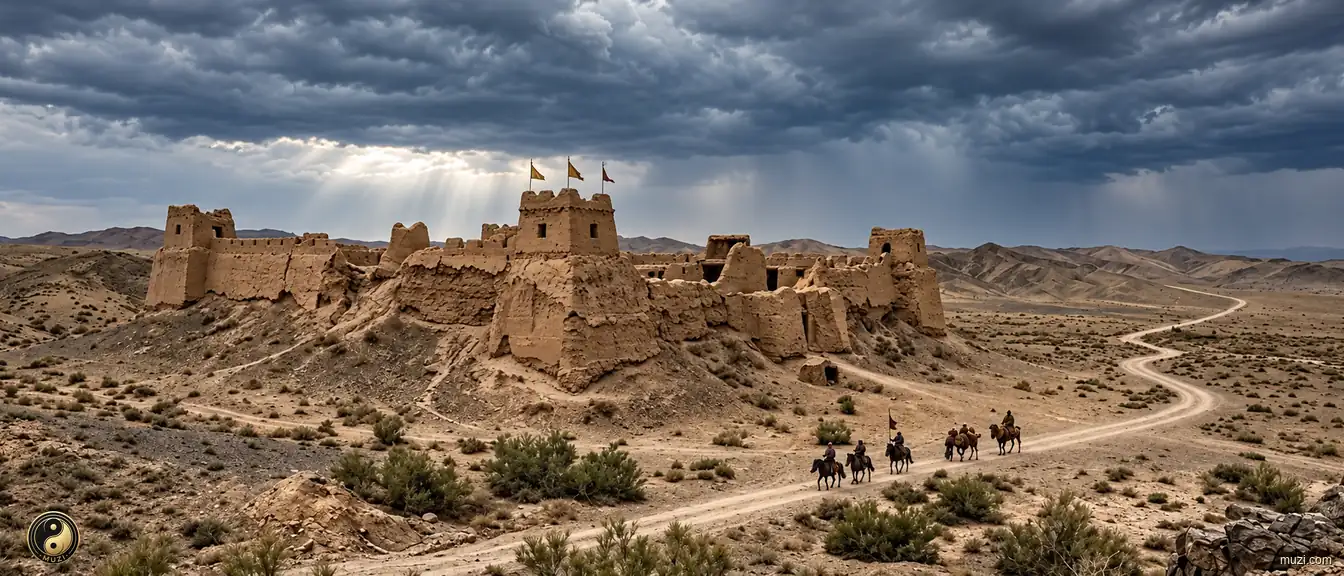
A small party of mounted riders follows the track below a rammed-earth fort, whose plain flags rise over the arid Junggar Basin.
Natural Wonder4

- Dushanzi Grand Canyon in Karamay
Meltwater from Tianshan snow has sliced this deep, dramatic canyon from soft clay, a spectacular sight at the northern end of the Duku Highway.
- Urho World Ghost City Yardang Landform
Wind-scoured yardang buttes resembling castles stand on the northwestern edge of the Junggar Basin, a howling desert realm known as Ghost City.
- Ailik Lake Ancient Wetland in Urho
A pristine desert oasis lake nourished by the Baiyang River, home to reed wetlands and migrant swans.
- Wulungu Lake Coastal Wetland Reserve
Dubbed the sea of the northern Junggar, Wulungu Lake supports Fuhai's winter ice fishing and a desert wetland where waterbirds breed.
In its history1
- Qianlong Emperor1711–1799 CE
Part of Junggar Basin's history: Pacification of Dzungar. Sixth Qing emperor, of the Qianlong reign, who conquered the Dzungars and the Tarim oases, commissioned the Complete Library of the Four Treasuries, and abdicated after sixty years
Qing2

- Kangxi Leads the 1696 Zhaomoduo Campaign1696 CE
In 1696, the Kangxi emperor led Qing forces in a decisive engagement with Galdan's army at Zhaomoduo.
- Pacification of Dzungar
Qing armies defeated the Dzungar Khanate and incorporated Ili and the Tarim region into new military and administrative frontier systems.