
 Atlas
Atlas


























 Mount Yandang
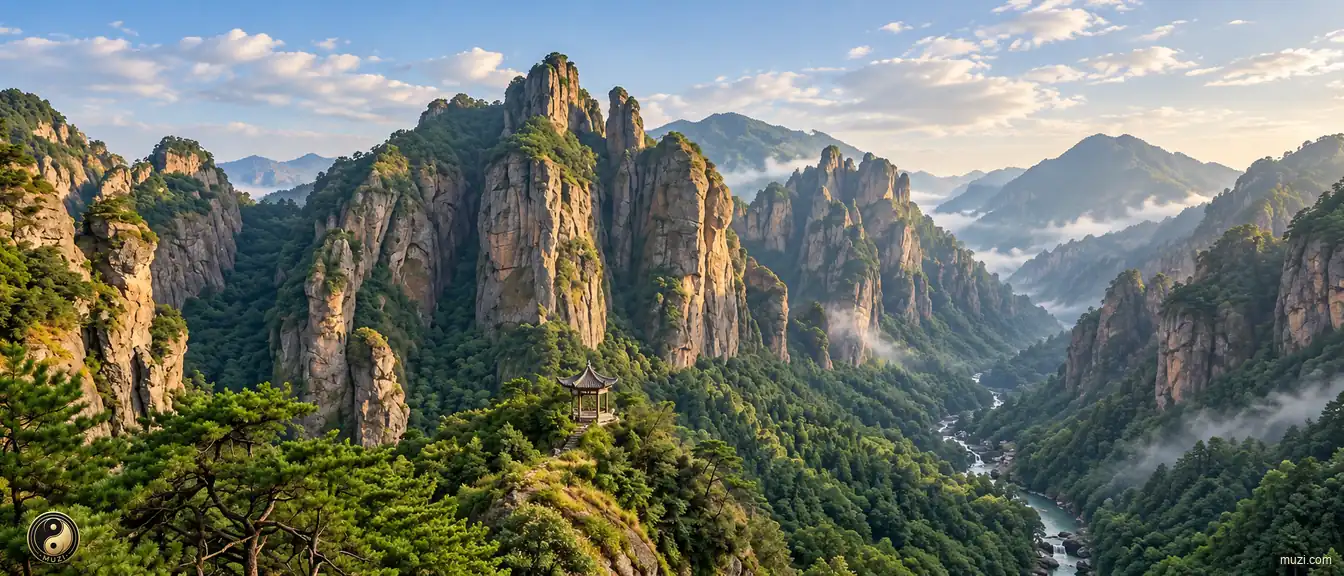
The premier mountain of the southeast — its rhyolite cliffs cut like knife and axe, breaking Jiangnan's gentle aesthetics with hard geometric lines.
 Prefecture: Taizhou
 Province: Zhejiang
Mount Yandang's angular rock towers rise above a wooded gorge in warm light, with a small pavilion on a forested spur and a stream winding through the misty valley.
Vista4

- Lingfeng Peak Night Vista
Famed for its optical silhouette transformations at twilight into lovers, eagles, and mythic beasts.
- Dalongqiu Waterfall
A 197-meter uninterrupted single-drop waterfall cascading from sheer volcanic rhyolite cliffs.
- Xiansheng Gate Gorge
A colossal stone gate formed by two 200-meter cliffs standing just a few meters apart.
- Sanzhe Waterfall
A multi-tiered cascade where river water plunges through three successive subterranean amphitheaters.
Bridge1

- Yandang Mountain Lingyan Flying Traverse
Traditional aerial acrobats crossing ropeways between massive 250m peaks over ancient Lingyan Temple.
Infrastructure1

- Fangdong Cliff Walk
A suspended walkway and sky bridge chiseled along halfway up sheer vertical volcanic cliffs.
Depicts1
- Brush Talks from Dream Brook: The Yandang MountainsClassical ProseShen Kuo
Wondrous peaks carved by water: Shen Kuo explains Yandang by erosion.
Authors1
- Shen Kuo1031–1095 CE (by another account 1032–1096)
Wrote of Mount Yandang in “Brush Talks from Dream Brook: The Yandang Mountains”. Northern Song official and polymath who reformed the astronomical bureau, negotiated borders with the Liao and wrote the Brush Talks from Dream Brook
Song1

- Shen Kuo Examines Yandang's Landforms1073–1074 CE
During his 1073–74 inspection of Liangzhe, Shen Kuo examined Yandang and explained its peaks and valleys through erosion by powerful water flow.
Ming1

- Xu Xiake Visits Yandang Three TimesMing Dynasty (1613-1632 CE)
Xu Xiake first visited Yandang in 1613 and returned twice, in March and April 1632, investigating Dalongqiu, Yan Lake, and the mountain's waterways.
Sui1

- The Norjuna Tradition at Yandang SanctuaryTang-period tradition, 618–907 CE
Yandang tradition identifies the mountain with Norjuna's meditation, a sanctuary memory carried by Tang poetry and later religious histories.