
 Atlas
Atlas




























 Yellow Mountain
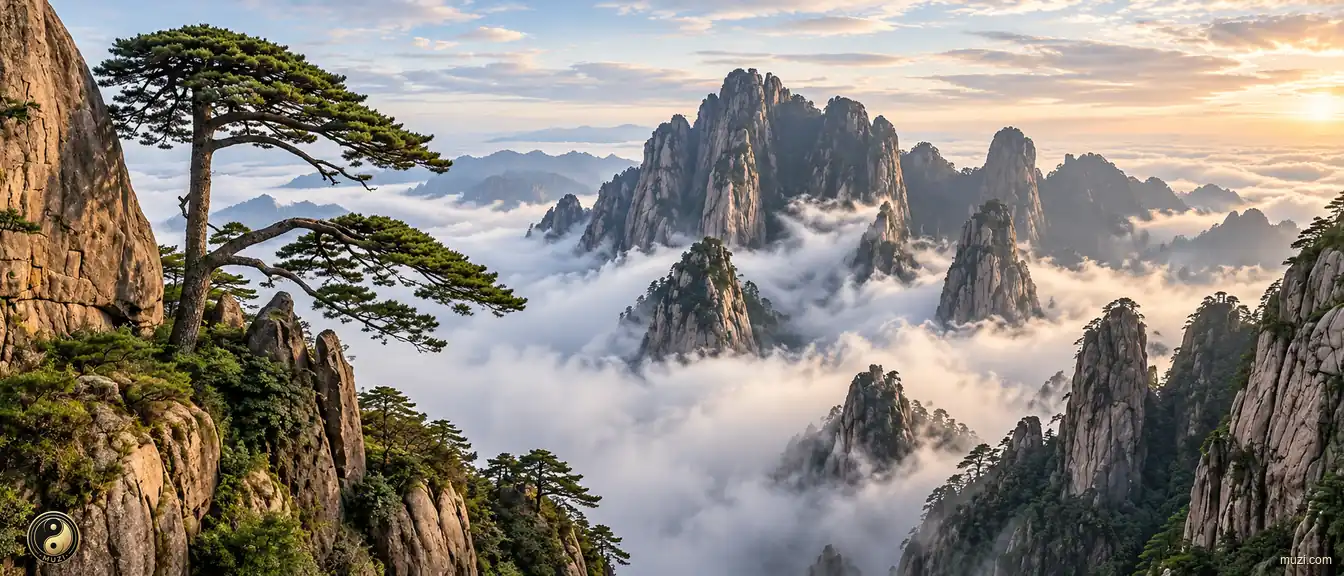
Famed for its peculiar pines, grotesque rocks, sea of clouds, and hot springs — the aesthetic matrix and inspiration wellspring of Chinese landscape painting.
 Prefecture: Huangshan
 Province: Anhui
A wind-shaped pine clings to Huangshan's granite cliffs above a sea of clouds, while jagged peaks emerge through the warm dawn haze.
Vista6

- Huangshan Guest-Greeting Pine
An ancient pine thriving upon granite crags, welcoming visitors worldwide as an enduring emblem of Chinese hospitality.
- Guangming Top Peak
The second highest summit of Mount Huang (1860m), offering panoramic views of sunrises and seas of clouds.
- Lotus Peak Summit
The highest peak of Mount Huang (1864m), soaring into the clouds with majestic granite petals.
- Xihai Grand Canyon
A grand canyon with vertical granite cliffs, mist-shrouded gorges, and hanging cliff trails.
- Shixin Peak
Celebrated for the quote 'Only upon arriving do you believe in Huangshan's wonder', rich in iconic pines.
- Feilai Peak Stone
A 12-meter-high balancing rock standing atop a flat ledge, a marvel of natural weathering.
Natural Wonder1

- Tiandu Peak of Mount Huangshan
The steepest of Huangshan's three main summits at 1,810 m, reached by the Hundred-Zhang Ladder and the Carp's Back ridge, and climbed by Xu Xiake in his travel diary.
Depicts1
- The Travel Diaries of Xu Xiake: Second Journey to Mount Huang: Climbing TianduClassical ProseXu Xiake (Xu Hongzu)
Clutching grass and brambles up Tiandu, ten thousand peaks below and a sea of cloud rising and falling.
Authors1
- Xu Xiake1587–1641 CE
Wrote of Yellow Mountain in “The Travel Diaries of Xu Xiake: Second Journey to Mount Huang: Climbing Tiandu”. Late Ming traveller from Jiangyin whose daily journals of three decades on the road, above all in the karst southwest, became the Travel Diaries of Xu Xiake
Tang1

- Yishan Renamed Huangshan in TraditionTraditional dating: 747 CE
A local tradition dates Yishan's renaming as Huangshan to 747, while the Yellow Emperor alchemy story is not established by the standard histories.
Ming2

- Pumen Founds Fahai Convent1606 CE
In 1606, the monk Pumen came to Huangshan and founded Fahai Convent, later expanded by imperial order as Ciguang Temple.
- Xu Xiake's Two Journeys to HuangshanMing Dynasty (1616-1618 CE)
In 1616 and 1618, Xu Xiake made two journeys through Huangshan and recorded its routes, peaks, valleys, geology, water, and weather in his travel diaries.
Modern1
- Huangshan Inscribed as Mixed Heritage1990 CE
In 1990, Mount Huangshan was inscribed under cultural criterion (ii) and natural criteria (vii) and (x).