
 Atlas
Atlas



























 Changbai Mountain
The highest volcano in Northeast Asia — Heaven Lake resting quietly at the summit, one mountain straddling three nations, sacred to both Manchu and Korean peoples.
 Prefecture: Baishan
 Province: Jilin
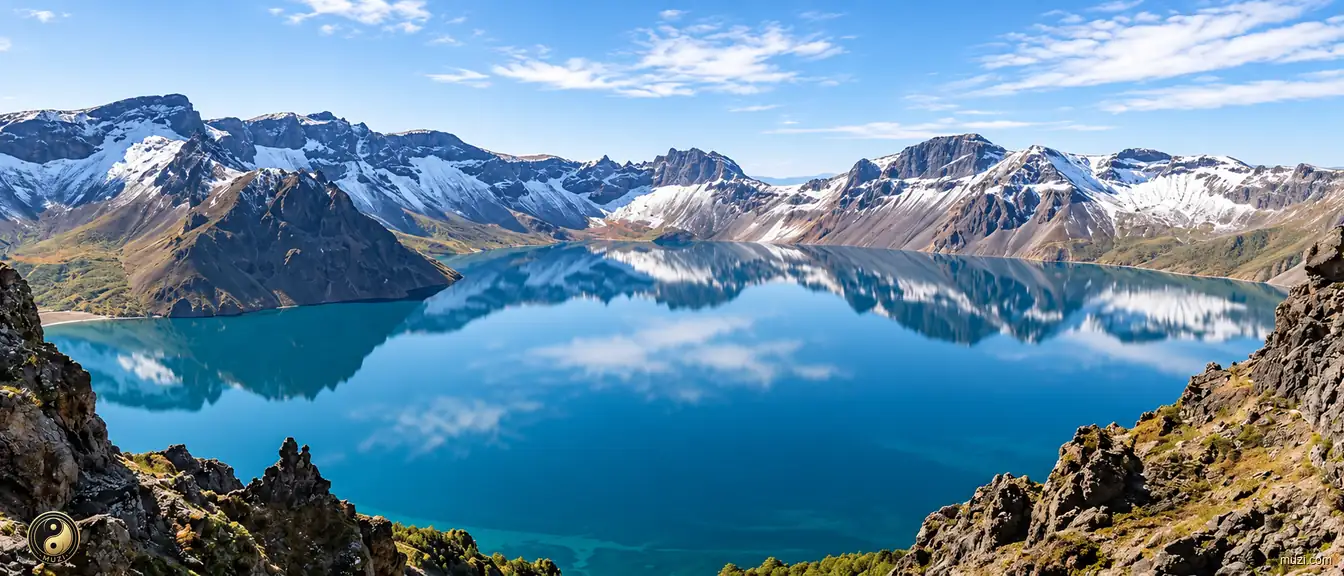
Changbai Mountain's blue Heaven Lake reflects a rugged volcanic crater rim streaked with snow, framed by rocky slopes and sparse alpine groundcover.
Vista6

- Changbai Mountain Tianchi Crater Lake
A majestic crater lake (2189m) encircled by 16 jagged volcanic peaks, deepest lake in China.
- Changbai Waterfall
A 68-meter thunderous waterfall flowing directly from Lake Tianchi, the cradle of the Songhua River.
- Julong Hot Springs
Volcanic geothermal springs steaming amidst snowy alpine slopes, rich in natural minerals.
- Changbai Underground Forest
A primeval forest flourishing deep inside a collapsed volcanic rift valley, ancient trees touching the sky.
- Lvyuantan Emerald Pool
A serene jade-colored pool fed by twin waterfalls amidst dense spruce and birch groves.
- Yalu River Grand Canyon
A 100-meter deep volcanic basalt canyon carved by the headwaters of the Yalu River.
Five Dynasties and Ten Kingdoms1

- The 946 Millennium Eruption of ChangbaishanLiao Dynasty (946 CE)
In late 946, Changbaishan–Tianchi produced a major explosive eruption whose tephra dispersed widely across Northeast Asia.
Song1

- Jin Enfeoffs Changbai as KingJin Dynasty (1172 CE)
In 1172, Jin emperor Shizong enfeoffed the deity of Mount Changbai as Xingguo Lingying King, ordered a temple north of the mountain, and instituted recurring state sacrifices.
Qing1

- Kangxi Institutes State Worship of ChangbaiQing Dynasty (1677 CE)
In 1677, the Kangxi emperor sent officials to survey Mount Changbai, then designated it a sacrificial mountain, established a restricted zone, and ordered spring and autumn rites.