 Atlas























 Guilin Landscape
Karst peaks and the Li River make Guilin a classic Chinese ink-wash landscape.
 Prefecture: Guilin
 Province: Guangxi
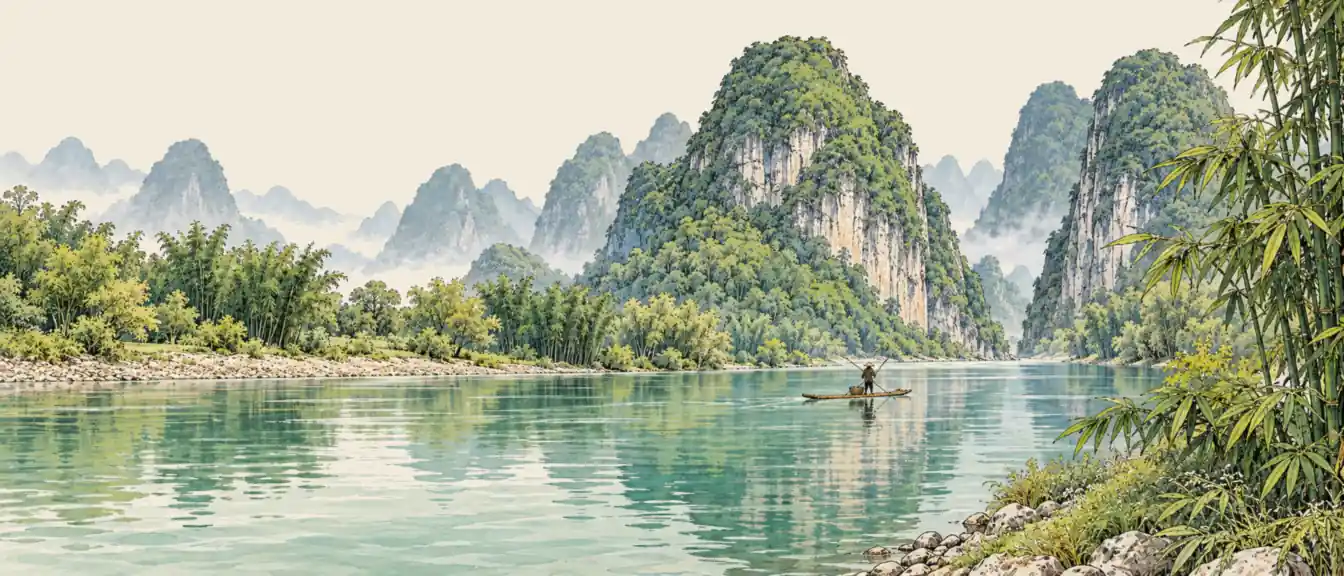
Jade-green river water lies mirror-calm, with one person on a small raft, bamboo groves on the banks, and steep tree-covered peaks standing one after another beyond.
Natural Wonder4
- Li River Yangdi-Xingping Scenic Course
The quintessential Karst river journey featuring Nine Horses Fresco Hill and Yellow Cloth Shoal.
- Moon Hill
Iconic karst peak crowned with a natural moon-shaped rock arch that shifts phases from different viewpoints.
- Yangshuo Yulong River
The tranquil Little Li River with bamboo rafting drifting past karst spires and pastoral villages.
- Reed Flute Cave
A spectacular Karst limestone cave filled with stalactites and crystal columns, illuminated like an underground palace.
Vista1

- Elephant Trunk Hill
The iconic city emblem of Guilin resembling a giant elephant dipping its trunk into the Li River.
Architecture1

- Jingjiang Princes' Palace
Grand Ming Dynasty princely palace situated beneath Solitary Beauty Peak in central Guilin.
Sculpture1

- Solitary Beauty Peak Inscriptions
Historic cliff inscriptions and Song scholar cave on Solitary Beauty Peak, source of the famous proverb.
Qin1

- Lingqu Canal and Lingnan CommanderiesQin Dynasty (214 BCE)
In 214 BCE, the Lingqu Canal directed by Supervisor Lu linked the Xiang and Li rivers to supply Qin forces; Qin then established Guilin, Nanhai, and Xiang commanderies in Lingnan.
Tang1

- Han Yu Depicts Guilin in VerseTang Dynasty (822 CE)
In 822, Han Yu wrote a farewell poem for Yan Mo on his appointment to govern Gui Prefecture, depicting its river as a green silk belt and its mountains as jade hairpins.
Song2

- Wang Zhenggong Inscribes the Guilin Landscape1201 CE
In 1201, Wang Zhenggong composed the line praising Guilin's landscape, which was preserved in an inscription at Duxiu Peak.
- Wang Zhenggong's Guilin Poem Inscription1201 CE
In 1201, Wang Zhenggong composed his Guilin poem while hosting successful examination candidates; its lines were later carved at Solitary Beauty Peak.
Modern Era2

- Landscapes Join the World Heritage List
Huangshan was inscribed on the World Heritage List in 1990, and by 2017 Mount Wutai, Longhushan, Xinjiang Tianshan, Guilin, Shennongjia, Hoh Xil and other Chinese mountain and landscape sites had followed.
- Guilin Karst Inscribed on UNESCO List2014 CE
In 2014, the World Heritage Committee approved the Phase II extension that added Guilin's tower- and cone-karst landscapes to the South China Karst property.