
 Atlas
Atlas


























 Mount Lu
A cultural mountain of matchless beauty — waterfalls, drifting clouds, swirling mist, where four thousand poems and essays were left by generations of literati.
 Prefecture: Jiujiang
 Province: Jiangxi
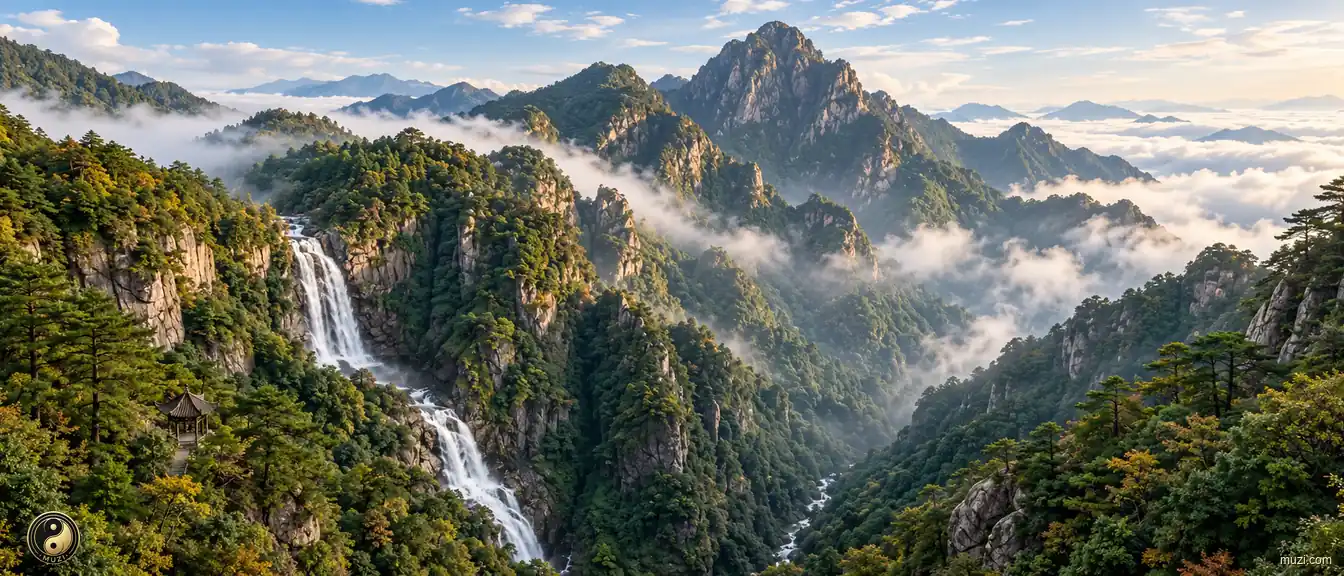
Mount Lu's white cascades descend through wooded cliffs beside a small pavilion, while rugged ridges rise above drifting clouds and a deep forested gorge.
Vista4

- Hanpokou Pass
A majestic ridge pass offering views over the vast expanse of Poyang Lake and the sunrise horizon.
- Sandie Waterfall
A spectacular three-tiered cascade dropping 215 meters below the Five Old Men Peaks.
- Meilu Villa
A distinguished stone estate that hosted both Chiang Kai-shek and Mao Zedong during critical historic summits.
- Xiufeng Scenic Area of Mount Lu
Ringed by Xianglu, Shuangjian and other peaks on Mount Lu's southern flank, Xiufeng holds the Kaixian falls, whose western cascade is generally taken as the one in Li Bai's poem.
Civic Building1

- Bailudong Academy
The premier of China's Four Great Academies, where Zhu Xi codified classical Neo-Confucian education rules.
Gate & Wall1

- Lushan Guling Historic Town & Modern Villas
A mountain town perched at 1100m, home to over 600 historic stone villas built in diverse global architectural styles.
Residence1

- Lushan Huajing Park & Bai Juyi Cottage
The tranquil park where Tang poet Bai Juyi composed his famous verses on late-blooming mountain peach blossoms.
Temple1

- Xilin Temple of Mount Lu
Founded in 377 for the monk Huiyong a few hundred paces west of Donglin Temple, it keeps a Tang brick pagoda, and its wall bore Su Shi's famous quatrain.
Depicts1
- Written on the Wall of Xilin TempleClassical PoetrySu Shi
I cannot know the true face of Mount Lu, only because I myself am within this mountain.
On its attractions1
- Viewing the Waterfall at Mount Lu, No. 2Classical PoetryXiufeng Scenic Area of Mount LuLi Bai
Its flying torrent plunges straight down three thousand feet; I wonder if the Milky Way is falling from the ninth heaven.
Authors2
- Su Shi (Su Dongpo)1037–1101 CE
Wrote of Mount Lu in “Written on the Wall of Xilin Temple”. Northern Song writer, calligrapher and official, exiled to Huangzhou after the Crow Terrace poetry trial and later to Huizhou and Hainan
- Li Bai701–762 CE
Wrote of Xiufeng Scenic Area of Mount Lu in “Viewing the Waterfall at Mount Lu, No. 2”. High Tang poet who served briefly in the Hanlin Academy, was banished to Yelang for joining Prince Yong, and was hailed by He Zhizhang as a banished immortal
In its history5
- Xiao Yan464–549 CE
Part of Mount Lu's history: Buddhism Spreading East. Founder of the Liang who reigned for nearly fifty years, four times gave himself to the Tongtai monastery, and died confined in Jiankang after Hou Jing's rebels took the palace city
- Kasyapa Matanga1–73 CE
Part of Mount Lu's history: Buddhism Spreading East. Eminent Indian Buddhist master who arrived at Luoyang upon Emperor Ming's invitation, co-founding White Horse Temple.
- Dharmaratna1–75 CE
Part of Mount Lu's history: Buddhism Spreading East. Indian Buddhist monk who accompanied Kasyapa Matanga to Luoyang and co-translated the Sutra of Forty-two Chapters.
- Zhu Xi1130–1200 CE
Part of Mount Lu's history: Zhu Xi's Neo-Confucianism. Southern Song Neo-Confucian whose Collected Commentaries on the Four Books became the set text of the civil examinations from the Yuan onward
- Lu Jiuyuan1139–1193 CE
Part of Mount Lu's history: Zhu Xi's Neo-Confucianism. Southern Song Confucian teacher known as Master Xiangshan, who held that the mind is principle and argued with Zhu Xi at Goose Lake in 1175
Jin2

- Buddhism Spreading East
Buddhist monks and texts reached Han lands through Central Asia; translation and monasteries gradually embedded the new religion in local society.
- Huiyuan Forms the White Lotus Society402 CE
In 402, Huiyuan and fellow practitioners formed a devotional society at Donglin Temple on Mount Lu, later remembered as the White Lotus Society and an early Pure Land tradition.

Tang2

- Bai Juyi's Peach Blossoms at DalinTang Dynasty (817 CE)
In the fourth month of 817, Jiangzhou vice-prefect Bai Juyi visited Dalin Temple on Mount Lu and wrote Peach Blossoms at Dalin Temple after finding the mountain blossoms in bloom.
- Li Bai's Lushan Waterfall PoemTang dynasty
Li Bai's View of Lushan Waterfall made the falls at Incense Burner Peak part of a renowned Tang poem and Lushan's literary memory.
Song2

- Zhu Xi's Neo-Confucianism
The official ideology that shaped East Asian intellectual elite's spiritual world for seven centuries.
- Zhu Xi Restores Bailudong AcademySouthern Song (1179 CE)
In 1179, while governing Nankang, Zhu Xi restored Bailudong Academy, appointed teachers, endowed fields, and formulated the Bailudong Academy Precepts.

Qing1

- Guling Summer Resort Opens in 18951895 CE
In 1895, Li Deli began developing villas on Lushan's Guling, establishing the resort's documented modern development.
Modern1
- Mount Lushan Inscribed on UNESCO List1996 CE
In 1996, Lushan National Park was inscribed as a cultural landscape shaped by the long interaction of scenery, religion, education, and art.