
 Atlas
Atlas




















 Mount Hua
The most precipitous mountain under heaven — a single knife-edged ridge, one path up since antiquity, daring climbers to this day.
 Prefecture: Weinan
 Province: Shaanxi
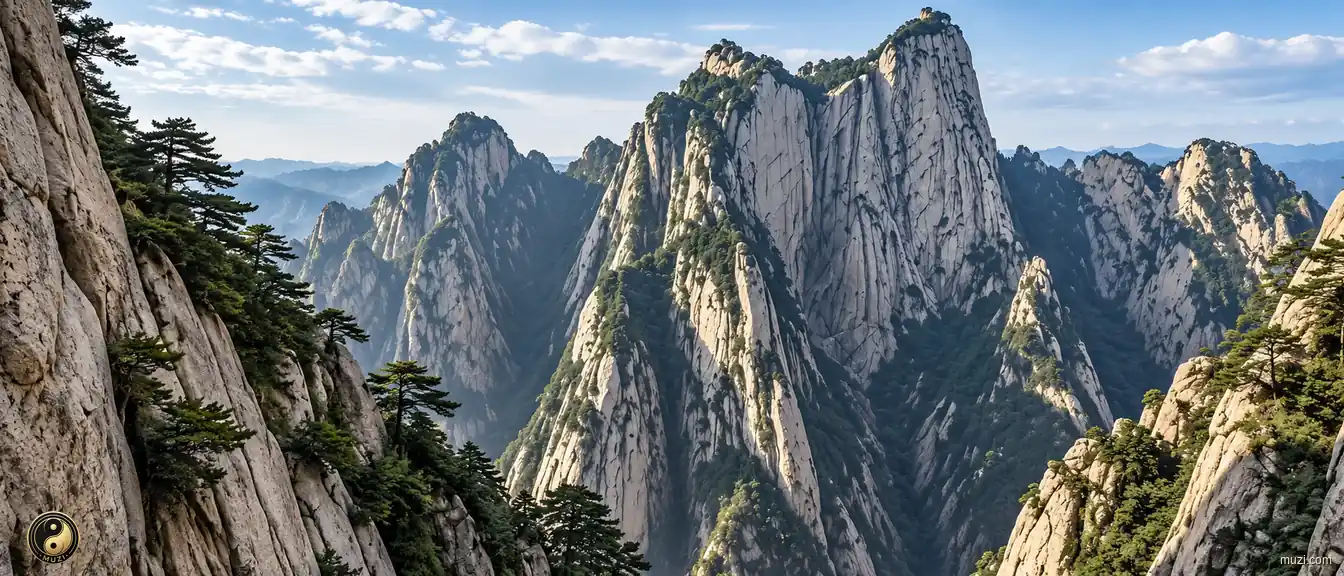
Mount Hua's sheer granite walls and narrow ridgelines rise above a deep chasm, with sparse pines rooted in the rocky ledges.
Vista3

- West Peak Lotus Summit
The West Peak (2082m) with colossal monolithic cliffs, famed for the legend of Chenxiang splitting the mountain.
- South Peak Luoyan Summit
The highest summit of Mount Hua and the Five Great Mountains (2154.9m), commanding vast vistas.
- East Peak Zhaoyang Summit
East Peak (2096m), the premier spot for viewing sunrise over the Yellow River and Guanzhong plain.
Infrastructure1
- Changkong Plank Walk
A narrow plank path bolted into sheer vertical granite cliffs, built by Yuan dynasty Daoist masters.
Temple2

- Xiyue Temple of Mount Hua
The imperial state temple for worshiping the West Mountain deity, nicknamed the Forbidden City of Shaanxi.
- Yuquan Courtyard
Ancestral temple of the Huashan Daoist sect founded in honor of Chen Tuan, entrance to Mount Hua trail.
Han1

- Han Wudi Establishes Jiling Palace134 BCE
In 134 BCE, Emperor Wu of Han established Jiling Palace at the foot of Mount Hua, the predecessor of the later Xiyue Temple.
Song1

- Chen Tuan's Huashan RetreatNorthern Song, 960–989 CE
Around 960–989, Chen Tuan lived in retreat at Huashan, studied the Changes, and developed writings that influenced later Song intellectual history.
Yuan1

- He Zhizhen Opens Changkong Plank RoadEarly Yuan, c. 1276–1300 CE
Local Huashan tradition attributes the opening of the Changkong Plank Road and He Lao's Stone Chamber to the early-Yuan Quanzhen Daoist He Zhizhen.