 Atlas
Atlas






















 Luoyang Ancient City
Luoyang, Center of All Under Heaven — the survey benchmark established at the Gaocheng Observatory, capital of thirteen dynasties, the orthodox capital coordinate every emperor dreamed of anchoring legitimacy to.
 Prefecture: Luoyang
 Province: Henan
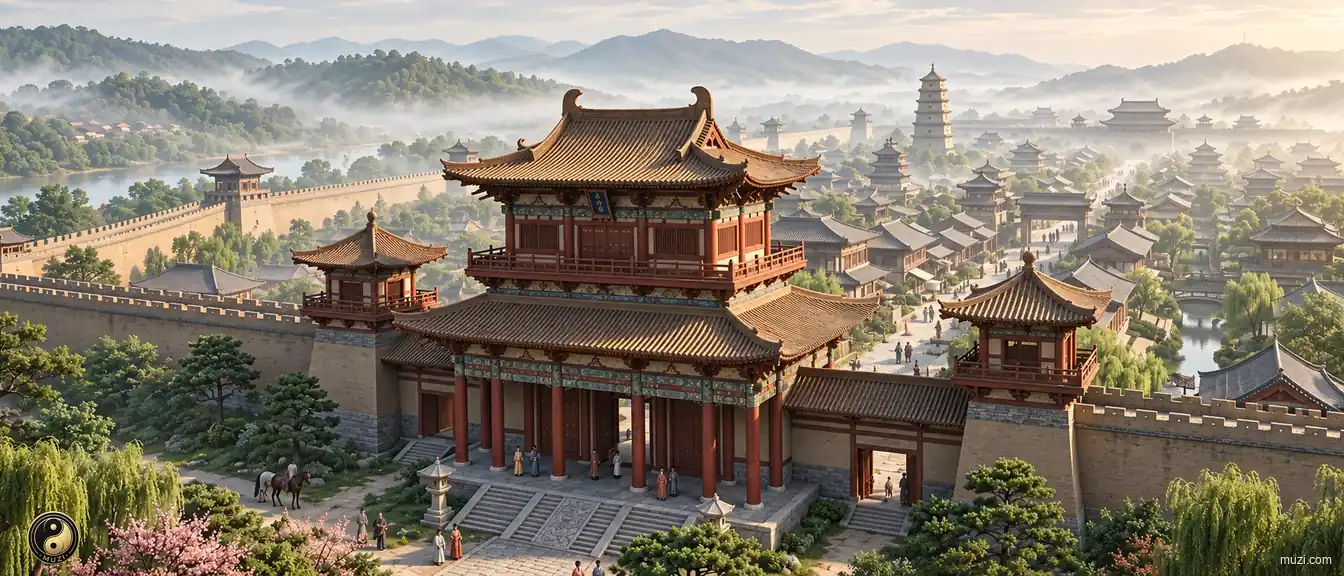
Visitors and a horse gather before Luoyang’s Tang-style gate, whose red pillars and sweeping roofs rise through morning mist.
Archaeology2

- Sui-Tang Luoyang Yingtianmen Palace Gate Site
Yingtianmen, the grand southern gate of Luoyang's imperial city where Wu Zetian proclaimed her reign, has paired towers and is hailed as the foremost gate of the Sui and Tang.
- Mingtang & Tiantang Site in Sui-Tang Luoyang
Here stood the Mingtang, Wu Zetian's central Hall of All Phenomena, and the Tiantang, which housed a towering Buddha, together revealing the grandeur of her Zhou dynasty.
Gate & Wall1

- Lijing Gate & West Street in Old Luoyang
A local saying holds that no visit to Luoyang is complete without Lijing Gate, a towered west gate of the old city surrounded by water-banquet cuisine and bluestone streets.
Temple1

- White Horse Temple & Qiyun Pagoda in Luoyang
Founded by Emperor Ming of Han in 68 AD as China's earliest state-built Buddhist temple, the White Horse Temple combines Chinese, Indian, Thai and Burmese halls.
On its attractions1
- Rhapsody on the Bright Hall · ExcerptRhapsody & Parallel ProseMingtang & Tiantang Site in Sui-Tang LuoyangLi Bai
Lofty and vaulted is the Bright Hall, opening against the sky. Its four gates open and ten thousand nations come; it examines auspicious signs and brings forward worthy men. Majestic, the imperial abode stands firm for a thousand ages!
Authors1
- Li Bai701–762 CE
Wrote of Mingtang & Tiantang Site in Sui-Tang Luoyang in “Rhapsody on the Bright Hall · Excerpt”. High Tang poet who served briefly in the Hanlin Academy, was banished to Yelang for joining Prince Yong, and was hailed by He Zhizhang as a banished immortal
In its history3
- Wu Zetian (Empress Wu)624–705 CE
Part of Luoyang Ancient City's history: Wu Zetian's Reign. Consort of Emperor Gaozong who governed first as empress dowager and then, from 690 until her forced abdication in 705, as emperor of her own Zhou dynasty
- Di Renjie630–700 CE
Part of Luoyang Ancient City's history: Wu Zetian's Reign. Chief minister under Empress Wu who cleared a vast backlog of court cases, survived Lai Junchen's frame-up, and persuaded her to recall Li Xian as heir
- Li Zhi628–683 CE
Part of Luoyang Ancient City's history: Wu Zetian's Reign. Third Tang emperor, Gaozong, who issued the annotated Tang Code, made Wu Zhao his empress, and destroyed Baekje and Goguryeo
Han1

- White Horse Temple Founded at Luoyang68 CE
In 68 CE, the Han court ordered White Horse Temple built at Luoyang; the mission, horse-borne scriptures, and dream are presented as transmitted historical tradition.
Tang2

- Wu Zetian's Reign
Wu Zetian proclaimed her Zhou dynasty, expanded examination recruitment, and promoted officials beyond the established aristocratic families.
- Wu Zetian Founds Wu Zhou690 CE
In 690 Wu Zetian ended the Tang mandate at Luoyang, the Divine Capital, renamed the state Zhou and took the title Sage and Divine Emperor; in 688 she had already built the Mingtang on the site of the palace's Qianyuan Hall.