
 Atlas
Atlas























 Beijing Central Axis
A north–south urban axis through Beijing's historic heart, uniting 15 heritage components and a capital-planning tradition rooted in the Yuan founding of Dadu.
 Prefecture: Dongcheng
 Province: Beijing
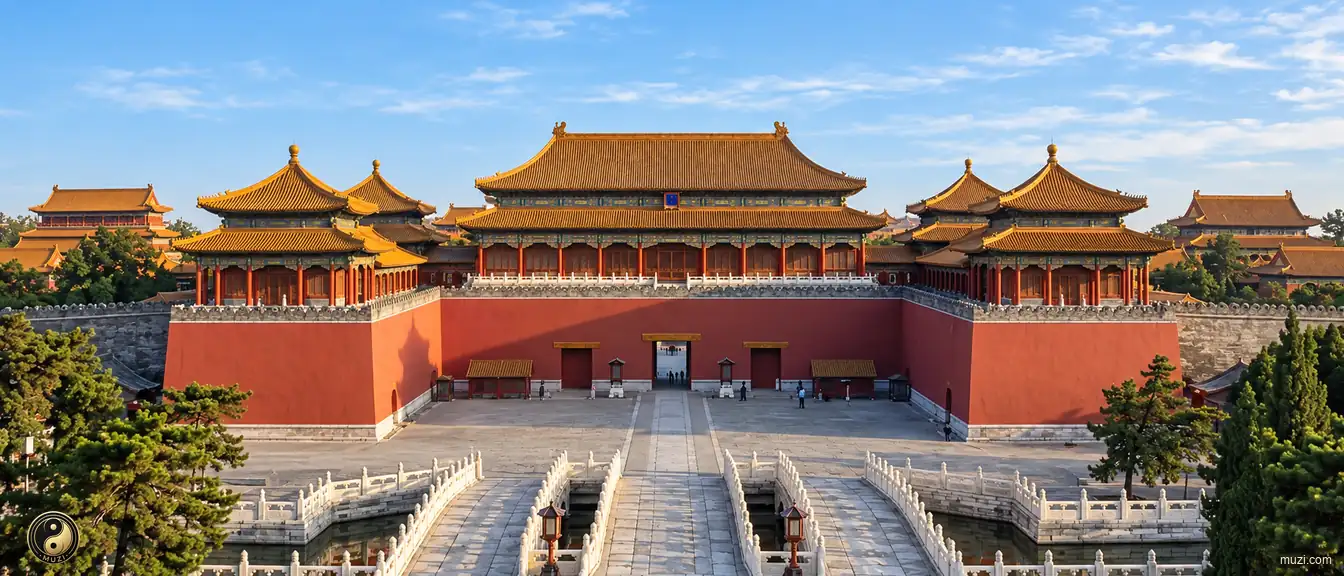
A few visitors cross the stone forecourt before Meridian Gate, centered between Beijing’s red walls and golden roofs.
Gate & Wall5

- Yongdingmen Gate
The reconstructed Ming outer-city gate marks the southern start of the Central Axis.
- Zhengyangmen Gate
The southern city gate connects the Central Axis with Beijing's civic and commercial spaces.
- Tiananmen Square
The square and its buildings show the Central Axis changing from an imperial ceremonial space into a modern national civic space.
- Tiananmen
Tiananmen is a national ceremonial and civic landmark on Beijing's Central Axis.
- Duanmen Gate
The gate connects Tiananmen with the Forbidden City within the ceremonial progression of the imperial precinct.
Architecture1
- Southern Central Axis Road Remains
Road remains preserve the southern axis alignment and evidence of historic urban engineering.
Temple5

- Xiannongtan
Xiannongtan links imperial agricultural rites with the southern section of Beijing's ceremonial axis.
- Temple of Heaven
The Ming imperial sacrificial complex, renewed in the Qing, anchors the southern ceremonial sequence.
- Altar of Land and Grain
The altar embodies state ritual traditions while its public-park setting carries that memory into modern civic life.
- Imperial Ancestral Temple
The temple preserves Ming–Qing imperial ancestral rites and later became a public cultural space.
- Forbidden City
The former imperial palace preserves the ordered palace-city sequence at the heart of the northern axis.
Bridge2

- Outer Golden Water Bridge
The bridge and watercourse organize the ceremonial forecourt of Tiananmen as a key transition in the axis sequence.
- Wanning Bridge
The bridge spans the Old Yu River and records the Yuan formation of Dadu's water system and northern axis.
Gardens1

- Jingshan
The artificial hill closes the palace-city landscape to the north and strengthens the axis's elevated view and balance.
Tower1

- Bell and Drum Towers
The paired towers mark the northern end of the axis and continue the city's historic timekeeping order.
In its history7
- Kublai Khan1215–1294 CE
Part of Beijing Central Axis's history: Establishment of Dadu. Grandson of Chinggis Khan who became Great Khan in 1260, named his dynasty Yuan in 1271 and completed the conquest of the Southern Song in 1279
- Liu Bingzhong1216–1274 CE
Part of Beijing Central Axis's history: Establishment of Dadu. Founding chancellor of the Yuan Dynasty who designed the imperial capitals (Daidu and Shangdu) and shaped the provincial administrative system.
- Zhu Di1360–1424 CE
Part of Beijing Central Axis's history: Yongle Capital Relocation. Fourth son of the Ming founder who seized the throne from his nephew in the Jingnan war, reigned as the Yongle Emperor and moved the capital to Beijing
- Kuai Xiang1398–1481 CE
Part of Beijing Central Axis's history: Yongle Capital Relocation. Ming carpenter from Xiangshan in Wu county who worked on the Beijing palaces, rebuilt the three great halls in 1440, and rose to vice minister of works
- Wu Zhong1373–1442 CE
Part of Beijing Central Axis's history: Yongle Capital Relocation. Ming Dynasty Minister of Works who directed the construction of the Forbidden City, imperial temples, and Changling Mausoleum for over three decades.
- Yuan Shikai1859–1916 CE
Part of Beijing Central Axis's history: Abdication of Puyi. Late Qing official who trained the Newly Created Army at Xiaozhan and governed Zhili, then served as president of the Republic of China from 1912
- Puyi1906–1967 CE
Part of Beijing Central Axis's history: Abdication of Puyi. Last Qing emperor, enthroned as a small child under the Xuantong reign title, in whose name the 1912 abdication edict ended imperial rule; later ruler of Manchukuo
Yuan2

- Dadu's Axis Is EstablishedYuan Zhiyuan 4–13 (1267–1276 CE)
Dadu's construction began in 1267, and the capital completed by 1276 established its first axial order.
- Establishment of Dadu
Kublai built Dadu northeast of the former Jin capital, using axial palaces and a gridded plan for the Yuan imperial center.

Ming4

- Yongle Capital Relocation
Relocating the capital to Beijing, realigning the imperial geopolitical center and anchoring six centuries of national governance.
- Beijing's Central Axis Takes ShapeMing (1406-1420)
Capital construction from 1406 to 1420 reorganized palaces, altars, and gates into the main axis of Ming Beijing.
- Temple of Heaven Completed in Beijing1420 CE
In 1420 the Great Sacrifice Hall of Heaven and Earth was completed in Beijing, forerunner of the Temple of Heaven.
- The Axis Extends South to YongdingmenMing Jiajing era (1553-1564)
After outer-city construction began in 1553, the axis extended to Yongdingmen and reached its overall form by 1564.

Qing2

- Jingshan's Axial Layout Is RefinedQianlong era (c. 1750)
Around 1750, five pavilions and a relocated Hall of Imperial Longevity refined Jingshan's axial composition.
- Abdication of Puyi
Puyi's abdication edict ended Qing rule and the imperial system, formally transferring sovereignty to the Republic of China.

Republican Era1

- Altar of Land Opens as Park1914
The Altar of Land and Grain opened as Central Park in 1914, marking the public transformation of imperial space on the axis.
Modern3
- Tiananmen Square Expansion Is CompletedModern (1977)
By 1977, the expanded square complex formed a modern public space organized symmetrically along the Central Axis.
- Central Axis Conservation Plan Is ApprovedModern (2022)
Beijing approved the Central Axis conservation plan in 2022, establishing a management framework for the property as a whole.
- Beijing Central Axis UNESCO World HeritageModern (2024)
In 2024, Beijing Central Axis and its 15 component sites were inscribed on the World Heritage List.