
 Atlas





























 Weiyang Palace Site
The Han Weiyang Palace ruins — a monumental palace built atop a colossal rammed-earth platform, using extreme vertical perspective to manufacture suffocating awe before imperial authority.
 Prefecture: Xi'an
 Province: Shaanxi
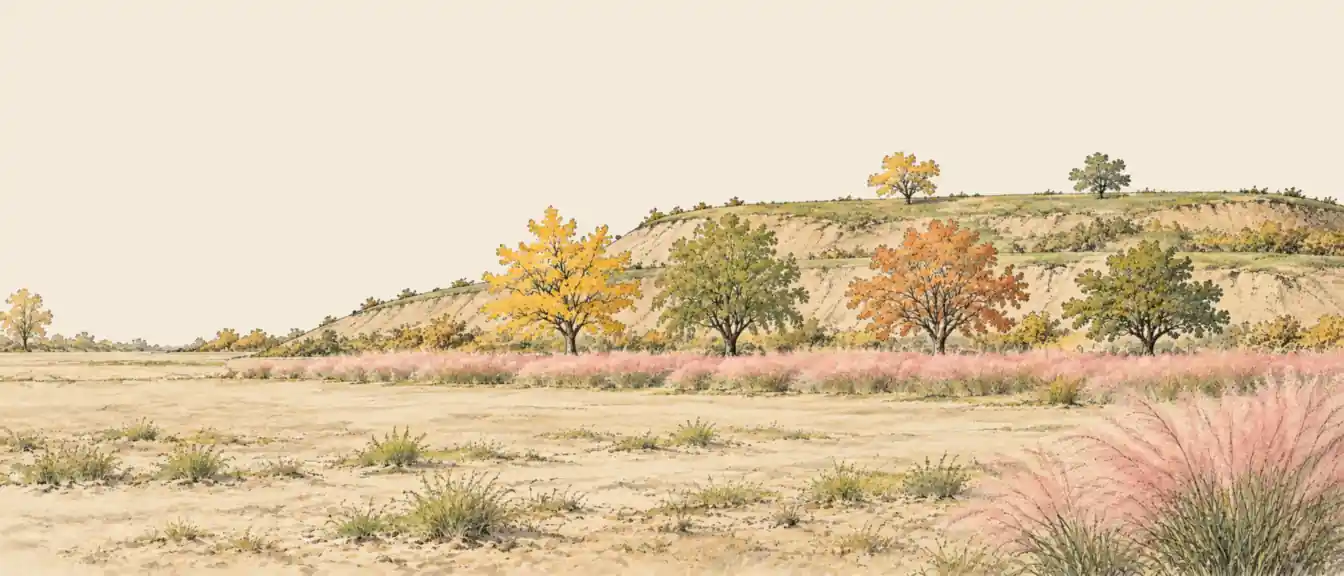
On open scrubland a bare earthen slope rises behind a few trees in yellow, green and orange, with a band of pink grass across the middle and small shrubs in front.
Temple1

- Han Weiyang Palace Front Hall Platform Site
The rammed-earth platform of the Han Weiyang Palace front hall measures about 350 by 200 meters and rises in three stages to about 15 meters.
Archaeology3

- Han Weiyang Palace Jiaofang Hall Ruins
The empress's main hall in Western Han Weiyang Palace, named for walls plastered with pepper and mud, lies about 360 meters north of the front hall.
- Han Weiyang Palace Shaofu Treasury Site
The Shaofu site at Han Weiyang Palace lies about 400 meters northwest of the front hall, and a dig from 1987 to 1988 yielded many clay seals.
- Han Weiyang Palace Cangchi Lake Site
Cangchi was a pool in the southwest of Han Weiyang Palace, about 400 meters east to west and 500 north to south, close to 20 hectares.
In its history2
- Zhang Qianc. 164–114 BCE
Part of Weiyang Palace Site's history: Zhang Qian's Mission. Western Han envoy who crossed Xiongnu territory to reach the Yuezhi and Bactria, was held captive for over ten years and opened Han contact with Central Asia
- Emperor Wu of Han (Liu Che)156–87 BCE
Part of Weiyang Palace Site's history: Zhang Qian's Mission. Western Han emperor for fifty-four years who began the use of reign titles, sent armies against the Xiongnu and envoys to Central Asia, and weakened the princes
Han3

- Xiao He Builds Weiyang Palace200 BCE
In 200 BCE, Chancellor Xiao He oversaw Weiyang Palace, whose eastern and northern gate towers (que), front hall, arsenal, and granary had reached substantial form; later expansions are outside this record.
- Zhang Qian's Mission
Zhang Qian's missions brought Central Asian geography and politics to the Han court, enabling sustained engagement along the emerging Silk Roads.
- Zhang Qian's First Western Mission138 BCE
In 138 BCE, Zhang Qian was commissioned by Emperor Wu of Han to seek the Yuezhi, beginning a new phase of Han engagement with the Western Regions.

Modern Era2

- The Canal and the Silk Roads
On 22 June 2014 the 38th session of UNESCO's World Heritage Committee, in Doha, inscribed the Grand Canal of China and the Silk Roads: Routes Network of the Chang'an-Tianshan Corridor on the World Heritage List.
- Weiyang Palace Joins Silk Roads Heritage2014 CE
In 2014, the Weiyang Palace site in Western Han Chang'an was inscribed as component 1442-001 of the Chang'an–Tianshan Corridor.