


 Shaanxi







 Xi'an
County-level
Xin Cheng District
Daming Palace southern esplanades overlook ancient pavilions in Xincheng, home to Tibetan Buddhist shrines at Guangren Temple near Xi'an Station.
 MUZIChinese Matrix
 Xi'an
Xi'an, capital to thirteen dynasties, guards the Terracotta Army, the Ming city wall and the Big Wild Goose Pagoda of old Chang'an.
 Qinling
's forested ridges stretch into the warm haze, with exposed rocky crests and winding streams tracing the deep branching valleys below.
Open the entryFor Xi'an, the relationship between place and life becomes visible in “Xi'an, capital to thirteen dynasties, guards the Terracotta Army, the Ming city wall and the Big Wild Goose Pagoda of old Chang'an.” This evidence connects landform, movement, settlement, and cultural expression instead of treating them as isolated details. The present profile of Xi'an reflects environmental adaptation and local stewardship built up over an extended period rather than a short-lived change. This process explains how Xi'an remains connected to its surrounding region while retaining a recognizable local character. That is why Xi'an matters: local detail can illuminate environmental setting, social process, and cultural memory together.
Xi'an
County-level
Daming Palace southern esplanades overlook ancient pavilions in Xincheng, home to Tibetan Buddhist shrines at Guangren Temple near Xi'an Station.
 Xi'an
County-level
Over four thousand calligraphic stone steles in Forest of Stone Steles Museum anchor Beilin, near World Heritage Small Wild Goose Pagoda.
 Xi'an
County-level
Ancient Bell and Drum Towers command central vistas in Lianhu, where bustling culinary traditions thrive in Muslim Quarter around Great Mosque.
 Xi'an
County-level
Historic willowed riverbanks at Baqiao Bridge recall ancient farewell verses in Baqiao, framed by modern lake wetlands and Chang'an Tower.
 Xi'an
County-level
Weiyang Palace Ruins mark the eastern starting point of the Silk Road in Weiyang, alongside monumental halls of imperial Daming Palace.
 Xi'an
County-level
World Heritage Giant Wild Goose Pagoda preserves Xuanzang Buddhist translation legacy in Yanta, adjacent to vibrant light shows of Grand Tang Mall.
 Xi'an
County-level
Advanced aircraft flight-testing and aerospace engineering drive innovation in Yanliang, bordered by the lush banks of Shichuan River Park.
 Xi'an
County-level
World Heritage Terracotta Army guards the Tomb of First Qin Emperor in Lintong, near hot springs and imperial pavilions of Huaqing Palace.
 Xi'an
County-level
Sacred peaks of Mount Zhongnanshan cradle landslide tarns at Mount Cuihuashan in Chang'an, home to the millennial golden ginkgo of Guanyin Temple.
 Xi'an
County-level
The clear and muddy confluence of Jing and Wei Rivers creates the famous natural phenomenon in Gailing, site of the Tang-dynasty Zhaohui Pagoda.
 Xi'an
County-level
Vibrant rural folk peasant paintings of Huxian flourish in Huyi, home to Kumarajiva Sanlun Buddhist ancestral cradle at Caotang Temple.
 Xi'an
County-level
Prized nephrite Lantian Jade has been carved since antiquity in Lantian, near Wang Wei tranquil Wangchuan Villa and Homo erectus fossil sites.
 Xi'an
County-level
Louguantai Daoist Ancestral Platform marks where Laozi preached the Tao Te Ching in Zhouzhi, global capital of sweet kiwifruit orchards.
 Qinling
The Qinling runs east to west as a natural climate and species divide between northern and southern ecosystems, with a long role in Chinese civilization.
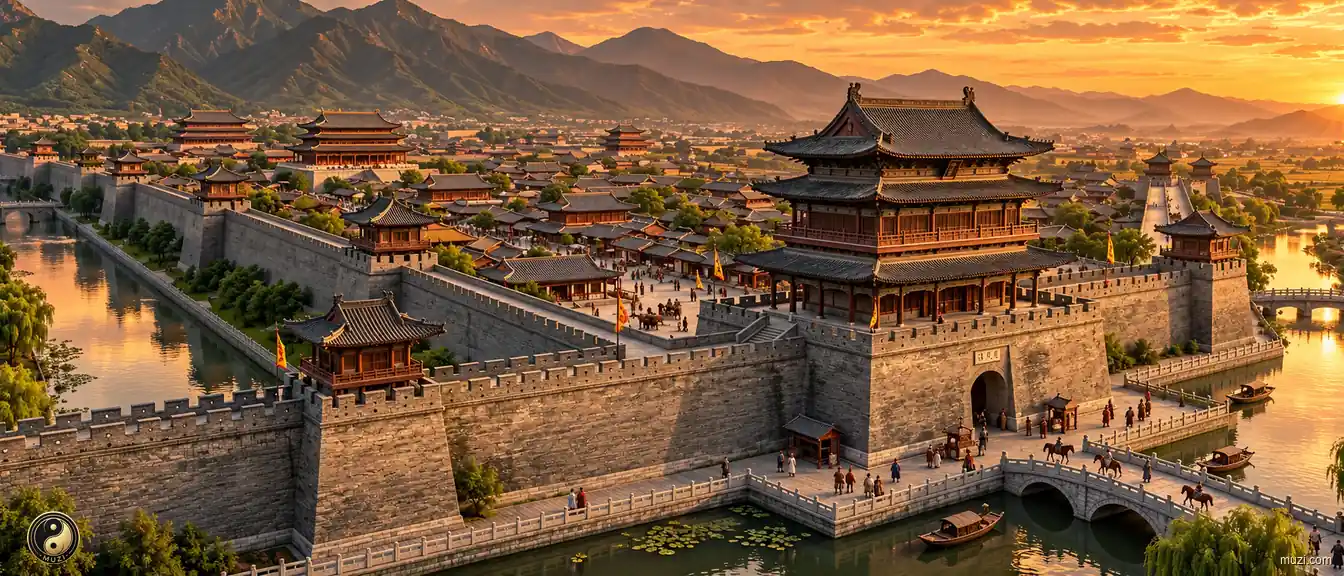
 Chang'an City
Sui-Tang Chang'an — one hundred and eight wards laid out like a chessboard grid, the largest and most orderly imperial capital planning masterpiece of the ancient world.
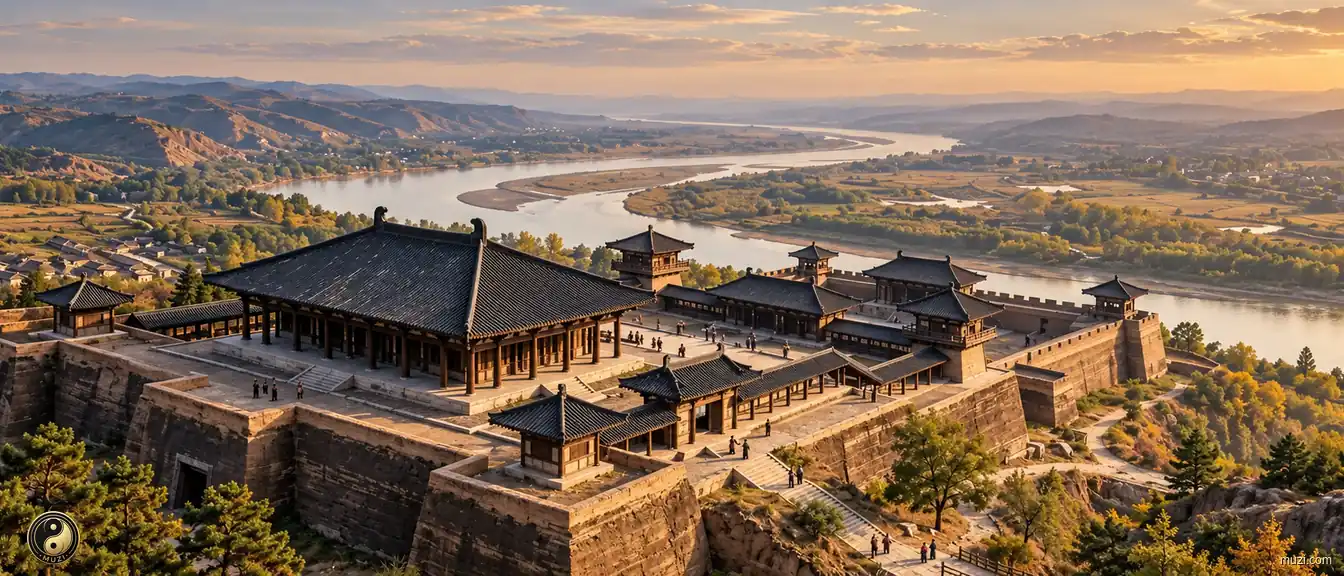
 Xianyang Palace Site
The Qin Xianyang Palace ruins — spanning the Wei River, mapping its separate halls onto the constellations, humanity's earliest super-stage for performing sovereignty through landscape geometry.
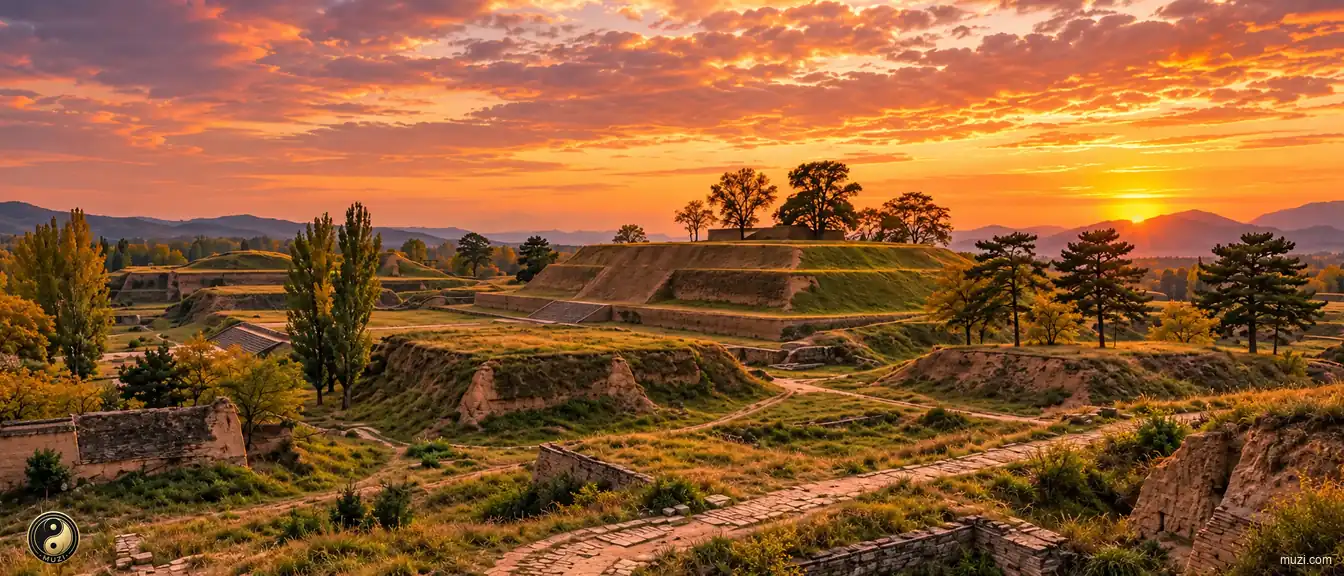
 Weiyang Palace Site
The Han Weiyang Palace ruins — a monumental palace built atop a colossal rammed-earth platform, using extreme vertical perspective to manufacture suffocating awe before imperial authority.
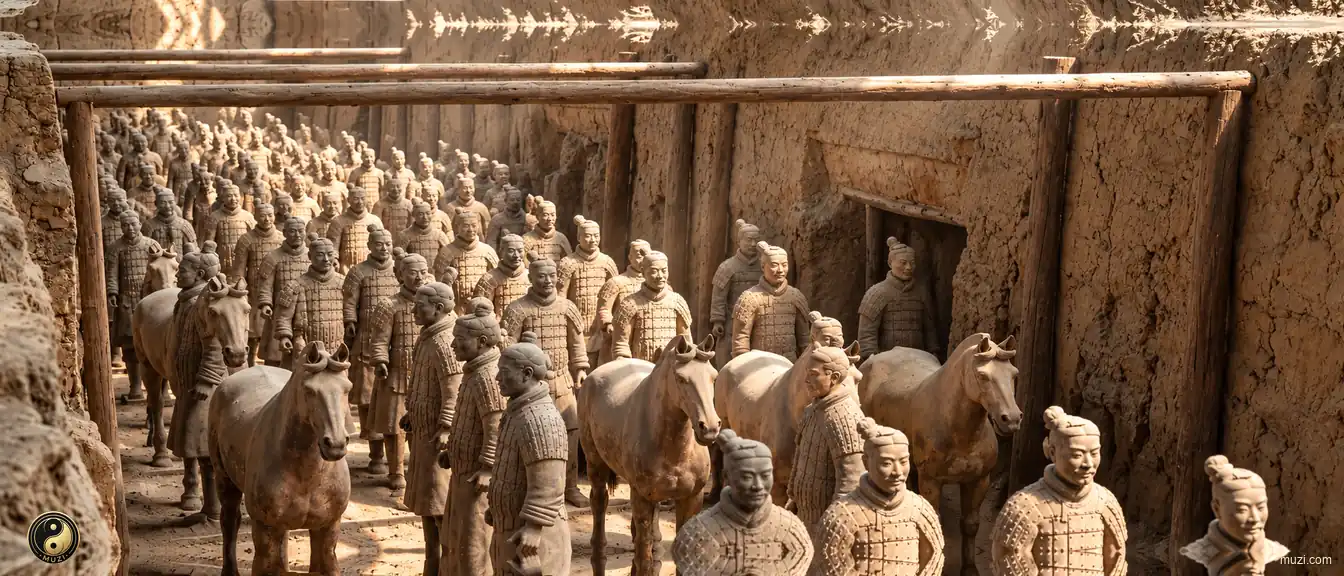
 Mausoleum of the First Emperor
The Qin Shihuang Mausoleum — eight thousand terracotta warriors arrayed underground in full battle formation, the ultimate subterranean palace seeking to replicate supreme earthly sovereignty in the underworld.
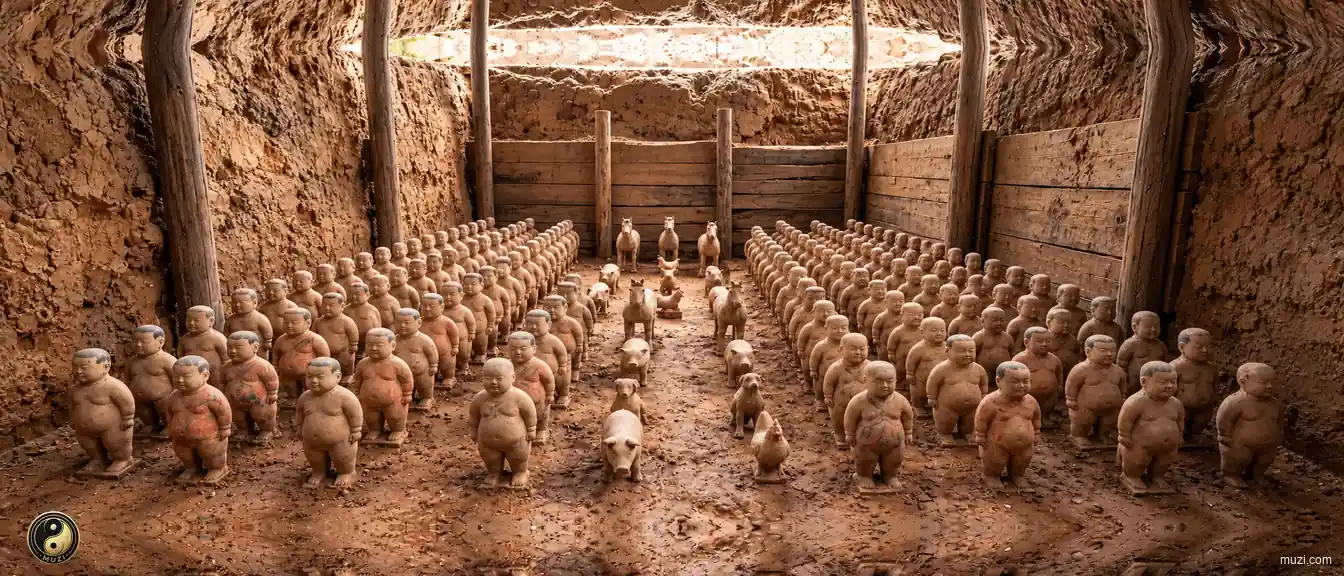
 Han Yangling
The Han Yangling Mausoleum — a vast collection of miniature pottery figurines and granary models entombed, locking state assets into an underground model, the foundational work of the Chinese imperial tomb system.
The nation is shattered, yet mountains and rivers remain; spring over the city, grass and trees grow thick.
In the heavens may we become twin birds flying wing to wing; upon the earth may we grow as entwined branches of two trees. Though heaven and earth may endure for eons, this everlasting sorrow shall know no end.
Those who destroyed the Six States were the Six States themselves, not Qin; that which exterminated Qin was Qin itself, not the people of the world. Qin had no leisure to mourn for itself, but posterity mourns it; if posterity mourns it yet fails to take it as a warning, they will only cause later posterity to mourn them in turn!
Vast and broad, eight rivers part and flow, turning their backs on one another in differing forms.
Suddenly I fall asleep and dream, and in spirit my lord seems to be at my side. Waking with a start I see nothing; my soul is lost and bewildered, as if something were gone.
I cannot make a tree live long or multiply; I only follow the tree's nature so as to bring out what it is.
Surveying Mount Li on all four sides, the Epang Palace burnt in a single torch: where is that imperial luxury today? Only sparse overgrown weeds remain, and streams winding in solitude. Lingering historical regrets shroud misty trees. Feudal kingdoms of Zhou, Qi, Qin, Han, and Chu: winner, all turned to dust; loser, all turned to dust!
Hongfu flees by night to Li Jing, telling him: 'I have long served Minister Yang and have seen many of the people of the world, but none like you. The dodder vine cannot grow alone; I wish to cling to a tall tree, and so I have come to you.' At the inn at Lingshi she takes the Curly-Bearded Guest as her brother.
When Wei Yin tries to force her, Miss Ren, her strength spent, rebukes him: 'Zheng has a body six feet tall and cannot protect one woman; is he a man at all? … Can you bear, with a heart that has more than enough, to rob another of the little he has?' Yin, ashamed, apologises.
On a day of heavy snow the young man from Xingyang comes begging to Li Wa's gate. She embraces him, wraps him in her embroidered jacket and cries: 'That you have come to this in a single morning is my crime!' She buys her freedom and sets him to study.
Proud in the spring breeze, my horse's hooves fly fast; in a single day I see all the flowers of Chang'an.
Where that face has gone I cannot tell; the peach blossoms still smile in the spring wind.
He was not careful in his conduct, and so lost his state and his power. He trusted slander and never awoke, and his ancestral temple was destroyed.
As she grew up she was slender, nimble and light, and moved so gracefully that people called her 'Flying Swallow'.
The Western Capital of Han lies in Yong province and is called Chang'an.
The girl in red raises three fingers, turns her palm three times and points to her mirror; the Kunlun slave Mole reads the signs, kills the guard dog and carries Cui and the girl out over more than ten walls. When soldiers surround him, he flies over the wall, dagger in hand, swift as a falcon.
The Liu clan will be secure, but the Chao clan will be in danger
Xiang Zhuang has drawn his sword to dance, and his aim is fixed on the Duke of Pei.
I was not troubled about returning to lay life; I worried only that the sacred teachings I had copied could not go with me.
I am rescuing the dynasty from danger and hastening to the aid of my sovereign and father. If the deed succeeds, the blessing goes to the dynasty; if it fails, I die for loyalty and filial piety.
That day the emperor, with the princes, consorts and empress, several hundred riders in all, left the inner city by the Hanguang Hall and the Jinguang Gate and fled to Shannan.
Your true heart is as firm as a mountain; even if they piled gold up to the Dipper, I know your feelings could not be moved.
The emperor left the palace and climbed Coal Hill; gazing at the beacon fires lighting up the sky, he sighed: 'It is only my people who suffer.'
The emperor rode in a goat cart, stripped to the waist with a jade disc in his mouth, a coffin carried behind him, and went out to surrender.
Jiancheng and Yuanji took no part in the planning when the righteous banners were first raised, and since then they have had no merit or virtue.
Huang Chao rode in a golden carriage, his guards all in embroidered robes and fine headcloths.
Clouds recall her floating robes, blossoms her radiant face; spring breezes brush the balustrade in heavy morning dew. If not encountered atop Mount Qunyu, she must be met beneath moonlit pavilions on the Jasper Terrace.
If within the four seas a bosom friend remains, heaven's farthest edge is next door.
Raising my cup, I invite the bright moon; with my shadow, we make a party of three.
Alone in a strange land, a stranger among strangers, at every festival I miss my family twice as much.
Its sky-piercing ranks of fragrance will pervade Chang'an, and the whole city will be clad in golden armour.
This is for the Dharma; why should one grudge one's life? If none of you will go, I will go myself.
Boil Hongyang, and Heaven will send rain.
Grown up, he loved the classics and was broad-minded and careful.
For more than twenty years he went in and out of the forbidden gates, careful and cautious, never once at fault
Dou Xian secretly plotted regicide.
Bu always rode a fine horse called Red Hare, which could gallop over walls and leap moats
This too is a strong enemy; how can you call them few!
She learned singing and dancing and was called 'Flying Swallow'.
This god did not deceive Zhao Wuxu; how would he fail me?
He has the bearing of dragon and phoenix and the look of sun and sky; by the time he is nearly twenty he will surely be able to save the world and bring peace to the people.
Heaven reproved me above and I did not wake; the people resented me below and I did not know.
Though Du You held the title of commissioner, in fact Wang Shuwen had sole control.
Not one Guizhen, nor a hundred Guizhens, could lead me astray.
If we had met Governor Yuwen earlier, how would we ever have followed the rebels?
The Retired Emperor did not accept presents; how dare I do otherwise!
The realm will fall into chaos, and you, Prince, must hold it together.
