
 Atlas
Atlas



























 Xianyang Palace Site
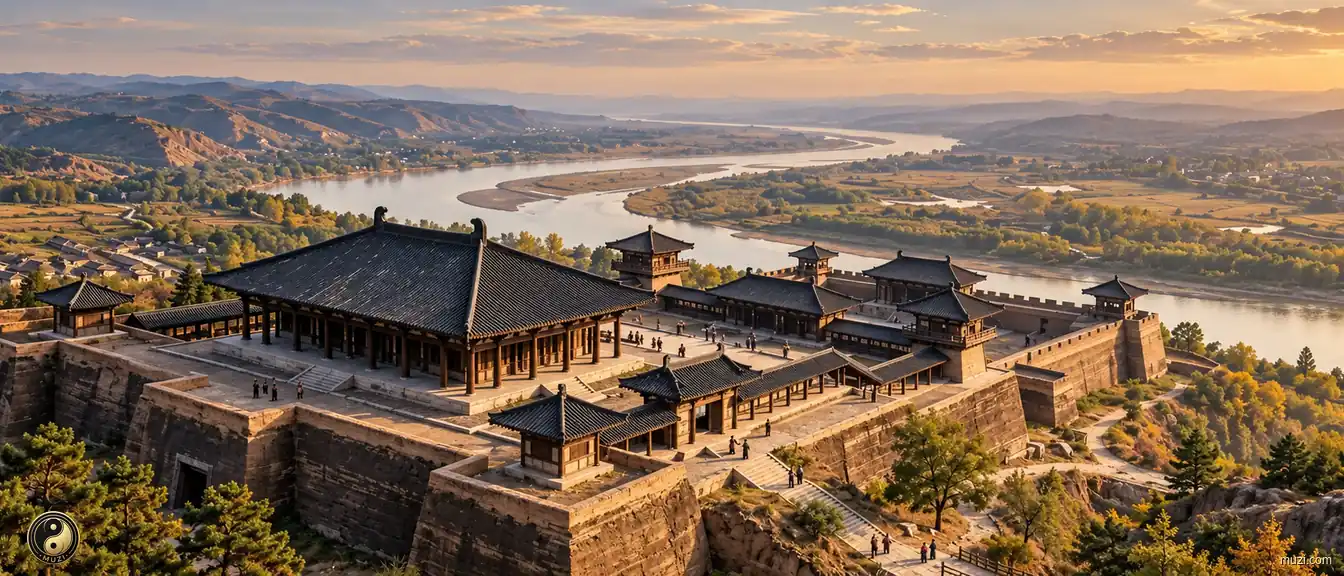
The Qin Xianyang Palace ruins — spanning the Wei River, mapping its separate halls onto the constellations, humanity's earliest super-stage for performing sovereignty through landscape geometry.
 Prefecture: Xi'an
 Province: Shaanxi
Small visitors cross Xianyang Palace’s earthen terraces among dark-roofed halls above the hazy Wei River.
Temple1

- Qin Xianyang Palace No.1 Hall Foundation Site
These foundations are thought to belong to the main hall of the Qin empire, where major decrees were issued, and excavations have yielded Warring States and Qin chariot murals.
Civic Building1

- Qin Xianyang City Archaeological Museum
Finds from Xianyang Palace on display include hollow bricks with dragon motifs, tiles wishing eternal longevity, bronze weights and measures, and Qin ceramic water pipes.
Archaeology2

- Qin Lanchi Palace Imperial Lake Site
The First Emperor channelled the Wei River to create Lanchi Lake with Penglai and Yingzhou islands, an imperial water palace reflecting Qin ideals of harmony between heaven and humans.
- Qin Xianyang Yaodian Workshop Ruins
On the north bank of the Wei River, excavations uncovered large Qin iron-casting and pottery workshops and rammed-earth office foundations with drains, showing the building power of the Qin empire.
In its history2
- Shang Yangc. 390–338 BCE
Part of Xianyang Palace Site's history: Shang Yang's Legalist Reforms. Statesman from the small state of Wey who carried out two rounds of legalist reform in Qin under Duke Xiao, became Lord of Shang, and was torn apart by chariots after his patron died
- Qin Xiaogongc. 381–338 BCE
Part of Xianyang Palace Site's history: Shang Yang's Legalist Reforms. Ruler of Qin who called for able men on his accession and backed Shang Yang's reforms, moving the capital to Xianyang and grouping villages into counties
Zhou2

- Shang Yang's Legalist Reforms
Shang Yang reorganized Qin through counties, military-rank rewards, and agrarian incentives, enabling direct taxation, conscription, and mass mobilization.
- Qin Moves Capital to Xianyang350 BCE
Around 350 BCE, Qin moved its capital from Liyang to Xianyang during the reign of Duke Xiao, making Xianyang the capital of Qin in the Warring States period.

Qin1

- Qin's Post-Unification Planning of Xianyang Palace221 BCE
After unification, Qin Shihuang used Xianyang as his capital, modeled palaces on the former states, and planned the city through a cosmological scheme; scale claims are not asserted here.