 Atlas
Atlas






















 Yin Xu
The ruins of Yin at Anyang — where oracle bones were unearthed, the Shang ancestral temples and bronze foundries, the dawn of Chinese written history and the pinnacle of the Bronze Age.
 Prefecture: Anyang
 Province: Henan
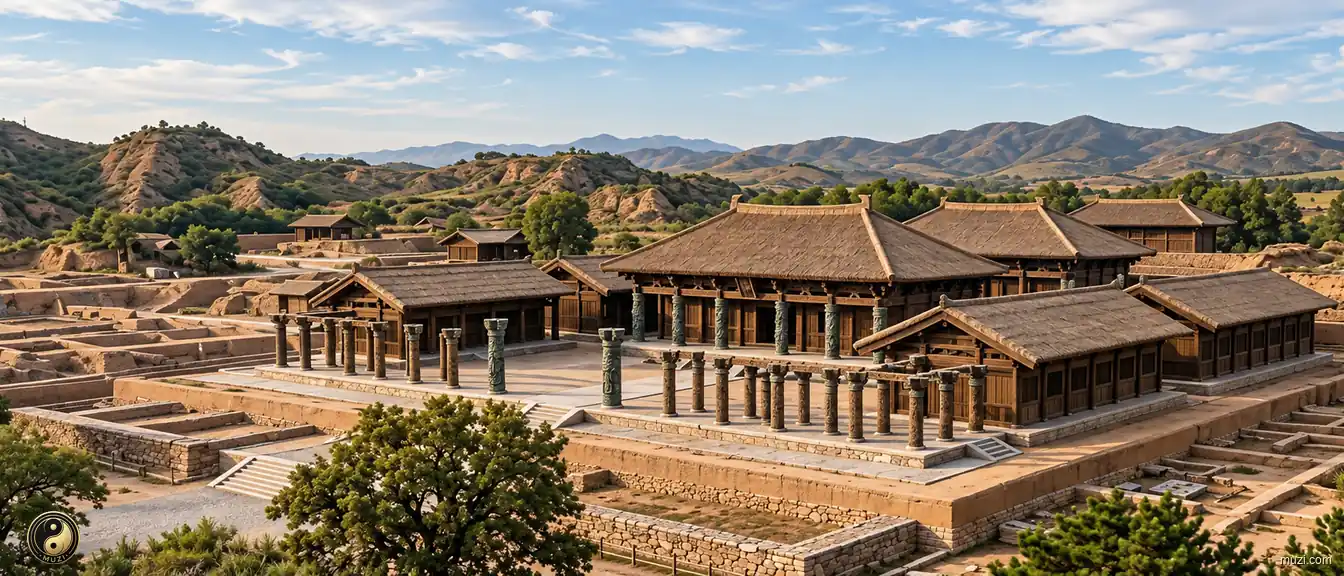
Thatched Shang halls rise on Yinxu’s earthen platforms, their carved columns set against the wooded Anyang hills.
Archaeology4

- Yin Xu Palace and Ancestral Temple Zone
The paramount royal palace and ceremonial precinct of the late Shang dynasty along the Huan River.
- Oracle Bone Pit
The landmark 1936 discovery vault yielding over 17,000 inscribed oracle bone fragments, representing China's earliest national archive.
- Yin Xu Miaopu North Bronze Foundry Site
The primary late Shang royal bronze workshop site demonstrating the world's most advanced piece-mold casting technology.
- Yin Xu Chariot Pit Exhibition Hall
In-situ exhibition of six preserved late Shang horse-drawn wooden chariots with skeletal remains of horses and drivers.
Memorial2

- Tomb of Fu Hao
The only undisturbed royal tomb of the Shang dynasty, belonging to Queen and military general Fu Hao, yielding nearly 2,000 treasures.
- Yin Xu Royal Cemetery Zone
The vast Xibeigang royal necropolis where late Shang kings were buried in multi-ramped tombs, the source of the monumental Houmuwu Ding.
Civic Building1

- New Yin Xu Museum
The monumental national museum on the Huan River showcasing nearly a century of Shang archaeological discoveries.
In its history11
- Pan GengDates unknown; mid-Shang king
Part of Yin Xu's history: Pan Geng Moves Capital to Yin. Shang king, brother of Yang Jia, whose move of the capital across the Yellow River is recorded in the Pan Geng chapters of the Book of Documents
- Fu ShuoDates unknown; traditionally Wu Ding's minister
Part of Yin Xu's history: Wu Ding's Golden Age. Minister of the Shang king Wu Ding who, according to the Shiji, was a convict building walls at Fuxian until the king found him after seeing him in a dream
- Fu HaoDates unknown; consort of the Shang king Wu Ding
Part of Yin Xu's history: Wu Ding's Golden Age; Part of Yin Xu's history: Lady Fu Hao's Campaigns; Part of Yin Xu's history: Apex of Shang Bronze Metallurgy. Consort of the Shang king Wu Ding who, according to oracle-bone records, led armies against the Tufang and Qiang and presided over sacrifices, and whose intact tomb was opened at Anyang in 1976
- Wu DingDates unknown; late Shang king (r. c. 1250–1192 BCE)
Part of Yin Xu's history: Wu Ding's Golden Age; Part of Yin Xu's history: Lady Fu Hao's Campaigns; Part of Yin Xu's history: Apex of Shang Bronze Metallurgy. Shang king who, according to the Shiji, revived the dynasty with Fu Yue as his minister; the largest body of oracle-bone inscriptions dates from his reign
- King Wu of Zhou (Ji Fa)Dates unknown; founding king of the Western Zhou
Part of Yin Xu's history: Battle of Muye. Zhou king, son of King Wen, who led the allied lords to victory over the last Shang king at Muye and founded the Western Zhou with its capital at Hao
- Jiang ZiyaDates unknown; late Shang to early Zhou
Part of Yin Xu's history: Battle of Muye. Early Zhou counsellor who, according to the Records of the Grand Historian, helped Kings Wen and Wu overthrow the Shang and became the first ruler of Qi
- Di XinDates unknown; last king of Shang
Part of Yin Xu's history: Battle of Muye. Last king of Shang, known as Zhou, whom the Shiji depicts as gifted but tyrannical and who burned himself on the Deer Terrace after defeat at Muye
- Dong Zuobin1895–1963 CE
Part of Yin Xu's history: Excavating Yinxu. Oracle-bone scholar and archaeologist who led the first trial excavation at Yinxu in 1928, devised a ten-criterion scheme for dating oracle bones and wrote Yin lipu.
- Li Ji1896–1979 CE
Part of Yin Xu's history: Excavating Yinxu. Archaeologist and anthropologist who excavated Xiyin village in Shanxi in 1926 and from 1929 headed the archaeology section of the Institute of History and Philology, directing the Yinxu excavations until 1937.
- Liang Siyong1904–1954 CE
Part of Yin Xu's history: Excavating Yinxu. Archaeologist who read the stratified sequence of Yangshao, Longshan and Shang remains at Hougang in Anyang and directed the excavation of the great Shang tombs at Xibeigang, Houjiazhuang.
- Shi Zhangru1902–2004 CE
Part of Yin Xu's history: Excavating Yinxu. Archaeologist who joined the Yinxu excavations at Anyang in 1931 and spent decades preparing the Xiaotun series of excavation reports.
Shang10

- Pan Geng Moves Capital to Yin
Pan Geng overcame noble resistance and moved the Shang capital to Yin, ending repeated relocations and stabilizing late Shang rule.
- Apex of Shang Bronze Metallurgy
The late-Shang Houmuwu Ding is a monumental bronze ritual vessel made for royal sacrifice, demonstrating the scale and courtly function of Shang bronze production.
- Pan Geng Relocating to Yinc. 1300 BCE
Around 1300 BCE, Pan Geng moved the Shang capital to Yin, establishing the late Shang political, economic, and ritual center for roughly 255 years.
- Wu Ding's Golden Age
Wu Ding promoted Fu Yue and led campaigns beyond Shang's borders, bringing Shang power and bronze culture to their zenith.
- Wu Ding Reign and Fu Haoc. 1250-1192 BCE
During Wu Ding's revival, Queen Fu Hao led military campaigns and served as a ritual specialist; her unlooted tomb preserves an exceptional late-Shang royal assemblage.
- Miaopu North Bronze Foundry at Peakc. 1250-1046 BCE
The Miaopu North workshops specialized in ritual bronzes, revealing the scale, organization, and techniques of craft production in the late Shang capital.
- Lady Fu Hao's Campaigns
Fu Hao led Shang armies against the Qiang and other rivals, leaving early evidence of a woman commanding major campaigns.
- Tomb of Fu Hao Excavationc. 1200 BCE
Fu Hao was queen, commander, and ritual specialist; her owl zun embodies her place in late-Shang political and ceremonial life.
- Casting of the Houmuwu Dingc. 12th century BCE
Cast in large ceramic moulds, the 832.84-kilogram Houmuwu Ding concentrates the ritual purpose, technical coordination, and resources of the late-Shang court.
- Battle of Muye
King Wu's coalition defeated Shang at Muye as troops turned against their commanders, ending Shang and founding Western Zhou.



Republican Era4

- Excavating Yinxu
From 1928 the Institute of History and Philology of Academia Sinica carried out fifteen scientific excavation seasons at Yinxu in Anyang, recovering oracle bones and Shang remains and opening modern Chinese field archaeology.
- Scientific Excavation Beginning at Yinxu1928
Archaeological excavation launched in 1928 at Xiaotun, marking the birth of modern Chinese field archaeology.
- Liang Siyong Excavates Xibeigang Royal Tombs1934–1935
From autumn 1934 to the end of 1935 Liang Siyong led the tenth to twelfth Yinxu seasons, opening the Shang royal tombs at Xibeigang near Houjiazhuang.
- Oracle-Bone Pit YH127 Found1936
On 12 June 1936 the thirteenth Yinxu season found pit YH127 at Xiaotun, which yielded 17,096 inscribed oracle-bone pieces.