
 Atlas
Atlas



























 Mausoleum of the First Emperor
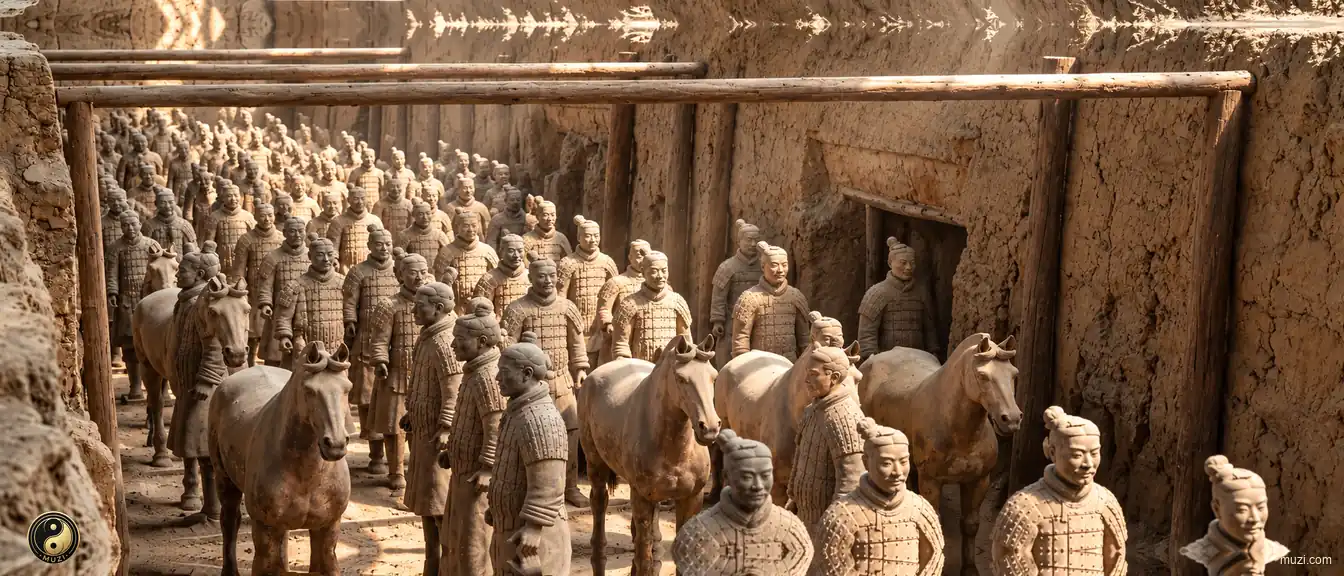
The Qin Shihuang Mausoleum — eight thousand terracotta warriors arrayed underground in full battle formation, the ultimate subterranean palace seeking to replicate supreme earthly sovereignty in the underworld.
 Prefecture: Xi'an
 Province: Shaanxi
Terracotta warriors and horses stand in ordered ranks beneath timber beams inside the earthen excavation pit.
Memorial3

- Mausoleum Mound of the First Qin Emperor
The 51-meter truncated pyramid earthen mound sealing the subterranean palace and mercury cosmos of China's first unifier.
- Museum of Qin Bronze Chariots
Dedicated museum displaying the two magnificent 1980 imperial bronze chariots and teams of four horses, known as the Crown of Bronze.
- Emperor Qinshihuang's Mausoleum Site Museum
The world-class national museum complex preserving and presenting the complete archaeological landscapes of the Qin imperial necropolis.
Archaeology4

- Terracotta Army Pit 1
The largest excavation vault exhibiting the main vanguard battle array of over 6,000 life-sized warriors and chariots.
- Terracotta Army Pit 2
The specialized combined-arms combat pit comprising cavalry squadrons, war chariots, and kneeling archers.
- Terracotta Army Pit 3
The subterranean command headquarters pit coordinating the underground legions, featuring ceremonial guards and officers.
- Qin Acrobatics & Stone Armour Pits
Excavation pits revealing hyper-realistic court entertainment acrobat figurines and thousands of meticulously crafted stone armor plates.
In its history5
- Qin Shi Huang (Ying Zheng)259–210 BCE
Part of Mausoleum of the First Emperor's history: Mausoleum Construction. King of Qin who conquered the six rival states by 221 BC, took the title First Emperor and imposed commanderies, one script and uniform measures
- Liu Bangc. 256–195 BCE (birth by another account 247 BCE)
Part of Mausoleum of the First Emperor's history: Chu-Han Contention. Founding emperor of the Han, a village head from Pei who rose against Qin, destroyed Xiang Yu in 202 BC and made Chang'an his capital
- Xiang Yu232–202 BCE
Part of Mausoleum of the First Emperor's history: Chu-Han Contention. Chu commander who broke the Qin army at Julu, made himself Hegemon-King of Western Chu, and killed himself at the Wu River after losing the war with Liu Bang
- Han XinBirth unknown–196 BCE
Part of Mausoleum of the First Emperor's history: Chu-Han Contention. Han general from Huaiyin who conquered Wei, Zhao and Qi for Liu Bang, was made king of Qi and then of Chu, and was put to death by Empress Lu on a charge of treason
- Consort YuDates unknown; active in 202 BCE
Part of Mausoleum of the First Emperor's history: Chu-Han Contention. The favored Lady Yu who answered Xiang Yu's song at Gaixia and became central to the later Farewell My Concubine tradition.
Qin6

- Mausoleum Construction
Qin Shihuang built his subterranean mausoleum at Mount Li, where life-size terracotta armies preserve the formations and equipment of Qin forces.
- Imperial Construction of Qin Necropolis246-208 BCE
Thirty-eight-year construction of the colossal mausoleum at Mount Li, mobilizing hundreds of thousands to build an underground imperial realm.
- Bronze Chariots in Qin Necropolisc. 246–208 BCE
Two painted bronze chariots made during the Qin mausoleum period were deposited in the imperial complex, preserving Qin vehicle, harness, and metalworking details.
- Creation of the Terracotta Army221–210 BCE
Peak of Qin military organization and monumental realism
- Qin Shihuang Buried at Lishan210 BCE
After Qin Shi Huang died in 210 BCE, he was buried in the mausoleum complex guarded symbolically by terracotta infantry, chariots, cavalry, and crossbow formations.
- Xiang Yu Burning Qin Necropolis206 BCE
In 206 BCE, after Xiang Yu's forces entered the Guanzhong region, fire destroyed surface buildings of Qin Shi Huang's mausoleum and collapsed timber roofing over the Terracotta Army pits.

Han1

- Chu-Han Contention
Liu Bang's coalition defeated Xiang Yu at Gaixia, ending the Chu-Han struggle and clearing the way for the Han dynasty.

Modern1
- Terracotta Army Inscribed on UNESCO List1987
Inscribed on the UNESCO World Heritage List in 1987 as a supreme monument of early Chinese imperial civilization.