
 Atlas
Atlas


























 Ming Tombs
The thirteen Ming imperial tombs — perfectly following the arc of the Tianshou Mountains, a grand mausoleum matrix using the natural peaks as cemetery walls, the ultimate underground political landscape.
 Prefecture: Changping
 Province: Beijing
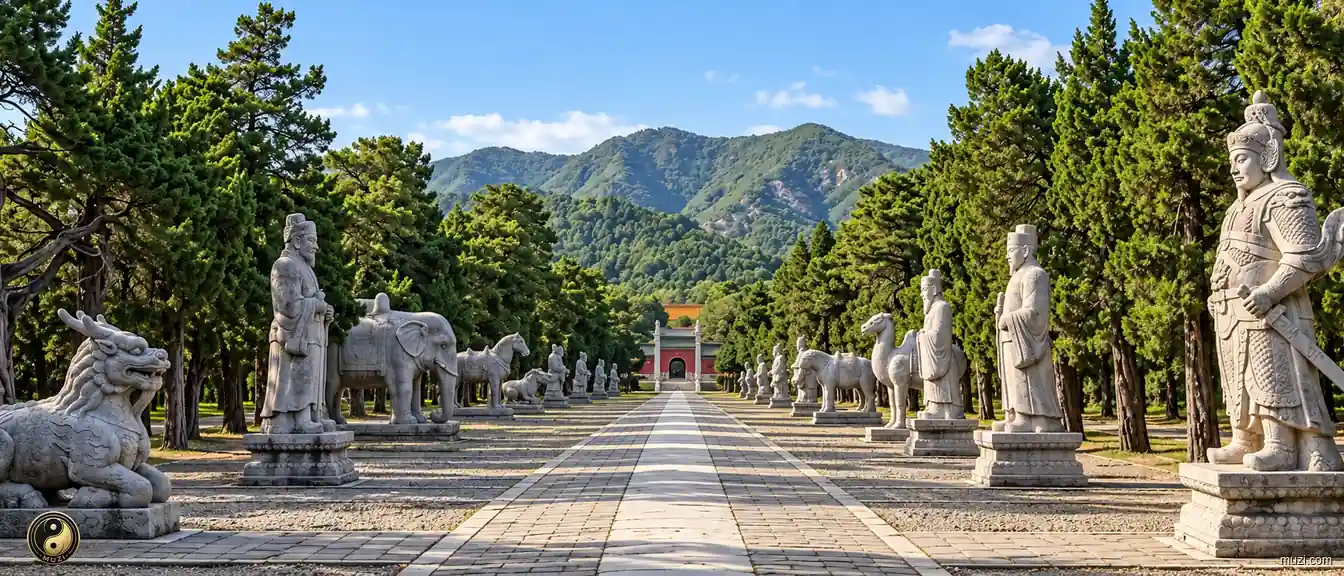
Stone officials and guardian beasts line the cypress-shaded Spirit Way toward the red gate beneath green mountains.
Memorial6

- Ming Tombs Sacred Way
A grand seven-kilometer imperial ceremonial axis lined with eighteen pairs of stone figures and beasts leading into the Ming Tombs.
- Ming Tombs Stone Archway
Built in 1540, a monumental marble archway with five bays and eleven roofs, one of China's largest and earliest surviving stone arches.
- Changling Mausoleum
The head mausoleum of Emperor Yongle and Empress Xu, featuring the majestic Nanmu-pillared Ling'en Hall.
- Dingling Mausoleum
The tomb of Emperor Wanli and two empresses, the only Ming imperial tomb whose Underground Palace was systematically excavated.
- Zhaoling Mausoleum
The tomb of Emperor Longqing, the first systematically restored Ming mausoleum displaying the complete architectural layout.
- Ming Tombs Seven-Arch Bridge
A stately seven-arch Ming stone bridge spanning the northern river along the Sacred Way axis toward Changling.
Gate & Wall1

- Grand Red Gate
The primary southern gateway of the Ming Tombs Sacred Way, featuring three arched portals and imperial dismounting steles.
Architecture1

- Ming Tombs Shengong Shengde Stele Pavilion
Imperial stele pavilion housing the monumental eulogy stele for Emperor Yongle atop a colossal Bixi tortoise, flanked by four Huabiao pillars.
In its history3
- Zhu Di1360–1424 CE
Part of Ming Tombs's history: Yongle Capital Relocation. Fourth son of the Ming founder who seized the throne from his nephew in the Jingnan war, reigned as the Yongle Emperor and moved the capital to Beijing
- Kuai Xiang1398–1481 CE
Part of Ming Tombs's history: Yongle Capital Relocation. Ming carpenter from Xiangshan in Wu county who worked on the Beijing palaces, rebuilt the three great halls in 1440, and rose to vice minister of works
- Wu Zhong1373–1442 CE
Part of Ming Tombs's history: Yongle Capital Relocation. Ming Dynasty Minister of Works who directed the construction of the Forbidden City, imperial temples, and Changling Mausoleum for over three decades.
Ming6

- Yongle Capital Relocation
Relocating the capital to Beijing, realigning the imperial geopolitical center and anchoring six centuries of national governance.
- Yongle Founds Changling at Tianshou1409 CE
Emperor Yongle surveyed Mount Huangtu in Changping, renaming it Mount Tianshou to found Changling as the ceremonial core of the Ming Tombs.
- Completion of Changling Ling'en Hall1413-1427 CE
The Underground Palace and the monumental Nanmu Ling'en Hall of Changling were completed, interring Emperor Yongle and Empress Xu.
- Shared Sacred Way at Ming Tombs1435 CE
The Xuande and Zhengtong reigns established the unified Sacred Way, erecting the Shengong Shengde Stele Pavilion and stone statues.
- Master Plan of Ming Tombs1540 CE
In 1540 the monumental marble archway was erected, culminating over two centuries of construction into a mature imperial necropolis.
- Building Dingling's Underground Palace1584–1590 CE
From 1584 to 1590, the Wanli Emperor's Dingling tomb and underground palace were built in the Ming Thirteen Tombs.

Modern1
- Ming Tombs Inscribed on UNESCO List2003 CE
UNESCO inscribed the Ming Tombs on the World Heritage List as an extension of the Imperial Tombs of the Ming and Qing Dynasties.