
 Atlas
Atlas


























 Songshan Zhongyue Temple
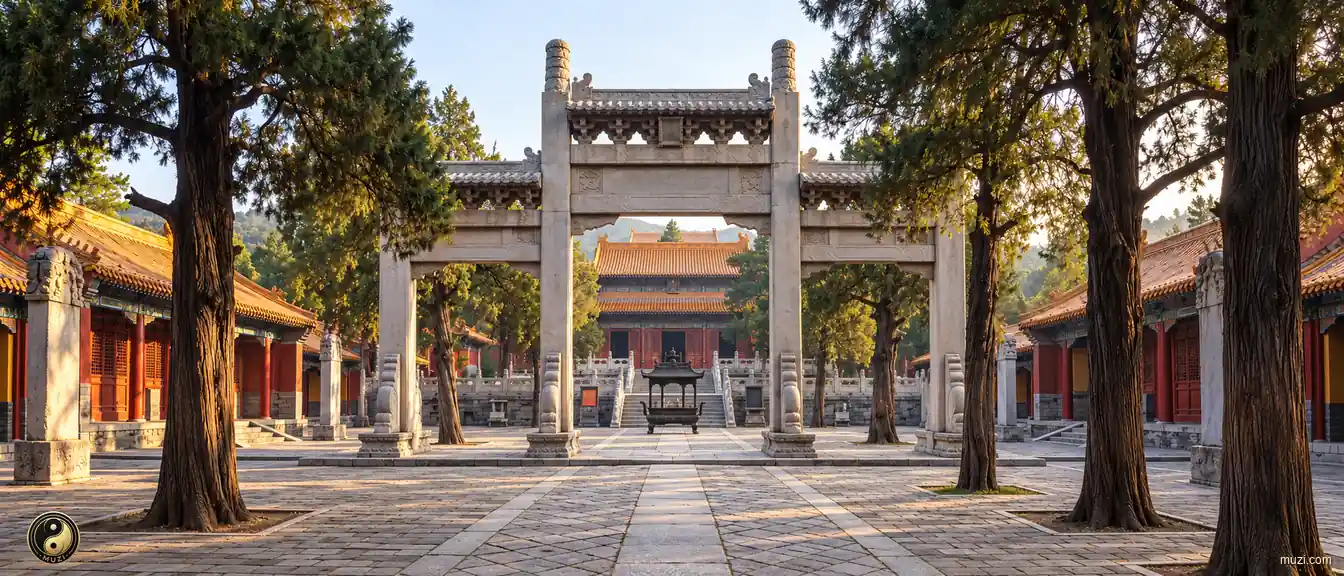
The Zhongyue Temple on Mount Song — situated at the very survey benchmark of the Center of Heaven and Earth, an ancient Daoist complex that formatted raw mountain worship into a state-sanctioned orthodox ritual order.
 Prefecture: Zhengzhou
 Province: Henan
A pale-stone gateway frames Zhongyue Temple’s incense vessel and golden roofs between ancient cypresses.
Temple2

- Zhongyue Temple Junji Hall in Dengfeng
Junji Hall leads the largest surviving temple complex of the Five Sacred Mountains, with a yellow-tiled hip-and-gable roof and towering Song iron guardians cast in 1064.
- Dengfeng Astronomical Observatory (Guo Shoujing)
Built by the Yuan astronomer Guo Shoujing, this is China's oldest surviving observatory, where work on the Shoushi calendar fixed the year at 365.2425 days.
Sculpture1

- Three Han Dynasty Stone Towers in Dengfeng
Built in the early second century under the Eastern Han, these stone towers are among China's oldest surviving ritual structures, carved with acrobats, cuju football and clerical script.
Civic Building1

- Songyang Academy & Ancient Cypress in Dengfeng
Where the Cheng brothers taught Neo-Confucian philosophy, two cypresses that Emperor Wu reputedly named the Great General and Second General are said to be thousands of years old.
In its history4
- Guo Shoujing1231–1316 CE
Part of Songshan Zhongyue Temple's history: Promulgation of Shoushi Calendar. Yuan astronomer and hydraulic engineer who designed the instruments and observations behind the Shoushi calendar and cut the Tonghui canal into the capital Dadu
- Wang Xun1235–1281 CE
Part of Songshan Zhongyue Temple's history: Promulgation of Shoushi Calendar. Eminent Yuan mathematician and astronomer who formulated the advanced computational mathematics for the Shoushi Calendar.
- Xu Heng1209–1281 CE
Part of Songshan Zhongyue Temple's history: Promulgation of Shoushi Calendar. Major Yuan Neo-Confucian philosopher and scholar who co-directed the theoretical foundation of the Shoushi Calendar.
- Kublai Khan1215–1294 CE
Part of Songshan Zhongyue Temple's history: Promulgation of Shoushi Calendar. Grandson of Chinggis Khan who became Great Khan in 1260, named his dynasty Yuan in 1271 and completed the conquest of the Southern Song in 1279
Han1

- Han Wudi Rebuilds Taishi Shrine110 BCE
In 110 BCE, Han Wudi visited and ritually honored Songshan and ordered officials to substantially rebuild Taishi Shrine; his edict, recorded in the Hanshu, says attendants heard the cry of 'ten thousand years' three times.
Yuan2

- Guo Shoujing Creates the Dengfeng Observatory1276 CE
In 1276 Guo Shoujing created the Dengfeng Observatory; it is a surviving Yuan astronomical structure, while broader measurement evaluations are outside this record.
- Promulgation of Shoushi Calendar
Guo Shoujing, Wang Xun, Xu Heng, and their collaborators compiled the Shoushi calendar using observations gathered across an unusually broad network of sites.

Modern1
- Dengfeng Historic Monuments Inscribed2010 CE
In 2010, Dengfeng's historic monuments were inscribed for the way ritual, religious, educational, and astronomical buildings express the idea of the centre of heaven and earth.