
 Atlas
Atlas
























 Hanging Temple
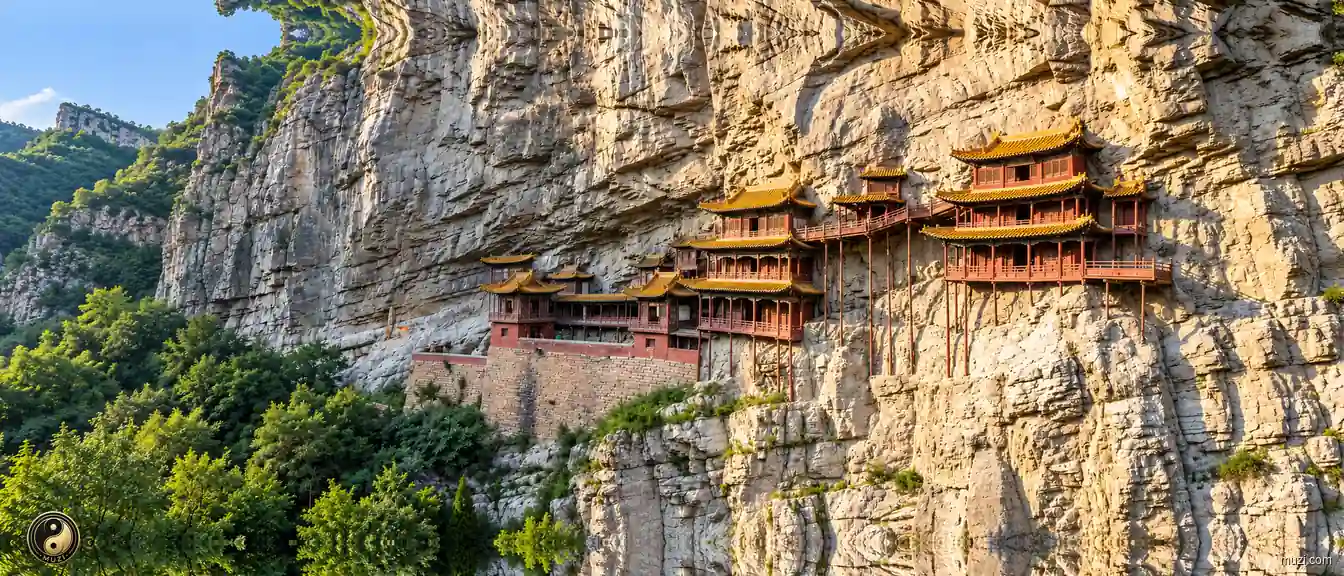
The Hanging Temple on Mount Heng — a three-teachings-in-one pavilion suspended on a vertical cliff by slender wooden pillars, a structural-mechanics miracle that has hung in midair for over a thousand years without falling.
 Prefecture: Datong
 Province: Shanxi
The golden-roofed Hanging Temple clings to stratified limestone, its timber stilts rising above the trees.
Temple3

- Hanging Temple Sanjiao Hall
At the temple's highest hall, Shakyamuni, Laozi and Confucius sit side by side, expressing a fifteen-hundred-year-old harmony of the three teachings.
- Hanging Temple Cantilevered Timber Beams & Cliffs
Founded in 491 under the Northern Wei, the temple clings fifty metres up a cliff of Jinlong Gorge, resting on beams inserted into the rock and natural ledges.
- Mount Heng Summit Tianfengling & Hengzong Palace
Beneath sheer cliffs of Mount Heng's 2,016-metre main peak stands the imperial temple to the God of the Northern Peak, reached by 103 steep Ming stone steps.
Sculpture1

- Jinlong Gorge Inscriptions & Li Bai's Zhuanguan
Legend says Li Bai, visiting in the Kaiyuan era, wrote the giant characters zhuangguan, meaning magnificent, on the cliff and added an extra dot to express his awe.
Northern and Southern1

- Hanging Temple Founded in Northern WeiLate Northern Wei, c. 471–523 CE
The Hanging Temple is generally dated to the late Northern Wei, with later repairs shaping the surviving complex.
Tang1

- Li Bai's “Spectacular” LegendKaiyuan 23 (c. 735 CE)
Local tradition dates Li Bai's visit to Xuankong Temple and the “Spectacular” inscription to 735 CE.