 Atlas

























 Mount Wudang
, foremost of Daoist mountains — the Yongle Emperor dispatched hundreds of thousands to carve this proclamation of imperial legitimacy into heaven-defying cliffs, a royal faith spectacle.
 Prefecture: Shiyan
 Province: Hubei
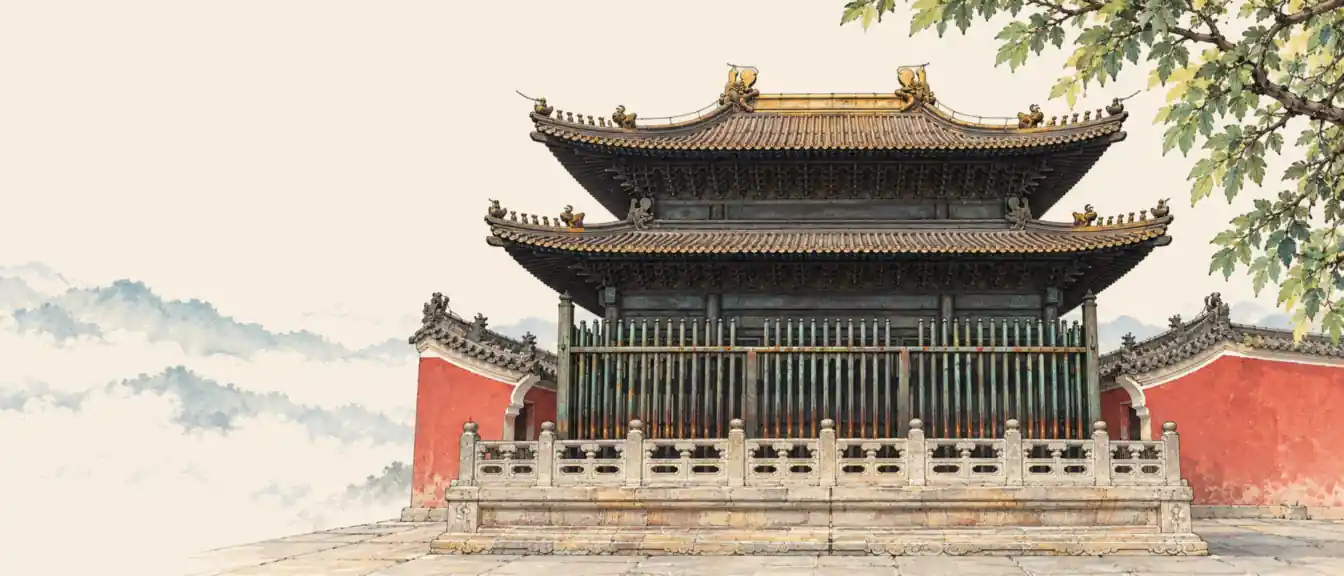
A dark two-roofed hall stands on a stone-railed terrace behind a row of upright bars, with red walls running off on both sides and faint peaks in the mist at left.
Temple4

- Mount Wudang Golden Summit Hall
Standing on the 1,612-meter summit of Mount Wudang, the Golden Hall is a Ming bronze hall made in the pattern of timber construction.
- Zixiao Palace (Purple Cloud Palace) on Mount Wudang
Commissioned by the Yongle Emperor, Zixiao Palace impresses with its double-eaved hip-and-gable main hall and is a traditional centre for Wudang internal martial arts.
- Nanyan Palace & Dragon Head Incense on Mount Wudang
Carved into a sheer cliff, this stone hall projects a three-metre dragon-head incense burner over the abyss, where pilgrims once risked their lives to burn incense.
- Taizipo (Fuzhen Temple) on Mount Wudang
Red walls with green tiles wind along the slope in the Nine-Bend Wall, and inside Wuyun Tower a single pillar famously supports twelve beams.
Modern Era2

- Later World Heritage Listings
In 1994 the Ancient Building Complex in the Wudang Mountains was inscribed on the World Heritage List; the Classical Gardens of Suzhou, the Yungang Grottoes, Quanzhou and others followed, and in 2023 the Jingmai Mountain old tea forest landscape was inscribed.
- Wudang Building Complex Inscribed1994 CE
In 1994, the Ancient Building Complex in the Wudang Mountains was inscribed for its Taoist palaces and temples and their architectural achievement across the Yuan, Ming, and Qing periods.

Ming2

- Yongle-Era Construction of Yuxu PalaceMing Yongle era
Yuxu Palace at Mount Wudang was built during the Yongle emperor's great imperial building campaign there, a key phase of Ming construction at the site.
- Zhang Sanfeng and Wudang Martial ArtsLate Yuan to early Ming
Wudang tradition and intangible-heritage records regard Zhang Sanfeng as an important founding figure whose teaching joined Daoist culture with traditional martial arts.