
 Atlas
Atlas
























 Mogao Caves
The Dunhuang Mogao Caves — a treasure-house of Buddhist art on the Silk Road, over seven hundred grottoes preserving forty-five thousand square meters of murals, a thousand-year three-dimensional art history.
 Prefecture: Jiuquan
 Province: Gansu
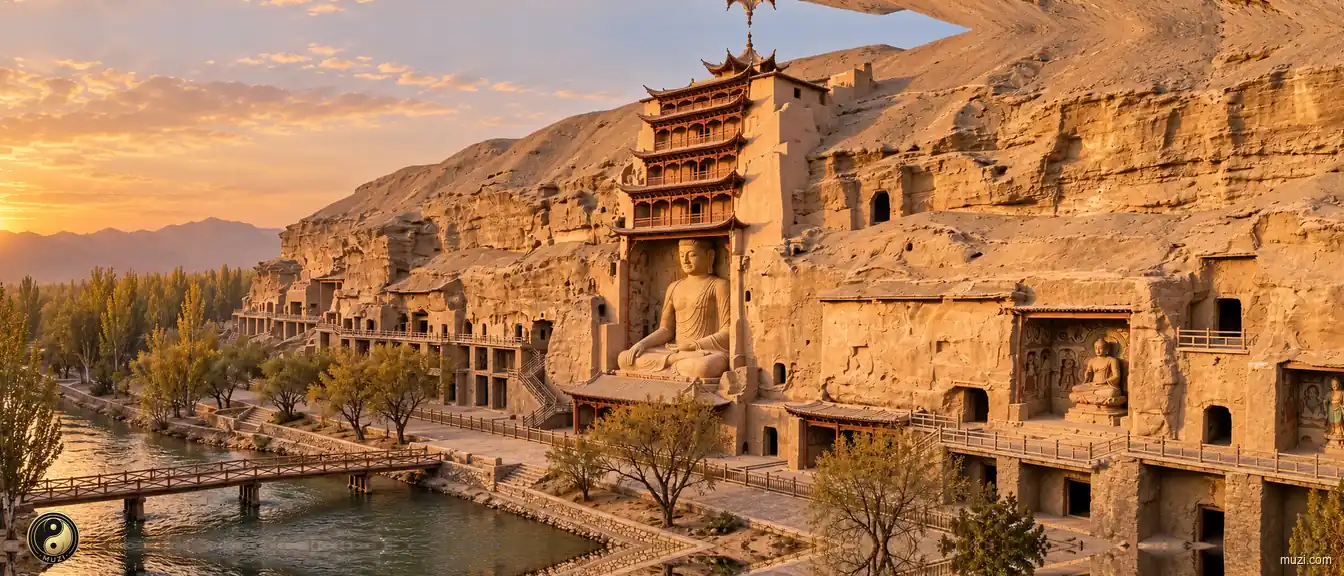
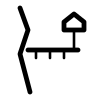
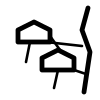
Mogao’s cliff-cut Buddha caves and timber pagoda overlook a river crossed by a wooden footbridge.
Sculpture4

- Mogao Cave 96 (Nine-Story Building)
Cave 96's nine-storey timber facade rises against the cliff of Mingsha Mountain, sheltering a 35.5-metre clay Maitreya, one of the largest indoor clay statues in the world.
- Mogao Cave 17 (Library Cave Historic Chamber)
Originally a memorial chamber for the late-Tang monk Hongbian, the cave was found by Taoist Wang Yuanlu in 1900, sealed for centuries and holding over fifty thousand manuscripts and silk paintings.
- Mogao Cave 148 (Tang Reclining Buddha)
A fifteen-metre painted reclining Buddha from the High Tang depicts Shakyamuni entering nirvana, while the rear wall shows seventy-two disciples and foreign princes in mourning.
- Digital Dunhuang Exhibition Center
Using dome-screen films and high-definition 3D scanning, this pioneering heritage digitization project preserves the desert cave art for future generations.
In its history3
- Zhang Daqian1899–1983
Part of Mogao Caves's history: Guarding Dunhuang. Painter who copied the wall paintings of the Mogao and Yulin caves at Dunhuang from 1941 to 1943, turning to a grander, archaic manner, and in later life developed splashed-ink and splashed-colour landscapes.
- Chang Shuhong1904–1994
Part of Mogao Caves's history: Guarding Dunhuang. Oil painter who, back from France, went to Dunhuang in 1943 and in 1944 became first director of the National Dunhuang Art Research Institute, leading the protection of the Mogao caves and the copying of their murals.
- Duan Wenjie1917–2011
Part of Mogao Caves's history: Guarding Dunhuang. Copyist and scholar of the Dunhuang murals who reached Mogao in 1946, copied more than 340 murals in a few years, and in 1984 became the first president of the Dunhuang Academy.
Jin1

- Le Zun Opens First Mogao Cavec. 366 CE
Traditional accounts place Le Zun's excavation of the first Mogao cave at about 366; the golden-light episode is retained as tradition, not fact.
Qing1

- Wang Yuanlu Finds the Library Cave1900 CE
In 1900, the Daoist Wang Yuanlu discovered the Library Cave while clearing sand at Mogao, bringing long-sealed Dunhuang manuscripts back to public attention.
Republican Era3

- Guarding Dunhuang
Zhang Daqian went to the Mogao Caves to copy their murals, and Chang Shuhong founded the National Dunhuang Art Research Institute, which cleared the sand, walled the site and surveyed and copied the caves: after centuries of neglect, Mogao began to be protected and studied systematically.
- Zhang Daqian Copies the Dunhuang Murals1941–1943
From 1941 to 1943 Zhang Daqian, with family members and pupils, spent two years and seven months copying murals at the Mogao and Yulin caves, producing more than 270 copies.
- National Dunhuang Art Research Institute Founded1944
On 1 January 1944 the National Dunhuang Art Research Institute was founded at Mogao with Chang Shuhong as its first director, giving the caves a resident body for their protection and study.

Modern1
- Mogao Caves Inscribed as World Heritage1987 CE
In 1987, the Mogao Caves were inscribed for a millennium of Buddhist cave architecture, murals, and painted sculpture.