
 Atlas
Atlas





























 Ruins of St. Paul's
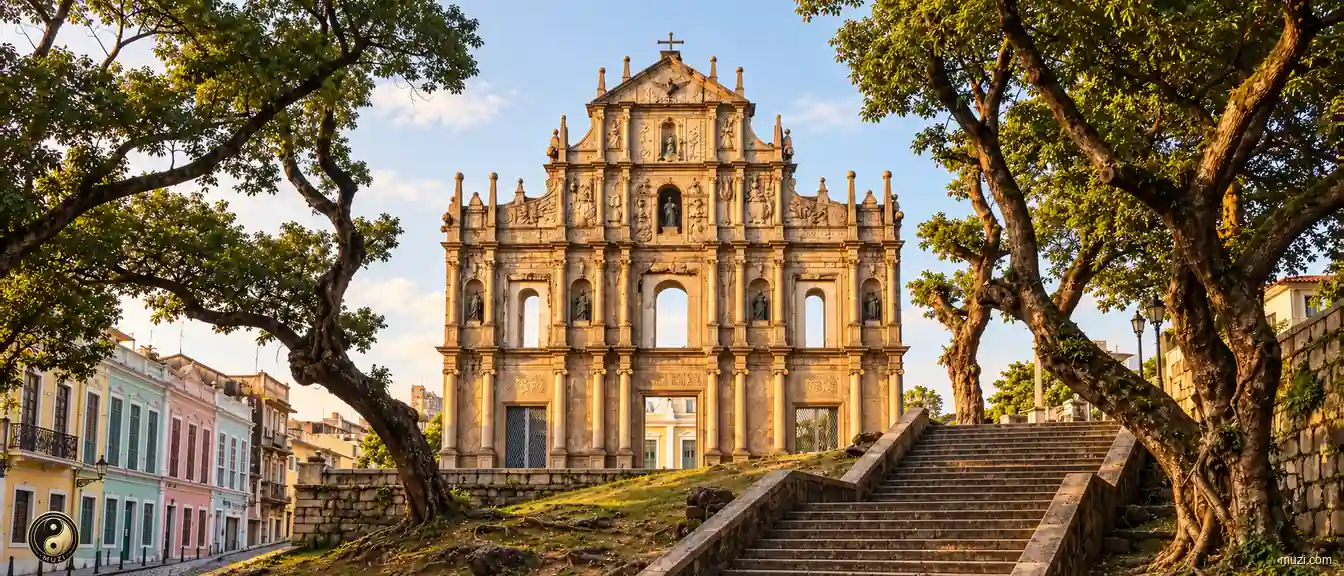
The facade of St. Paul's in Macau — begun by the Jesuits in 1602, the largest Catholic church in the Far East blending Baroque and Eastern motifs, a UNESCO World Heritage landmark and the eternal witness of East-West civilizational dialogue.
 Prefecture: St. Anthony
 Province: Macau
The sculpted stone facade of St Paul’s rises above a broad stairway framed by old trees and pastel Macau buildings.
Temple1

- Ruins of St. Paul's in Macao
Begun in 1602 by Japanese Christian craftsmen working with Chinese and Western carvers, the ruined church facade blends Chinese characters and chrysanthemums into remarkable Catholic stonework.
Tower1

- Guia Fortress & Lighthouse in Macao
Built from 1622, the fortress holds the first modern lighthouse on the China coast and the Chapel of Our Lady of the Snows with rare murals mixing Chinese and Western motifs.
Memorial1

- Museum of Sacred Art at St. Paul's in Macao
In the crypt of the former College of Saint Paul, often called the first Western-style university in the Far East, the museum keeps relics of Japanese martyrs and Catholic sacred objects.
Civic Building1

- Senado Square & St. Dominic's Church in Macao
Wavy black-and-white Portuguese paving leads to the golden Baroque facade of Saint Dominic's Church at the core of Macao's World Heritage blend of East and West.
Ming1

- St. Paul's Church Built in Macao1602–1640 CE
St. Paul's Church began construction in 1602, with the main structure and façade completed between 1637 and 1640; its façade survives as the Ruins of St. Paul's.
Qing1

- Fire Leaves St. Paul's Façade1835 CE
A fire in 1835 destroyed St. Paul's College and its church, leaving the façade, much of the foundation, and the front steps.
Modern1
- Historic Centre of Macao Inscribed2005 CE
In 2005, the Historic Centre of Macao was inscribed for its architecture, urban spaces, and testimony to sustained exchange between Chinese and Western cultures.