
 Atlas
Atlas




























 Mount Putuo
Mount Putuo, the bodhimanda of Guanyin — a sacred island Buddhist realm suspended alone in the East China Sea's waves, a spiritual lighthouse whose thousand-year Sanskrit chanting and tidal rhythm illuminate the return path for seafarers.
 Prefecture: Zhoushan
 Province: Zhejiang
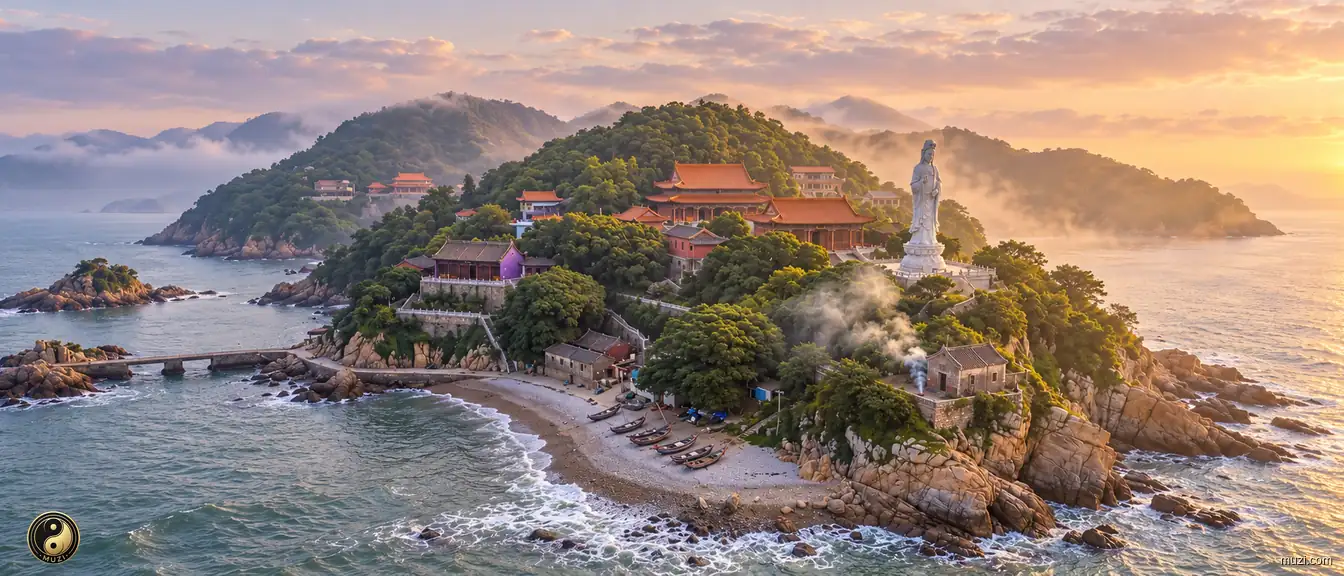
The white Guanyin statue overlooks Putuo’s wooded monasteries, misty cove, moored boats and rocky islets.
Temple4

- Puji Temple Yuantong Hall & Haiyin Pool at Mount Putuo
Mount Putuo's largest temple, known as the Front Temple, enshrines an eight-metre seated Vairocana Guanyin, with three bridges spanning the lotus-filled Haiyin Pool before the hall.
- Fayu Temple Nine-Dragon Palace at Mount Putuo
The island's second great temple, Fayu Temple has a Nine-Dragon Hall that reuses glazed tiles and a nine-dragon caisson moved from the Ming palace in Nanjing.
- Huiji Temple on Bodhidharma Summit at Mount Putuo
Hidden in the forests of Foding Mountain, the third great temple has white-walled, black-tiled courtyards in Jiangnan style and protects the rare Putuo hornbeam.
- South Sea Guanyin Statue & Zizhulin at Mount Putuo
A thirty-three-metre gilded bronze Guanyin holding a Dharma wheel overlooks the spot where the Japanese monk Egaku began the Tang-era legend of the Guanyin Reluctant to Leave.
Tang1

- Hui'e Founds the Unwilling-to-Leave ShrineLate Tang to Five Dynasties, c. 858–916 CE
Late-Tang and Five-Dynasties local traditions say that the Japanese monk Hui'e left a Guanyin image at Putuo, giving rise to the Unwilling-to-Leave Guanyin Shrine.
Qing1

- Kangxi Names Fayu Temple1699 CE
In 1699, the Kangxi court granted the plaque “Heavenly Flowers and Dharma Rain,” and Putuo's Zhenhai Chan Temple was renamed Fayu Chan Temple.