
 Atlas
























 Mount Longhu
, the ancestral seat of Zhengyi Daoism — Danxia pictographic peaks, thousand-year hanging coffins, and talismanic ritual codes converge in the South's esoteric faith center.
 Prefecture: Yingtan
 Province: Jiangxi
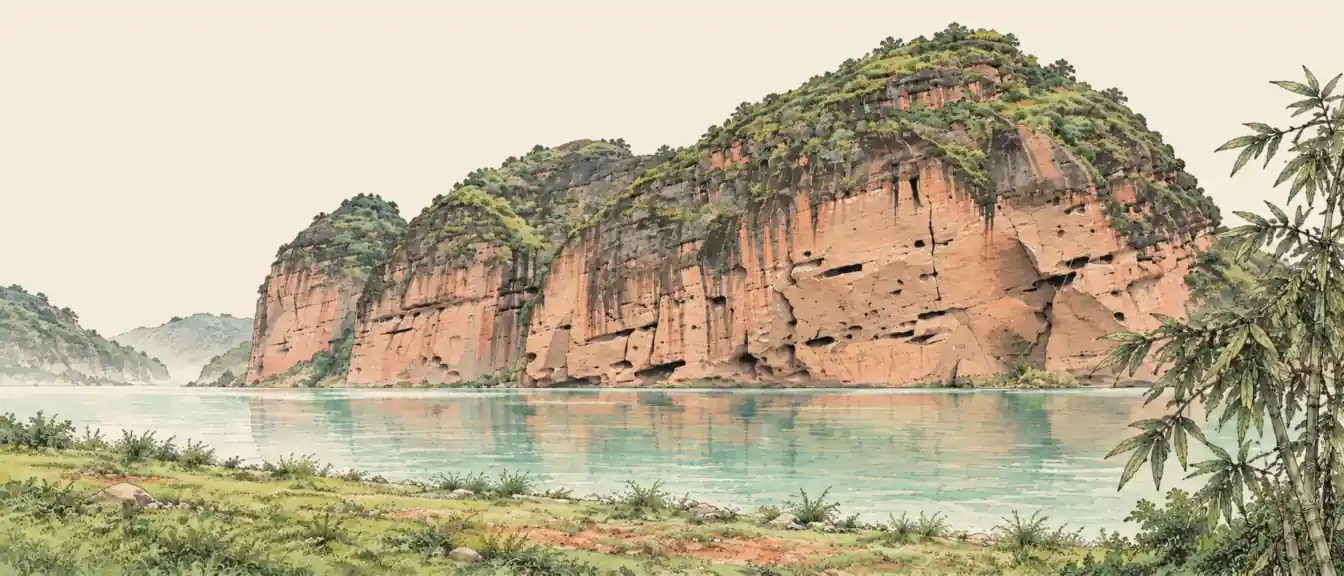
Reddish rock hills rise straight from calm blue-green water, capped with green scrub and pitted with small holes, with a grassy bank and bamboo leaves in front.
Temple1

- Tianshi Mansion on Mount Longhu
For generations the Celestial Masters of the Zhang family ran Taoist affairs from this official-style mansion, covering fifty thousand square metres and centred on the imposing Sanxing Hall.
Memorial2

- Zhengyi Temple on Mount Longhu
According to legend, Zhang Daoling refined an elixir here in the Eastern Han and a dragon and tiger appeared when it was complete, giving the mountain its name.
- Xianshuiyan Cliff Hanging Coffins on Mount Longhu
Hundreds of hanging coffins placed by the ancient Yue people some 2,600 years ago dot the red cliffs along the Luxi River, with a daily show recreating how they were raised.
Gate & Wall1

- Shangqing Ancient Town Street on Mount Longhu
Running along the Luxi River beside the Celestial Master's Mansion, this long bluestone street keeps a herbal shop, an old wharf and a time-honoured Taoist tea banquet.
Yuan1

- Kublai Summons Zhang Zongyan1276–1278 CE
Between 1276 and 1278, Kublai Khan summoned Zhang Zongyan and granted him office and seals, formalizing his standing within the Zhengyi Taoist tradition.
Modern Era2

- Landscapes Join the World Heritage List
Huangshan was inscribed on the World Heritage List in 1990, and by 2017 Mount Wutai, Longhushan, Xinjiang Tianshan, Guilin, Shennongjia, Hoh Xil and other Chinese mountain and landscape sites had followed.
- Longhushan Danxia Inscribed on UNESCO List2010 CE
In 2010, the Longhushan and Guifeng sections were inscribed as the Jiangxi components of the serial China Danxia property.

Han1

- Zhang Daoling's Alchemy at LonghuEastern Han traditional period
Longhu Mountain tradition holds that Zhang Daoling practiced and made elixirs at Yunjin Mountain in the Eastern Han, giving rise to the story of dragons and tigers appearing.