





 County-level
Han Shan District
Centuries-old stone alleys of Huiche Lane evoke famous Warring States idioms in Hanshan along the banks of the Fuyang River.
 MUZIChinese Matrix
At the eastern Taihang foothills and southern North China Plain, Handan combines ancient Zhao heritage with a transport and industrial role in southern Hebei.
The regional profile of Handan begins with the concrete evidence “At the eastern Taihang foothills and southern North China Plain, Handan combines ancient Zhao heritage with a transport and industrial role in southern Hebei.” The clue links spatial form with everyday experience, giving the regional idea a concrete setting and human scale. Long-term change preserved, adjusted, and transmitted these relationships, showing how environmental influence and community action worked together. These interactions provide a factual basis for understanding the connections, distinctions, and continuities between Handan and nearby places. Its significance lies in connecting regional geography, historical continuity, and cultural difference through checkable local evidence about Handan.
County-level
Centuries-old stone alleys of Huiche Lane evoke famous Warring States idioms in Hanshan along the banks of the Fuyang River.
County-level
The multi-tiered brick terrace of King Wuling Congtai Platform commemorates Warring States military reforms in Congtai, heart of ancient Zhao.
County-level
The colossal royal mounds of the Zhao Kings Mausoleum overlook green willow promenades along the Qin River in Fuxing.
County-level
Masterpiece Northern Qi Buddhist cliff sculptures at Mount Xiangtangshan Grottoes 4A meet black-and-white pottery kilns of Cizhou in Fengfeng.
County-level
Mausoleum of Warring States lord Pingyuan Jun Zhao Sheng commemorates his hospitable patronage in Feixiang, rich in sweet apple orchards.
County-level
Surrounded by lotus-filled moats, Guangfu Ancient City 5A in Yongnian stands as the revered global cradle of Yang and Wu style Tai Chi.
County-level
Earthen mounds of the Bronze Sparrow Terrace at Yecheng Site in Linzhang mark the six-dynasty capital where Cao Cao composed Jian'an poetry.
County-level
Ancient brick eaves of Tang-dynasty Yuanzhao Pagoda overlook strawberry greenhouses in Cheng'an, along fertile plains of the Zhang River.
County-level
Historic Northern Song Secondary Capital Beijing Damingfu preserves the monumental Wuli Ji Stele in Daming, famed for pure sesame oil.
County-level
Cliff-hanging timber pavilions of Wahuang Palace 5A honor mythological creator Nüwa in Shexian, preserving Northern Qi cliff-carved sutras.
County-level
Ancient ceramic kilns at Futian Village produce iconic white-slip Cizhou ware in Cixian, setting of historic lore along Yishui Lake.
County-level
Whimsical ink caricatures flourish in Qiuxian, Comic and Folk Art Capital bordered by sweet peach orchards along the Old Shahe River wetlands.
County-level
Long curved Yangjiao peppers dry in crimson heaps across Jize, Chili Capital and legendary homeland of Warring States diplomat Mao Sui.
County-level
Cypress groves shade ancient Zhao King burial mounds in Guangping, historic clan center thriving with modern greenhouse agriculture.
County-level
Intricate mosaic paintings crafted entirely from grain seeds adorn Shoudong Village in Guantao, Cucumber Capital along the Grand Canal.
County-level
Snowy white blossoms drape millions of pear trees in spring in Weixian, Duck Pear Capital known for sweet thin-skinned Ya Pears along Lake Shenshan.
County-level
Pioneering agricultural scientists transformed saline plains into golden wheatlands in Quzhou, site of the historic Longgao Pagoda.
County-level
Crimson sandstone cliffs plunge into emerald waters at Lake Jingnianghu 4A in Wu'an, near Neolithic millet grain storage at Cishan Site.
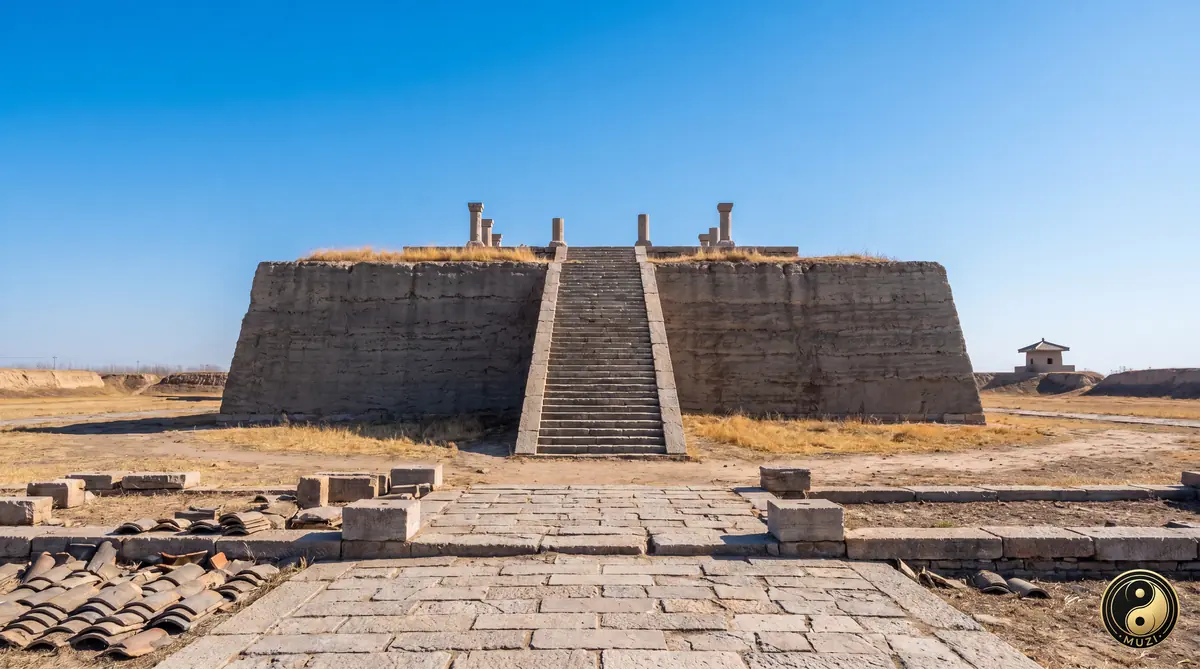
The Cao-Wei Ye City ruins — the first capital to isolate the ruler's core citadel outside the grid of wards, shattering the Han chaos of mixed officials and commoners, the ancestral template for a thousand years of rigidly compartmentalized imperial city planning.