





 County-level
Tai Shan District
The soaring granite stairways of Mount Taishan 5A UNESCO Dual Heritage rise through the South Gate to Heaven in Taishan, First of the Five Sacred Mountains.
 MUZIChinese Matrix
A useful way into Tai'an is through bay shores and fishing practice.
For Tai'an, the relationship between place and life becomes visible in “A useful way into Tai'an is through bay shores and fishing practice.” This evidence connects landform, movement, settlement, and cultural expression instead of treating them as isolated details. The present profile of Tai'an reflects environmental adaptation and local stewardship built up over an extended period rather than a short-lived change. This process explains how Tai'an remains connected to its surrounding region while retaining a recognizable local character. That is why Tai'an matters: local detail can illuminate environmental setting, social process, and cultural memory together.
County-level
The soaring granite stairways of Mount Taishan 5A UNESCO Dual Heritage rise through the South Gate to Heaven in Taishan, First of the Five Sacred Mountains.
County-level
Neolithic painted pottery from Dawenkou Culture was unearthed in Daiyue, surrounded by precipitous granite pillars of Mount Tianzhufeng.
County-level
Prized fighting crickets known for courage are caught across fields in Ningyang, Cricket Capital nestled along the historic Dawen River.
County-level
The vast reed waters of Lake Dongping preserve the only surviving waters of the ancient Liangshan Marsh in Dongping, home to Mount Baifushan Grottoes.
County-level
Nine lotus petal peaks rise above mist at Mount Lianhuashan 4A in Xintai, ancient cultural region rich in sweet cherries along the Chaiwen River.
County-level
Mammoth sweet Feicheng Peaches ripen across 100,000 mu of orchards in Feicheng, Peach Capital and ancestral home of Spring and Autumn chronicler Zuo Qiuming.
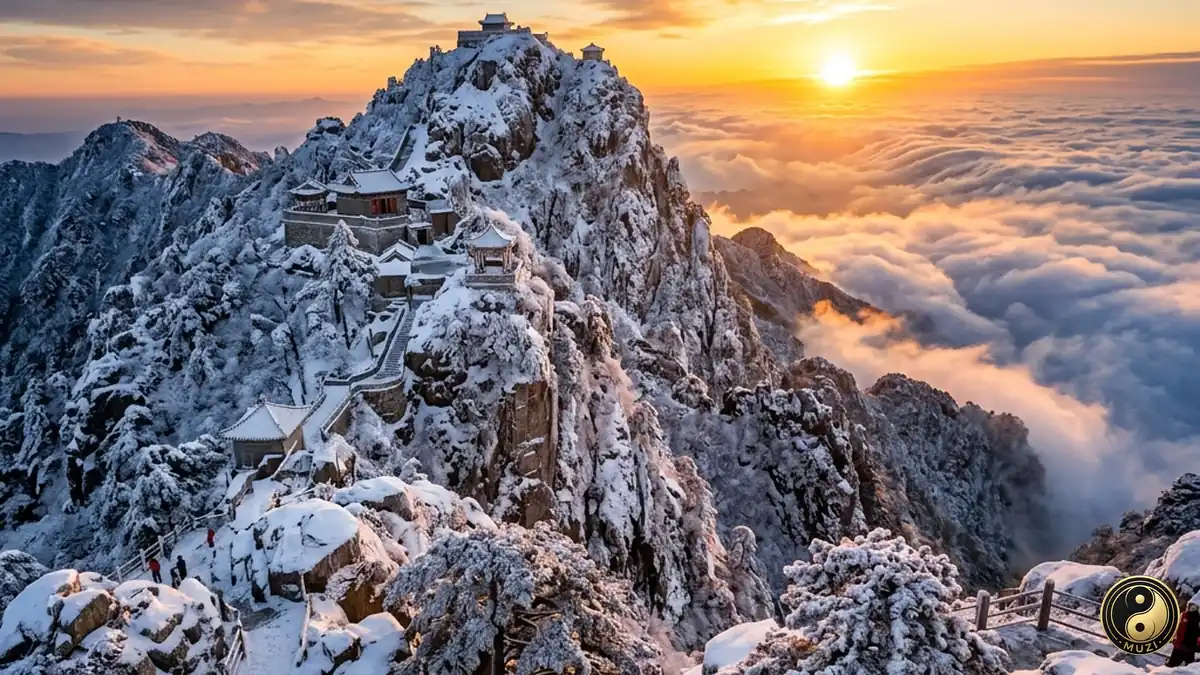
Foremost of the Five Sacred Peaks, where emperors performed the Fengshan rites — rising abruptly from the North China Plain, symbolizing dynastic stability and legitimacy.
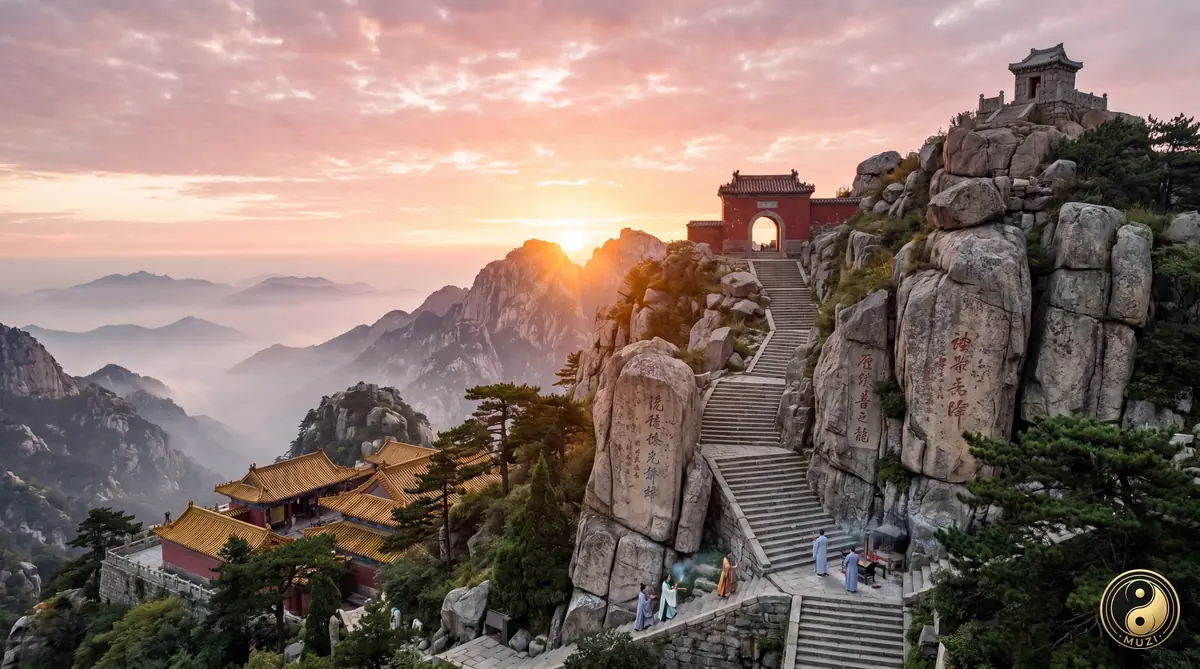
The Fengshan altar at the summit of Mount Tai — where every dynastic emperor must ascend in the flesh to sacrifice to Heaven and Earth, broadcasting to the cosmos the mandate of legitimate rule.
The main hall of Dai Temple built by Emperor Zhenzong in 1009, ranked alongside the Hall of Supreme Harmony and Dacheng Hall as one of China's Three Great Halls.
View attraction
The primary southern portal of Dai Temple, a monumental fortress-gate threshold where emperors formally entered for the Fengshan rites.
View attraction
The ceremonial prelude pavilion situated before Dai Temple, where pilgrims and emperors performed preliminary distant homage to the God of Mount Tai.
View attraction
A monumental 6th-century Northern Qi Buddhist cliff inscription carving the Diamond Sutra directly into a vast granite stream-bed.
View attraction
The pivotal mid-point mountain pass along the sacred Mount Tai trail, marking the transition from foothills to the steep alpine ascent.
View attraction
The dramatic staircase ascending the shear mountain cliffs through 1,600 stone steps into the celestial South Heavenly Gate.
View attraction
Song-dynasty Daoist temple complex crowned with bronze and iron roof tiles atop Mount Tai, dedicated to Lady Bixia.
View attraction
The colossal 726 CE cliff inscription written and composed by Tang Emperor Xuanzong following his imperial Fengshan ceremony.
View attraction
The 1545m summit of Mount Tai crowned with the ancient altar platform where Chinese emperors performed the supreme Heaven-worship rites.
View attraction
A stately Ming-era pavilion tower built in 1620 spanning the primary mountain footpath north of the Red Gate.
View attraction